Showing posts with label Blony. Show all posts

Saturday, June 29, 2024

Cocktail TIme

Every once in a while I like to bring Bowman into the mix here since its been a Topps brand since 1956.  The name didn't really get much use after the acquisition until a set of Baseball cards using the brand was released in 1989 and eventually became a big hit for Topps.  The Blony bubble gum brand was also put into various uses by Topps through some time in the early Seventies. But I'm not here to talk about all that, instead I'd like to look at some older Bowman gum products.

Warren Bowman was a very interesting man who had already worked at a number of professions by the time he was 30. In 1927 he moved his fledgling confectionery company from Lansing, Michigan to Philadelphia after introducing a chewing gum called Ju-Ce-Kiss.  I managed to find a scan of a wrapper but it's a rare one:

I really like that $50,000 tagline!

While I don't really want to look at Blony for this post, as I have covered it somewhat previously and plan to do a much deeper dive at some point, Warren Bowman had it in the marketplace not long after moving to the City of Brotherly Love and in May of 1932 had formed and capitalized Gum, Inc. who had a decade long run as the premier manufacturer of bubble gum cards before World War 2.  Blony was introduced around this time as well.

Bowman had his ups-and-downs, even at his own firm but kept cranking out bubble gum until the war throttled his sugar allotments.  He rebranded as Bowman Gum, Inc. in August of 1943 and pivoted to "adult" gums under the "Warren's" name as the conflict raged. In 1943 he came up with Cin-A-Mint, intended primarily as a post-smoke palate and breath cleanser.:


You can see corn syrup and artificial flavors were in use:


The same year saw "Fruit" Cocktail gum, another wartime mélange:


Then 1947 saw a Mint Cocktail gum introduced:

Breathtaking was only one superlative:


Bowman also re-established his bubble gum line in 1947, with Bub:


All sorts of ingredients in this one!


1948, of course saw the reintroduction of Bowman's trading cards, as the U.S. returned to a normal manufacturing footing.  Bub was around for a bit and in 1950 saw this particular combo offered:


Nice marketing idea:


I hope to delve into the many vagaries of Bub at some point down the road as well but will leave off for now.

Warren Bowman exited his company in 1951 and moved to Florida to develop real estate and work on various food products and packaging innovations before passing away in 1962 at the age of 67.

Saturday, August 20, 2022

Banners Day

BFF o'the Archive Jeff Shepherd auctioned off a couple of old Bazooka Point of Sale banners recently and while I didn't bid, thanks to the overflowing archives here, they were two things of beauty to be sure.

First up, for the Fall 1949 launch of the penny packs of Bazooka ("tabs" in the confectioner's parlance), Topps created a wonderful banner with the original Bazooka Joe shown, as he often was, blowing a bubble containing the pack.  Given the year and the fact there was a contest to win a pocket knife, it was most likely run by Sy Berger, who was in charge of such things back then.  10,000 knives was likely a number they knew would never be reached as 100 comics was a whole lotta gum packs.

Topps used these knives for premiums over many years and they resemble (or more likely, are) the ones used by the U.S. Military during the war and issued for many years after with bespoke nameplates; the Boy Scouts were one such organization that did that..  Berger had connections for surplus goods, so this all ties in nicely with what I know about such things.

The banner is a beauty:

Jumping forward ten years, 1959 brought a really colorful banner detailing the premium pennants Bazooka was pushing at the time (and for another ten years at least).  Five Bazooka wrappers was a much more manageable amount than the 100 required a decade earlier:


That September 15, 1959 deadline makes me think this banner debuted when the 1959 Major League season opened in April.  Why Blony didn't get more than a passing mention in the copy is beyond me,

Mail in offers were useful for Topps as they could do market research based upon the origins of the redemption requests.  With a product launch in 1949 and the two big league west coast team moves very recent in memory - and notions of expansion more than hot rumors in 1959 - these were both marketing and sales tools.

Saturday, March 12, 2022

Roger That!

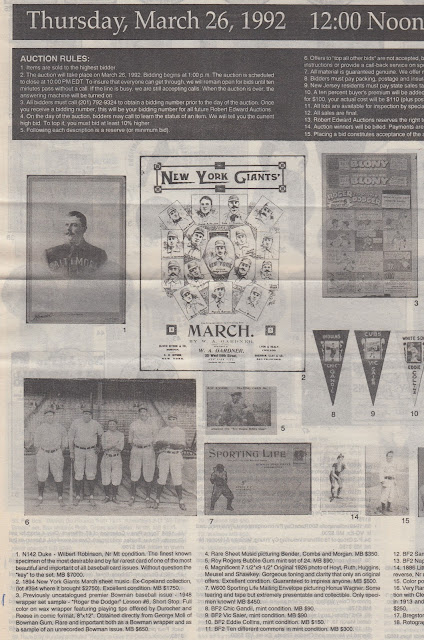
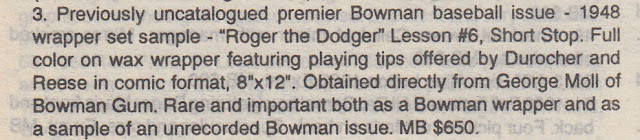
I'm on a bit of a Bowman kick of late and it seems to be centered upon unissued items.  Of particular noteworthy item is what's described as a 1948 proof issue that was meant for a five or possibly ten cent piece of Blony bubble gum featuring a comic strip called Roger The Rookie Dodger. As near as I can tell, the first indication this set ever existed was when a sample proof wrapper popped up for the first time in a now thirty year old REA auction:

Here is a blowup of the blurb:

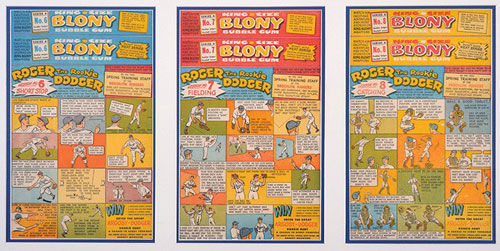
Leo Durocher and, as it turned out, his coaching staff (Jake Pitler, Ray Blades and Clyde Sukeforth). plus some players, would present tips for the younger ballplaying crowd to enjoy as they chewed away on potentially monstrous piece of bubble gum dubbed King Size Blony. As you can see Pee Wee Reese was also helping demonstrate the nuances of playing shortstop, although Durocher was no slouch at the position.  Indeed, he was Brooklyn's starter at the position in 1938 and 1939, before it was claimed by Reese!

The wrappers, which are flat as they were never folded, measure around 7" x 12" and would seem to have been intended as a loud retort to Bazooka's five cent roll, which had launched nationally during the summer of 1947.  The sheer size has me leaning toward a ten cent chew as that's a massive amount of real estate for a nickel gum wrapper.

However, the choice of Durocher was a curious one as he was coming off a year's suspension from Major League Baseball and whether or not that had an impact, the set never saw the light of day.  The REA description also indicates a planned series of Yankees-oriented comic instruction was being planned and it would be very interesting to know what they planned to dub it.   Presumably it would have been presented by the Bombers manager in 1948, Bucky Harris, and his coaching staff, which included Charlie Dressen, who later went on to manage in Brooklyn. 

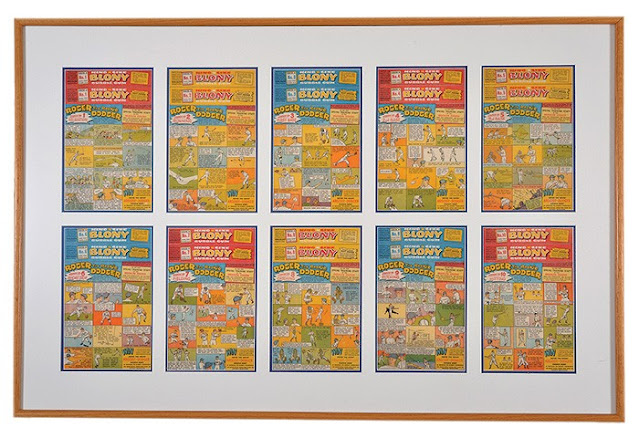
The 1992 example is almost impossible to make out but thankfully a larger stash of a complete set of 10 was consigned to REA for their Spring 2014 auction

The originally auctioned single wrapper matches the one at the bottom left of the frame (and the one at left, below) but more than one example of it exists as the 2014 description seems to paint it as not being in a flattened, or proof, state. The proof wrappers (and the wrinkly single) don't seem to have been part of the Topps purchase of Bowman in early 1956 but rather are described as coming from the archives of George Moll, whose agency prepared Bowman's many sets over the years.


Too bad these never saw the light of day, they look fairly appealing and while the artwork appears a bit basic, they are colorful and there is a multiple Hall of Famer lineup; presumably other Dodgers players were used as demonstrators (it's not possible to tell from the scans) and their roster was well stocked in terms of Cooperstown enshrinees, so more HOF power seems quite likely.

As for the presenters (I think it says "Spring Training Staff" actually) and their cards from the years before 1948, Durocher of course is pictured on numerous cards from both his playing and managing days and Blades made a few sets as well.  Pitler and Sukeforth had some appearances in picture packs and the like but none of the four were in the 1948 Bowman Baseball issue.

What could have been.....

Saturday, February 20, 2021

Letters Imperfect

Some correspondence from Topps has presented itself of late on eBay and what better thing to do than cadge some scans and share the results here?!

First up we get a dunning letter from Joel Shorin, son of Topps executive Phil Shorin and who would one day run the company himself:


Messinger's Variety Store (or more properly 5¢ to $1.00) was a mainstay for a very long time on Glasgow Street in Clyde, New York where Scottish influence once held considerable sway, so much so that the town was named for the river in Scotland.  It served the small town on the former Erie Canal about ten miles south of Lake Ontario from 1936 to 2001, or in other initials from mid-FDR to early-W, which is about 65 years if you're counting.  Clyde itself prospered as a stop along the canal, which opened in 1825, but its population has hovered around 2,300 souls for quite a while it seems. Clearly a letter mailed there without a street address would make it to Messinger's without much fuss in 1948 (and probably 1998!).  

Donald and Messinger his wife Thelma also had a variety store outpost in Williamson, New York until about 1974.  Here's a peek at the Clyde store's counter and candy racks from the Rochester Democrat & Chronicle on July 4, 1994:


The Messingers promptly paid up by the way, Thelma must have been in charge of the books:

If the invoice for the order was sent on September 9th, Topps must have been very much on top of their receivables!  Check out this sweet Topps bank deposit stamp on the back of the the check:

Many old checks in the years before electronic clearinghouses would admonish people not to fold, spindle or mutilate them. Perhaps one reason for this was due to the hole-stamped method of noting the check had been cleared and cashed.

Things were far more relaxed ten years later when this little gem was sent out:

That's actually the Topps letterhead, circa (early) '58.  I say "early" 1958 as "The Atom" on the front of each Bazooka penny tab was replaced by "Topps" mid-year.  Blony was the province of Archie comics, to wit: 


Yes, this rode along with a 1958 Topps Baseball Team Emblem premium! I covered those in February of 2010 and if you click through, you will see at least one 1958 pack insert promoting those had the new Bazooka gum tabs with "Topps" now prominent; perhaps as a preview or (more likely) already rolling out as Topps used up a supply of out-of-date letterhead.

Topps helpfully noted  on the flipside of this letter that several premiums could be yours for enough comics and/or change:


Those were pretty hefty buy-ins for the time and this seems like a direct marketing and audience survey form post-MLB stabbing westward as it took only a mere wrapper and SASE to get the original felt emblem premium.  They may have been burning off excessive stock of some premium items as well.

Is it just me or is e-mail just not as fun as postal letters?

Saturday, June 1, 2019

Tasty Blony

I've covered Bowman's Blony Bubble Gum before in these parts, mostly focusing on the multi-year Archie Comics that inner-wrapped their (by-then-Topps) gum in the late 50's, but today I'm pleased to showcase a number of their earlier comics thanks to a wealth of scans recently provided by BFF o'the Archive Jeff Shepherd.

Blony was originally marketed for the better part of the decade preceding World War 2 and was manufactured by Warren Bowman's aboriginal confectionery company Gum Inc.  He mostly or completely suspended production during the war and got things going again with the brand around 1947, at which time he had already turned his concern into Bowman Gum, Inc with a mid-war rebranding four years prior.  Blony was a big seller and had presumably included some rudimentary inner wraps with their penny tabs and/or twists prior to the war, although like many things associated with the brand, they remain hard to document. This was from a retail box end and it gives you an idea of how things were pasted up for Blony around 1952-53:


So Shep sent me scans of several dozen Blony "comics" that look to fall into the period between 1947 and the purchase of Bowman by Topps in 1956.  These are, by and large, inferior to what Bazooka was giving the kiddies as you will see.

These appear to be the earliest example in the group, which is pretty obvious given the graphics and (very helpful) numbering scheme.  I think this was from a twist wrap:


Pretty boring, I'd wager sure the kiddies didn't think much of the quiz format.  Here's a couple from a little later, check out how lame the 3rd question is on the Hidden Metals quiz in the second example:


The Wild West was a big theme but man, the production values are pretty much sub-par. Still, this seems to be where more than one spot color was introduced:


Looks like the color bleed problem went away as the series progressed.  I seem to recall Bowman offering wrapper premiums previously but don't seem to have a scan of anything offering same. 


In the below example, an older, larger example appears on the right but it's the insert on the left I'm looking at.  It's a bit of a reversion color-wise, so maybe these were produced independently to a degree but I really don't know. Note the Cincinnati address, just like Topps different locales provided premium redemptions:


Furthering the "independently produced" theory, the pencils from the above left make a reappearance:


None of these are scaled, so who knows how things actually went down but maybe twists had one style and tabs the other.

Here's that heart story, rotated:


Pretty gruesome, just the thing for the kids who were voraciously lapping up EC Comics and such!

It's plain, to me at least, that Bazooka featured much better comics and premiums but I doubt that had anything much to do with sales.  Besides, Bowman also was able to offer this in Blony's stead:


 Thanks to an opened wrapper over at Tick Tock Toys, we can get a peek at some indicia:


Hard to see but Haelan Laboratories are detailed and that became a business entity as of April 28, 1952 so Uncle Miltie was issued after that date. I suspect 1952 was indeed the year of issue as the Milton Berle Show (really Texaco Star Theatre) was peaking that year, with an average rating around 50%!

Now, all I need is a scan of the inside of that wrapper!

Saturday, March 2, 2019

A Real Knife Time

You may have noticed I'm wading into Bazooka territorial waters with increasing frequency these days; it's certainly true and I'm even diving into the Blony tidal pool where I can. This has been prompted by a mini wave of uncut material from the 1950's surfacing along with some random single pieces and lots coming up for auction and a barrage of incoming scans from BFF o'the Archive Jeff Shepherd.  In short, I have not seen this much comical activity since the last time I saw Dave Attell and Lewis Black perform together (with Mitch Hedberg and Mike Birbiglia supporting no less-true story).

First up is our old pal Buzzy.  This particular Bazooka comic, featuring the namesake character, saw at least two if not three distinct printings around 1953-54 as these scans from Shep show:


The top two are essentially the same but the first is waxed while the second is not.  The unwaxed comics are out there in significant enough numbers that they appear not to be print freaks but rather a separate run.  Maybe the unwaxed versions were sold in the party boxes of Bazooka?

The bottom Buzzy is clearly from a second print run as the font for the Fortune is different and the premium offer has had an expiration date added.  Here are closeups of these areas of interest from the top and bottom comics:


The life of the premium offers is generally 15-18 months, so the undated varieties are likely from 1953 and sold into 1954 while the dated versions are from 1954-55 and contemporary with the first Bazooka Joe and Henry comics, last seen here. The knife also became "free" as it aged! I realize only about six dozen people on the whole planet care about this all but these are clues to the dating of these comics, which are scarce.

Next, more pre-Joe:


Well, looks like the undated comics had a nice little secret code kit that ran its course and a quick substitution was made.  Since Buzzy had the knife in color and Honey Bun didn't, it suggests the color separations were not prepared for the goggles and knife due to rushed production and only the line art was used to print these. The font changes we saw with the Buzzy comic above also come through on both of these. I wonder if Topps thought their market was skewing very young at the time due to the mostly non-textual nature of these strips?

More New York News Syndicate goodness.  The lack of text continues with Little Brother Hugo; no real insights from these but I just like showing them:


I like the 22 and 24 karat rings!  The Bazooka Double Feature Comics get a little more texty:


Now, take a gander at these 1957 Blony comics featuring Archie characters:


That top left one looks like it has a familiar premium offer, no?  I like how they never even bothered to prepare color separations for the knife but changed the text from the Bazooka version!  Maybe this means the comics were printed in more than one location?  I really don't know but color and no-color versions of the knife offer occurring over a 3 or 4 year period does seem to point at something like that.

I'll post more findings here as things turn up.

Wednesday, October 23, 2013

Blony At The Malt Shop?

After Bazooka Joe, the next most iconic character Topps memorialized in comic form would have to be Archie Andrews (with apologies to Henry).  As a result of their early 1956 acquisition of Bowman, Topps inherited the Blony bubble gum brand. Blony had been a major brand for Bowman and must have had its adherents for Topps to keep it around.  Instead of cross promoting Bazooka Joe And His Gang, Topps went with two series of Archie And His Pals comics instead in 1957-58.

I only own one of these (1 '57) and they are far, far less abundant than Bazooka Joe's of the period:


That comic measures 2 13/16" x 3 5/8", it's a big boy!  The code reads 1A-57-25.  Here's another, just on eBay (which I missed), same series but #38:


I would surmise then that there are 42 in the series, that being a common number for the Bazooka Joe runs. Betty also got some face time and I'm sure Veronica, Jughead and mean ol' Reggie did too:


She's also a '57 but I can't make out the number.  I believe the below style was from '58 as it is slightly smaller (not mine, from eBay) but am not 100% sure as I can't make out any code:


A nice foldup Bazooka-Blony premium catalog also came out around this time.  This one from the 'bay  is red but I have a blue one as well. It's definitely from 1958 or later as "The Atom" is no longer on the Bazooka tab.  The blue catalog seems to be a year older than this one as a different Blony design was used. Here's red, then an extract of my blue:


This blue version extract does not mention Blony in the text above the gum tab illustrations.  Weird.


A code (which I can't decipher) has been added as well. BFF o'the Archive Jeff Shepherd is not positive the striped Blony wrapper was marketed.  I wonder instead if the flavored Blony tabs used it and the regular version kept the rainbow version seen on the red catalog.

Here's more detail from the red version.  Archie looks like a real geek:


Archie comics were advertised on at least one 1957 Topps wrapper, this one housed Isolation Booth, despite the Gee Whiz Quiz moniker::


Blony was always the poor cousin to Bazooka but it lived on at least until the 1970's, sometimes tweaked into a twist wrap, sometimes not. Later comics actually appeared on the outside of the Blony wrapper but that's a tale for another day.