Saturday, February 27, 2016

Planely Speaking

I've got a bit more to say on Topps Fighter Planes, last looked at here in 2011. Looking at them in the context of a Topps mania for flying aircraft novelties, that ran from the mid 60's until the mid 70's, they seem to fit into the gaps of Flying Things, which were issued in three waves (circa 1966-67, 1970-71 and 1975) and Marvel Flyers (1966).

Fighter Planes were issued twice, once in 5 cent packaging, with their Brooklyn address and once in 10 cent livery, using the Duryea address (according to Chris Benjamin). Topps was listed as a distributor as the planes were made in Japan (although I suspect the wrappers were produced in the U.S.) and the product contained no gum. I had originally thought the five cent version was an early 1960's issue based upon the artwork on the wrapper (which was an envelope) but the first item on the checklist:


I've shown those previously and they are courtesy of Howard Schenker. The set of 24 seems to consist mainly of a mix of World War 2 and Korean War fighter jets and newer planes introduced in the 1960's. If you look at the checklist carefully you will see the first plane listed is the F-111. This would be the "Aardvark", manufactured by General Dynamics and introduced in 1967.   Given the F-111's debut date, the set could not have been issued any earlier than 1967, which is my best guess as to a date right now. (UPDATE 2/22/23: Test flights were already happening around 1965)

I suspect the Fighter Planes were issued after Marvel Flyers (which had a ten cent price point at a time when Topps was firmly entrenched with five cent packaging, maybe due to the costs of licensing) but before Flying Things (ten cents on all packaging for the first four series). In any event, Topps mostly dropped five cent pricing in 1969 (Stickers and Tattoos being the most common exceptions) so there is really a three year window in which they could have been distributed. Other companies offered similar styrofoam planes and indeed they were popular boys birthday party favors back in the day.

The ten cent version, which uses the same artwork but for which I do not have a back scan, alas, was given a 12 subject checklist by Chris Benjamin in his 4th guide and he seemed pretty decisive on the matter, so I assume he had seen the reverse of this particular wrapper.  For the record, he lists:

Bell X-1
F-51 Mustang
F-86 Saber Jet
F-100F Super Saber
Flying Tiger
Grumman (sic) Avenger
Hawker Hunter
M-109
MIG 15
X-15
XF3D-1 Skynight
Zero

Topps reissued certain Flying Things series in similarly cut down fashion as time progressed, going from a high of 24 planes to a low of 6 by 1975. I'm not sure what year the ten cent version was issued though, maybe between the 1970-71 and 1975 Flying Things would be my guess but a product code would seal it.

Here is a nice flattened box, courtesy of REA:


As well as a proof of the wrapper/envelope:


Not to mention some proofs of the planes proper:


It's a neat set and a bit hard to find compared to Flying Things and Marvel Flyers.

Saturday, February 20, 2016

Where The Flying Things Are

If you are a fan of confusion, this post is for you!

Over a roughly ten year period from 1966-75, Topps distributed a series of user-assembled styrofoam gliders called Flying Things.  I touched on them briefly back in 2013 but I've been researching them lately, along with the related Fighter Planes and Marvel Flyers sets.

Flying Things saw multiple releases over this span, while  Fighter Planes was issued twice and Marvel Flyers once. I'll leave the latter two for a later post and will probably have a Flying Things followup as well as this post will be all about the wrappers. I'll try to put things in chronological order but as we'll see, it's difficult to do so with precision.

The first Flying Things issue was released in the spring of 1966. The first wrapper, provided here by Friend o'the Archive Terry Gomes, was a doozy:


The Flying Skeleton would have been instantly appealing to a little boy in the mid 60's.  I was one of those boys but for the life of me cannot recall ever seeing a Flying Thing anywhere. I have zero memory of these as a kid.

The back is handy as it has a visual checklist:


Those are the original 12 Flying Things. The indicia is interesting (I always find indicia interesting):


The Things were made in Japan and Topps is listed as distributor, which is something not often encountered.  This may mean they licensed Flying Things from a third party, something I am working on determining.  Given the curved Topps logo and Brooklyn address this can be pinned to an early 1966 to mid 1969 time frame, although as we will see below there is now an anomaly to this theorem.

Sales were robust enough to warrant a second series (and then some) as these scans from Mr. Gomes demonstrate:


A whopping 24 Flying Things were available in series two:


No change to the indicia, although .the assembly instructions have gone to a more graphical look. I suspect the first series came out in 1966 and the second in 1967 but there are no production codes to go by.

Next up, I think, is the 1970 series, courtesy of Wax Pack Dude.  These are bedecked with a contest to create a Flying Thing on the wrapper and give us a September 30, 1970 deadline for entries:


The back is lacking a checklist unfortunately,which indicates  a rehash of subjects but the contest prizes look to be taken from the gift catalog ballplayers and wholesalers and retailers got to choose from with their various certificates and contractual payment clauses:


The indicia has moved us to Duryea but it's still a distribution deal for Topps:


Made in Japan of course! Here's a look at the box and some packs:


A second series of this run of Things was issued in 1971 and we get a few more hints, once again courtesy of Mr. Wax Pack Dude:


That Flying Bathtub just screams classic Topps design to me.  The back is where it's at:


That looks like a mix of old and new designs to me.  The indicia tells the tale, as always:


It's a little hard to make out but there is a product code that reads: 453-55-1, which puts us in 1971. And, if you are really eagle-eyed, you will note the address is back to Brooklyn, two years after they had made the changeover to Duryea.  I'm not sure why this is; it may have to do with which corporate entity was importing these from Japan. But wait, there's more!

A 15 cent pack with the same product code also exists, identical in every way except for price and the massive, missing "New Series" banner:


Part of the product code (the part after the 3 digit product prefix) refers to the packaging configuration I think, either the box or case for these was likely different than with the 10 cent version.  But wait, there's still more:

Things got all purply in 1971 as well:


That;s the same graphic but the Topps logo got moved to the right and a line about the contents was added (CONTENTS: ONE FLYING THING).  Maybe someone thought there was more than one Flying Thing in each pack and complained?

The back is the same as the orange with one very small exception:


Again, it's tiny but the product code has changed to 453-06-1 from 453-55-1 on the orange wrapper.

Now we get to a couple of test packs, also from Terry Gomes.  They are like so:


Right away it's clear this is a different beast.  The manufacturing was done in the U.S.A., there is a test code on the front and no price.  We also have CONTENTS: ONE FLYING THING shown. The back only has six in the checklist, not twelve, which is often hallmark of a test issue (a truncated number of subjects when compared to the retail release): 


You can see it's a Duryea copyright, although it still says "Distributors".  I'll get to potential dating momentarily as there another test wrapper item as well:


Same as the first test wrapper but this is a header card and has a different test suffix. As Terry explains it:

The test pack was a vertically-aligned cello bag and I believe it was intended to be displayed using a J-hook. It has a test code as shown below. I suspect that there is also T-42A out there as well. As you can see, they only started with 6 titles before moving to 12 when the first series was put into production. In addition, the nose clip on the test bag "Thing" was made of METAL and not plastic like all the other series. 

I grew up in Toronto and did buy some of these around 1970-71 but they were not manufactured by O-Pee-Chee. I believe the ones distributed in Canada simply reused the Topps packaging.

The timing of the test is odd, since the series had obviously sold well previously but a metal nose clip in the early 70's is about five years after they went with plastic for the retail releases. It's a bit of a mystery. And as we see above, there is indeed a T42A out there. Still, the graphics match up with the 1970 Flying Hot Dog Wrapper above so it likely was a test before they released Flying Things again.

We're not quite done though.  The cello bag test of 42B may have led to the 1975 issue which was all cello, as per Wax Pack Dude::


Notice there is no price?  The back is like this:


Most of the names have been truncated from the earlier releases but at least we are back in Duryea (and made in the U.S.A.) but still Topps is the distributor. Curiouser and curiouser.

More to come on these.....


Saturday, February 13, 2016

Coming To Terms

With the primary focus here shifting to the 60's and 70's, I thought it would be a good time to run through some of the key phrases and nomenclature I use to identify certain traits of historical Topps production.  A number of these identifiers were covered in a post a while back that got into things such as eras of card production and the difference between a proof and test issue, so this one will mostly cover things not addressed previously.

Giant Size: This refers to the regular issue cards measuring 2 5/8" x 3 3/4" issued between 1952 and 1956. The name comes from Topps own advertising and box art. 1954 Baseball is an example.

Standard Size: Cards measuring 2 1/2" x 3 1/2". An example would be 1971 Baseball.

Uncut Sheet: What most people refer to as an uncut sheet is generally a Half Sheet.  Using Topps Baseball as an example, these are arrayed 10 cards by 10 cards (10 x 10) from 1952-54. 10 x 11 from 1955-56 and then after the card dimensions were reduced from Giant Size to Standard Size, 12 x 11 from 1957 onward. So a half sheet from say 1964 would consist of 132 cards. Two half sheets of 132 make up a Full Sheet of 264, with each half sheet divided by a gutter in the middle.

Rule of 11: This is a phrase I coined to describe how most patterns in standard sized Topps sets are divisible by 11.  This is due to the row length on the half sheets being 11 cards in length.

SP, DP, TP, QP, OP: These are some of the most useful abbreviations there are as they describe how many cards were produced on a sheet, or in a set or series relative to other cards:

Short Print (SP) - Can also stand for Single Print.  A cards printed in lesser quantities than the majority of cards on a sheet.  Usually this means by a factor of half but not always. Many cards identified as SP over the years in price guides were designated so on the basis of observation of half sheets and may not be short printed at all.  While a card can be an SP on a half sheet,  in order to determine if a card is truly short printed within a series or set, the full sheets must be seen.

Double Print (DP) - A card appearing twice as often as other cards. A 110 card series printed on a half sheet of 132 would have 22 DP normally.

Triple Print (TP) - A card appearing thrice as often as other cards.  A 55 card series printed on a half sheet of 132 would have 22 TP.

Quadruple Print (QP) - A card appearing four times as often as other cards. Unusual but not unknown. a couple of 1955 Baseball cards may fall into this category.

Over Print (OP) - This can mean a variety of things. It's sometimes used to identify cards printed in a ratio of 3:2 but it can really refer to any card printed in more quantity than an SP.  It can also refer to part of the printing process where one image is inadvertently printed on top of another.

Theory of Checklist Relativity: Another phrase of mine. This refers to Topps seeding a checklist from the next series in all but the high number packs from 1961, the year individual, numbered checklists began, through 1972, the last year of cards issued in series. For example, they would print the second series checklist on the same sheet as the first series cards and do so throughout each press run/series. This was a cheap way to preview what was coming in the next series. It also led to myriad checklist variations over the years.

Series Lagging:  Topps would, in addition to seeding checklists, lag their series counts in many sets from 1958-66, especially Baseball. Take a 110 card press run (leaving 22 DP on the half sheet). Now make the first series 88 cards and show it that way on the corresponding checklist.  That leaves 22 cards above #88 that are shown on the second series checklist which were printed in the first press run, although the inclusion of the next series checklist reduced that count by one with with each successive series (so Series 1 ends with #109). The last series would see the numbering and series matched up again. This was another way to entice kids to buy the next series. Once the set sizes started growing in 1967, the series checklists added more cards and the practice stopped. Note too that from 1958-60 checklists were printed on the backs of team cards while the 1957 checklists were inserted into the packs and were not printed with the rest of the cards.

Here is how series lagging played out:


Here is the first series checklist from 1964.  Note it runs from 1-88:


Now take a look at this uncut full sheet from 1964. 


You can easily see two half sheets with the gutter down the middle and starting on the left side, lettering the rows gives you: 

A  C
B  D
C  H
D  I
E  J
F  A
G  B
H  C
I  D
J  E
A  F
B  G

Rows A, B, C & D are over printed and appear three times over the full sheet, while rows E, F, G H, I & J are short printed and only show twice. This is a 3:2 ratio. So we also have overprints.

The sheet runs from 1-109, if you number the columns, #109 (Rusty Staub) is at position D7. I think the 1st series checklist is at the right edge of row D and the left edge of F while the 2nd series checklist is on the right edge of row I but they are hard to make out. Series lagging and Theory of Checklist Relativity are present and accounted for though. 

The patterns such as checklist placements, overprint ratios and even the arrangement of each 11 card row do not necessarily repeat like this for all series or years. Why Topps did things a certain way I can't really say but this first series sheet from 1964 really illustrates a lot of their marketing strategies.

Saturday, February 6, 2016

Instruction Card

We'll shortly be moving more into the 1960's and early 70's in terms of the overall vibe of this blog but there are still many things from and about Topps in the 1940's and 50's worth posting about.  Near and dear to my heart are the postage stamps sized issues of 1948-49 and the last gasp of those little wonders, the Hocus Focus set of 1955. Still without a complete checklist for the smaller sized version some 60+ years after issue, the whole set is a bit of mystery in terms of timing and packaging, although I suspect it was retailed in response to another confectioner's offerings.

I managed to snag an image of the instruction card issued with the larger version of the set recently and it's pretty neat:


I like how you can make out the bare outlines of the World Leaders subset in panel 3.  It's a lot more detailed than most instructional drawings from Topps over the years. The card also shows signs of high speed "ribbon cutting' where strips of uncut cards were cut at high speed, resulting in a slight curl that's just off kilter.

The back is plain Jane man:


I post reverses of things even when blank to help identify potential counterfeits.

I still need an example of the blue developing paper and although I don't collect wrappers per se, I do collect the penny wrappers from these tiny little issues.

I bought my panel from Larry Serota, known to many in the hobby as a collector of many hard-to-find cards. Larry also had a number of auctions going on eBay with small and large groupings from the set.  Here are some undeveloped and uncut panels of the large sized cards, as inserted in the nickel packs, showing how panels of four plus three came packaged, although I have seen some that may be only "twos" (hard to tell this long after the fact):


It's one of those sets where the backs look nicer than the fronts!

As previously noted on the blog, the small cards do not show signs of perforations or dotted lines as they were inserted as singles in the penny gum tab packs.

As I stated above, I'll be focusing more on the 60's and 70's going forward but will still, of course, post anything worthwhile from the earlier decades of Topps as items come to my attention.

Saturday, January 30, 2016

Can I Have Your Autograph?

So I was stumbling around eBay the other day, just sort of window shopping, when this little baby caught my eye:


Now, in a testament to how screwed up I am with all this stuff, I asked myself "Self, how did they get rid of the line under Bobby Murcer's name?" My second thought was more like "Hey, why is one missing?" and then I moved on to wondering who had checked the first signature and written 44% on the sheet.  But as it turns out, I was asking the wrong questions.

Bobby Murcer first appeared on a Topps card in 1966, a year with no autographs. In 1967 there were autographs a-plenty but he signed as Bobby Ray Murcer.  He was in the army from 1967-68 and had no card for 1968.  In 1969 and '70 there were no autographs and in 1971 he repeated 1967:


You can see how his signature evolved, can't you? The M in Murcer could still have been connected to the Y in Ray but he didn't link to anything early on. He made the cut for Bazooka in 1971 but no autographs there either, nor were there any on the 1972-74 Topps cards. Now the sheets says Yankees but that's just the team he was with when he signed his name in quintuplicate. In 1975 he's a Giant, being sent over to San Fran in exchange for Bobby Bonds, the first time two players making over $100,000 per year were traded for each other. And sure enough that's where we see the signature from the sheet:


The 'bay also had a Billy Martin sheet, signed when he was with Texas. 


That stint lasted from 1973-75 and as seen above, there were no autographs the first two years.  Billy though, goes back to the ur-set in 1952:


A couple points.  If he dotted the "i" in Billy, what the hell is that bubble above the two "l's"?  And he added a dash above the "i" in his last name.  WTF? So I got curious.


The next year with an auto is 54 and the dash is gone but not the dot/circle combo:


The dash was back in '56 after a sig-free '55:


No autographs in either 1957 or '58 but in '59 he was back, missing top part of the bubble but retaining the dash:


There were no signatures again through 1962 and then no more cards of Billy until 1969 when he was shown as the Twins manager.  He won the West that year but knocked out two of his players in a bar fight in August and was summarily dismissed after the Twins got swept by the Orioles in the ALCS. As you can imagine, he was out of baseball in 1970 but the Tigers gave him a chance in 1971 and he ended up with a double bubble and a bit more of a stylized autograph, a lot closer to what's on the signature sheet but not an exact match for any of the five examples thereon, nor was he a Ranger at the time:


After the three year autograph hiatus in 1972-74, you would think his 1975 card would have an autograph but they used team cards like so:


He became Yankees skipper in the middle of the 1975 season, then 1976-77 brought more team/manager hybridization before manager cards were en vogue again in 1978, although sans autograph. He got canned again in '78 then had no cards in 1979 or 1980 having been re-hired in mid-season in the '79 and getting fired again after the season ended.

In 1981 he got a good A's team red hot and ushered in "Billy Ball" but that was another team card/manager card year and then somehow he wasn't in the 1982 card set but did make the sticker set, which did not sport autographs.

He was on Topps cards in 1983 (regular and traded), 1984 (regular), 1985 (traded) and 1986 (regular) and that was that.  His signature never made it to a card after he signed the sheet. Despite Sy Berger's assertion that a player's "signature was extremely popular with the youngsters", Topps didn't actually have many years with autographs on the cards. I have to think it was a huge PITA gathering and reproducing them all and in fact, over the 38 years from 1952-89, there were only ten years where the regular issue set carried an autograph (1952 - 1954 - 1956 - 1959 - 1967 - 1971 - 1975 - 1977 - 1980 - 1982). Some secondary and insert sets carried them during the 60's heyday of Topps oddball issues but those were far, far lesser in length than the annual offerings. I always thought of the cards having autographs but it ain't necessarily so.

Saturday, January 23, 2016

Hoop-De-Do

As longtime reader of this blog know, I've been trying to track down one of the most elusive inserts Topps ever slipped into their packs for quite a while now.  I am talking of course about the 1968 test Basketball issue, a 22 card black and white rarity issued in minute quantities almost fifty years ago.

The cards are well known in vintage basketball collecting circles but not so much to the casual hobbyist:


Just under 170 cards have been graded by PSA and the highest amount for any single player is 13 for Wilt Chamberlain. Pop reports can be tricky things, what with crackouts and resubs and the more common players seem to average about a half dozen examples each.  In my experience and opinion test issues from the 1965-72 era, sort of the golden age for such things, are available in direct proportion to how they were tested.

The test cycle went roughly as follows: 1) Controlled opinion and market testing in a lab, 2) field testing where Topps executives would actually hand out cards at schoolyards near HQ in Brooklyn ("here little boy, would you like some gum?"), and 3) retail testing where a couple of boxes would be put out in stores near Topps HQ (Cortelyou Road is a rumored location for such things). Later on, regional issues such as the 1975 Mini Baseball would occur and give us products with production runs well beyond anything that should be considered a test. Normally, the farther along in the test cycle a set went, the more cards there are out there to collect. Under ten wax boxes would be a typical run of test cards that made it to the retail level from what I can gather.

There is also another phase, that of the failed test where cards (or internal proofs never market tested) were dumped via Fun Packs (like Flash Gordon), or the Card Collectors Company (1970 Cloth Baseball) or by other means. My own opinion is that most black and white cards, like the one above and also quite a few other sets in the mid to late 60's, did not make it to a full retail test and were only handed out in the lab setting or never actually made it out of the executive offices.

So the 1968 Basketball issue possibly made it to the schoolyard phase but not the retail test to my mind.  Unlike almost all other test issues though, they came in an envelope and not a pack:


Ignore the writing, it's likely added after the fact.

Three things:  1) The gum may have been individually wrapped given that this was not a traditional wax pack; 2) the envelope measures about 3" x 4 1/2" -thanks to Friend o'the Archive Don Huse for the measurements- and; 3) nobody has ever seen the insert.

Well, as is my wont, I was trolling around the internet recently and found this:


That is from this site:  http://www.vintagebasketball.com/home/category/booklets-food-and-drink/hood-cousy-how-play-better-basketball/ and it has scans of 11 other booklets. The site is semi-defunct but if you look you will see the webmaster attributes these booklets to a Hood Dairy issue in 1963. I have sent a message to the webmaster looking for details, especially measurements (remember the oversized envelope wrapper).  I have no idea if there is Hood indicia on the booklet but I could see Topps somehow getting a small supply of these and using them for the insert.  I'm guessing but it's the closest thing I have ever seen to what the wrapper advertises.

Further Update 8/12/17 - Folded Booklets were indeed found in the test packs. More here.

Update 1/25/16-See the Comments for a measurement of the booklet.  It appears that even if folded it would be to big for the pack on even its shortest side.  There is Hood indicia on the back cover to boot. Back to square one it seems, or square zero (no insert exists).

Saturday, January 16, 2016

Driven Batty

I started delving into 1968's Batty Book Covers a few posts ago when discussing some Basil Wolverton original art used by Topps in that set and also the same year's Ugly Hang-Ups. 1967-69 was the era of very large Topps products and Batty Book Covers are no exception, coming in at 11 1/16" x 18 13/16".

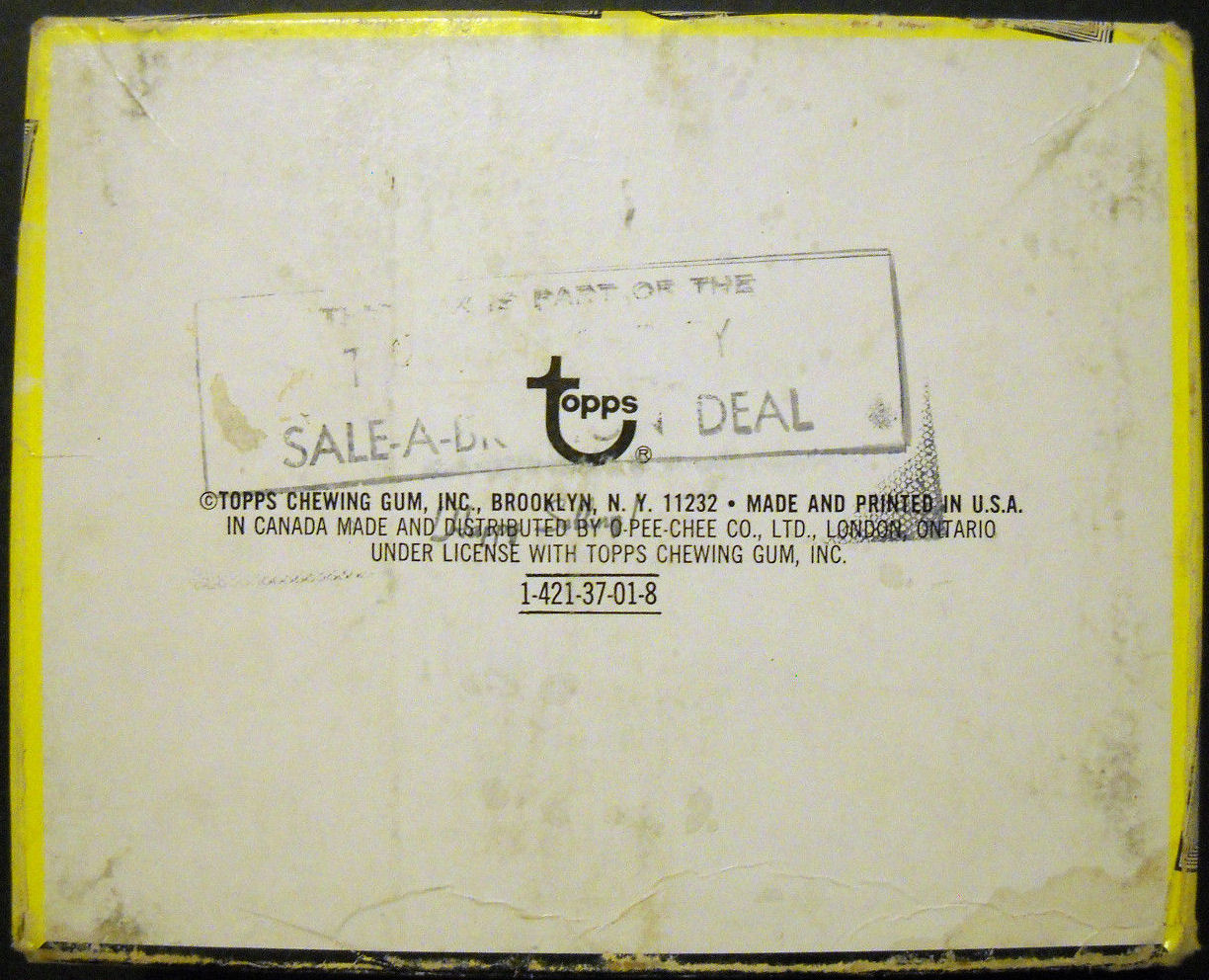
Obviously designed to be used to cover textbooks, the set was clearly a 1968 issue as detailed on the box:


Looks like Topps had a promotional deal going on ("Sale-A-Bration") with this box, possibly indicative of poor sales.

The wrapper is, well, batty:


The checklist is handy but inaccurate:


No. 5 is listed as "Wacky Packages" but it ended up being something called "Topps Is What's Happening" presumably because of worries over potential legal issues with the former's intended subject:


(Courtesy The Sport Americana Price Guide to the Non-Sports Cards Number 4 by Chris Benjamin)

Intriguingly, you can see the baseball card depicted is a fair approximation of the burlapped 68's. No less than 13 Topps products are shown, including Bozo gumballs, which is helpful to me as I have been trying for ages to track when they went from bulk wholesale product to retail packaging. I like the checklist appearing on the product itself as well.

Here are a few others, it's a great (and very tough) set and the covers are quite fragile as these examples from an old Legendary auction show:


That looks like Paul Coker artwork on the left panel (UPDATE 11/11/23-It's not-Mark Newgarden advises it's in Art Spiegelman's hand) and I see Jack Davis's hand on the main part of the cover above.  The whole set is peppered with art from MAD artists and it's amazing.  Look at the ad section from the above example (click to blow it up):


Here is more Davis, look at this tableaux!


The left panel has the instructions and they are classic-check out no. 4:


Legendary also had a concept sketch from the set:


Topps had some great artwork early on (1950-51) but it's got nothing on their late 60's output.