Showing posts with label Lord Baltimore Press. Show all posts

Saturday, January 6, 2024

A May-September Marriage

Happy New Year folks!  Today I want to dip into the recent past, December 9th, 2023 to be exact, wherein I examined some of the subtleties of a 1959 Topps Baseball 3rd series proof sheet. Friend o'the Archive Keith Olbermann recently posted some images of a 7th series proof sheet on Net54 Baseball and was kind enough to send me some higher-res scans. I don't want to usurp the discussion on Net54 but do want to look at some of the production details, just like last time.

Here is the front side, with all 66 cards showing, including the Bob Gibson rookie and Roy Campanella's Symbol of Courage tribute card among its very colorful array:


As with the 3rd series, there is production detail on the sheet itself:

The reference number for the third series sheet was G-803 and we're all the way up to G-1174 here.

While it seems like the high numbers were issued just in August and September most years, their preparation clearly was undertaken in May, at least in 1959. Since the 3rd series was being prepped in March, it seems like a new series was being created every three weeks or so.  With May seeing work this advanced on the high numbers, even allowing for final printing in say, June, there seems to be a bit of a lag built in. This surprised me as it may indicate sheets were stored onsite at Topps Warehouse/HQ in Brooklyn (or in another nearby warehouse of theirs) or even packed and held for a spell.  There's a reason that gum tasted so stale even in a newly issued series!

Intriguingly, this sheet has the backs as well:


That looks really cool, I must say.

Topps made an attempt in '59 to track some trades and options by adding a short statement to the text on the reverse.  The earliest these appear is in the 4th series, referencing transactions from March. They disappear from the 5th and 6th series then reappear in the seventh series of high numbers. There's some subtleties to these, which I plan to examine quite soon but today I just want to look at card #541, which features Gary Thurman.

Thurman's regular issue card has his May option described like so:


With the proof version looking like this:


Clearly a work in progress.  The typeface, font size, color and the use of quotes all differ from the issued version. Topps wisely abandoned such updates the following season. The proof stock is not nearly as white as the regular issue's, which is a little odd.

Spoiler alert-Thurman did NOT regain his 1956 form (and he seems to have actually had a better year in 1957 if measured by WAR). His failure to replicate things may have been because, despite the birth date used by Topps, he was actually born in 1917 and in 1958 turned 41 midseason!

Little details like this fascinate me and also lay bare the amount of work that went into issuing a set of Baseball cards.  Work on their flagship set would begin annually after the end of the World Series and then the set would roar to life as Spring Training and the regular season got underway. It was an entirely mechanical process with many, many time-consuming steps along the way. And until the 1973 oil crisis or thereabouts, it worked out to a mere penny a card for the consumer!

Saturday, December 9, 2023

Tickled Pink

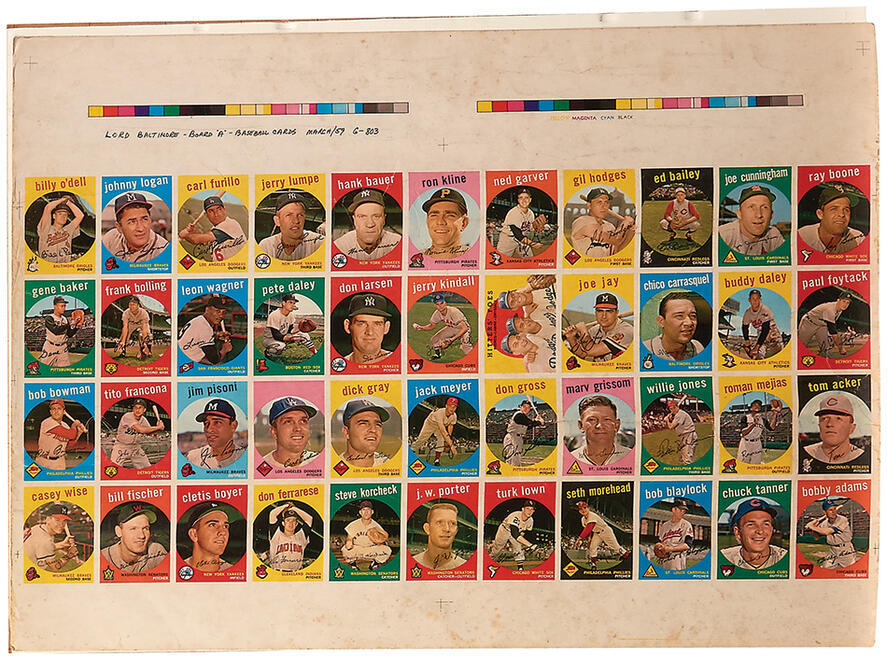
Friend o'the Archive John Moran recently pushed some 1959 Topps Baseball partial proof sheet scans through to Net54 Baseball, where a clutch of dedicated sleuths are piecing together Topps press sheet arrays (i.e. the A &B slits) for the years covering 1956 to 1969 (and maybe a little bit on either side of that). I'm not here to steal their thunder but one of the scans posted there had some really interesting details that are not often seen on the partial proofs that have entered the hobby over the years:


You can plainly see this was a Lord Baltimore Press production. Also quite prominent are the color keys and some alignment crosses at left, center and right (The crosses are also visible at the bottom).

I'll blow up the entire left side waste area above the cards and below the key to make the discussion easier:


I often talk about blocks of cards on a press sheet being arrayed in an ABA/BAB pattern across the two slits when an 88 card series was being printed. Each letter represent the same 44 card block on the slits, but the Board "A" reference is merely coincidental here (I think) as Topps also would prepare and proof their art work in batches of 44 (or 55, 22 or even 33), depending upon the configuration of the series being printed. I assume this is because each slit had at least one batch on it and they could move around the films shot  by the printer or each accordingly. You can see the proof date, or at least the month (March) and what I assume is a batch order number (6-803) or some other such reference. It's not clear to me if that's a Topps notation or one from LBP but I suspect the latter.

The cards on the A Board run from nos. 201 to 285, entirely consistent with a 110 card first series, followed by two series of 88 cards each.  It's a little weird that Carl Erskine's name does not appear on the proof. I know he voluntarily retired on June 15, 1959 so the printing predated that but occurred during spring training.  Perhaps he was contemplating retirement before the start of the season and caused Topps some pause? Or it's just a goof-up.  Here's the finished card:


Board B would have had the other 44 cards from the series, including Fence Busters (with Ed Mathews and Hank Aaron), Early Wynn, a couple of team cards, a second year Maris and some not-so-hot rookie cards.  Kind of a meh series overall, talent-wise, isn't it?  In fact the whole set only has a couple of big name cards but it's a release that I've always liked the looks of thanks to the big blocks of color and well-designed backs.

So a neat little bit of Topps printing history there-too bad there's no complete record but of course, what else would those of us who dig this stuff do if there was?

Saturday, June 13, 2015

Printers Link

One of the more esoteric things I like to look at sometimes is the actual production of Topps cards. Artwork was worked up by firms such as Solomon & Gelman in the 1940's and early 50's before Topps took this vital function in-house but the printing of the cards was always outsourced, at least in the vintage era. I've taken some quick peeks before but wanted to get all of the details I can into one post.

There were two main Topps printers early on: Lord Baltimore Press (alternatively Lord Baltimore Printing), with offices in New York and a printing plant in Baltimore; and Zabel Brothers Lithographers of Philadelphia, which functioned as Bowman's printer.  It's fairly clear to me that, after they acquired Bowman from Connelly Containers in early 1956 Topps, first used Zabel Brothers to print the 1956 U.S. Presidents set. Bowman's main card size at the time of the purchase was of the same height used by Topps but 1/8" lesser in width, which matches the dimensions of  U.S. Presidents in '56.

(Lord Baltimore Press logo from 1949 Topps Stop & Go wrapper)

The other Topps Giant Size issues from 1956 (Baseball, Football, Davy Crockett "A" Series, Round Up and Flags of the World) were manufactured  in the regular size used by Topps for such cards since 1952 and almost certainly were all the work of Lord Baltimore Press (LBP). Topps went to standard sized cards measuring 2 1/2" x 3 1/2" when Elvis Presley came out in late 1956 and never looked back, so any differences in size were rendered moot.

LBP was purchased by International Paper in 1958 and within about two years had been switched from high quality commercial lithography to producing shipping cartons and the like. I suspect Topps sporadically used Zabel Brothers in the 1957-60 period before switching over somewhat permanently but right now it's impossible to tell.  Complicating matters are three other printing firms that come up.

The first of these, Stecher-Traung Lithographers of Rochester, New York may have been involved with the production of the 1962 Baseball green tints series and few other sets. Stecher-Traung also had a facility in Hartford, Connecticut and until about two months ago I never would have associated that state with the printing of Topps cards.  However it turns out another printer in the Nutmeg State, namely Chromographic Press, Inc. of Hamden produced some cards from roughly 1966-71 and was owned by Topps director P. Peter Shorin.  The plant may have been in New Haven but that's not clear to me right now. The Shorin connection is interesting as Topps co-founder Philip Shorin held at least two patents relating to printing technology.

Then there is the mysterious case of A. Hoen & Company of Baltimore, also commercial lithographers.  An obituary for Thomas Townsend Hoen, known as "Townie" and noted to be the last President of A. Hoen & Company appears in the May 25, 2011 issue of the Baltimore Sun and mentions the firm printed cards for Topps. A. Hoen certainly did high quality work as they printed maps for National Geographic. Chromographic Press went into bankruptcy around 1971, likely a planned one as Topps consolidated expenses in advance of their 1972 IPO.

Zabel Brothers was shut down in 1982 after being sold to American Bag & Paper, also known as American Packaging (around 1980) while A. Hoen printed its last in 1981.  Stecher-Traung looks like it managed to hang on until about 1985 after it merged with Schmidt Lithographic of San Francisco (printer of the glorious Obak tobacco cards from 1009-11) and an offshoot or two may still be around today. What Topps did post-Zabel I am not 100% clear on. Len Brown mentioned Topps printed their own cards in-house at some point in Duryea while I recall some hobby press articles about high quality printers used by them in the 1990's when the technology really leapfrogged mid-decade.


Large scale commercial lithography of course was done in eventually by more modernized methods of reproduction and printing but despite it being a business, it was also an art form. Just look at the detail in the advertisement above.