Showing posts with label 1974 Topps Baseball Stamps. Show all posts

Saturday, September 23, 2023

America's Volume Dealer

As it often happens, I was searching the WWW for some obscure information about a certain Topps set and stumbled across some equally obscure information concerning an entirely different offering.  

In August of 2021, Robert Edward Auctions closed a lot of over 800 panels from the 1974 Topps Baseball Stamps set. Troves of these stamps have been found over the years, so this was no surprise but what caught my eye was the way these had been packaged, namely inside a vending box.  Here is the central image from the auction:

Those tight left end cuts are a hallmark of these panels, so that matches up perfectly with the zillions of known panels offered in the hobby press and online lo these past thirty years.  The panels, folded twice, matche how they were found in the test packs that also contained one of 24 team albums. That is also 100% on point.

The auction description mentioned the generic vending box was, in the opinion of REA, original to the panels. There is no mention of it being a Topps vending box and indeed, I haven't seen a similar one in many years of keeping track.  It does remind me a little of the circa 1949 vending boxes used by Topps to sell their tiny little cards like X-Ray Roundup but really since the early 1950's Topps had either used a semi-generic Trading Card Guild box - which came in two basic designs over about a dozen years, namely either black and red, or red, white & blue.  Topps switched to the much more familiar mostly-blue venders sometime in the 1960's. 

To refresh your collective memories, here is the generic 1949 vender:

Compare that to the graphics on this 1953 Trading Card Guild box, the first or second of a line that held cello packs of the larger Giant Size cards like Baseball and Wings. As readers here know, the Guild was just Topps rebranded when they sold early cello's without gum:


This is a slightly reconfigured version, apparently used for horizontally-oriented cards as it was said to contain 1955 All American Football cellos.

I'm not entirely sure how Topps sold their larger sized cards in a vending configuration.  They very well could have been in generic gray sleeves with no graphics evident, perhaps with just an end stamp indicating the product inside. But based upon later designs identifying the Trading Card Guild in the graphics, I would think Topps employed this color scheme in the early Fifties.  It's also possible any Guild boxes held loose Giant Size cards for vending, as Topps did this on occasion in the Seventies with their taller cards, but I cannot verify either point at this time.

UPDATE 9/25/23-Lonnie Cummins had sent me a scan of a gray box that likely held some configuration of 1955 Rails & Sails. It's stamped "TRAINS AND SHIPS":


A more familiar version of the vending box seems to have debuted around 1956, when Topps switched to the now standard size of 2 1/2" x 3 1/2" for the majority of their cards and even began indicating they were the company behind the Guild on some 500 count boxes. This one held Elvis Presley cards in a more traditional vending format.

Here's one that held 1957 Baseball, and we can tell from the stamped code using the Cummins Method that it was packed on May 9, 1957 by the third shift in Brooklyn:

At the same time, these started popping up, used when Topps was selling cello packs:

So as things got more colorful, a divergence occurred where Topps took responsibility for unwrapped vending boxes while the Trading Card Guild was shown as manufacturer of anything in cello form:


The red, white & blue boxes were used through at least 1966 as Monster Laffs packs from that year have been seen in them and I suspect the mostly blue boxes that replaced this version came came a bit after Topps moved production from Brooklyn to Duryea in 1966. Both styles probably overlapped as Topps transitioned their packaging when they killed off the Guild.

Somewhat of a case in point is this 1966 Baseball cello box:  
:


Note the new (at the time) curved Topps logo and a distinct lack of any displayable Trading Card Guild graphics, although the box bottom tells a different tale:

(Courtesy Dan McKee)

By 1968 the blues were certainly in use as this high number vending box shows:


There is a Brooklyn address on the bottom but note it says "trading cards' which is still a Guild carryover.  At some point in 1975-76 this switched to "picture cards" as the 1975 Baseball vending was found in the older style while the 1976's came in this 500 count bad boy:


So anyway, I was talking about the 1974 Baseball Stamps, right? Well here is a parting tidbit from the August 20, 1974 issue of Sports Collectors Digest, some detail on where the set was tested:


Belmont is just a couple of miles west of Boston, a tried-and-true metro area for Topps testing purposes, along with Brooklyn and Duryea PA (plus a couple of other locales). I'm trying to ID a second test store in Brooklyn (one is already known) near 76th St and 20th Ave in Bensonhurst that was possibly called Pecker's and identified by Gary Gerani in his new and highly entertaining book The Card King Chronicles.

The one that is known is this store, which is long gone:


Another rumored one was on or just off Cortelyou Rd in Brooklyn (Flatbush to be exact) but I haven't been able to zero in any further.

Saturday, April 22, 2023

What Have You Done For Me Philately?

We've been looking at 1952 for the good part of a month now but today let's travel 22 years into that future for a look at the 1974 Topps Stamp Albums. Continuing a tradition started in 1961 and 1962, where stamps were inserted in regular issue Baseball packs and a separate, large album was sold for ten cents, their second full-fledged effort at producing a stand-alone set of baseball stamps (1969 saw the first), was a colorful affair. Packaged as a self-contained combo of a handful of stamps and a mini album (one for each team) for a mere dime, the 1974 release should have been a hit based upon past experience and results.  

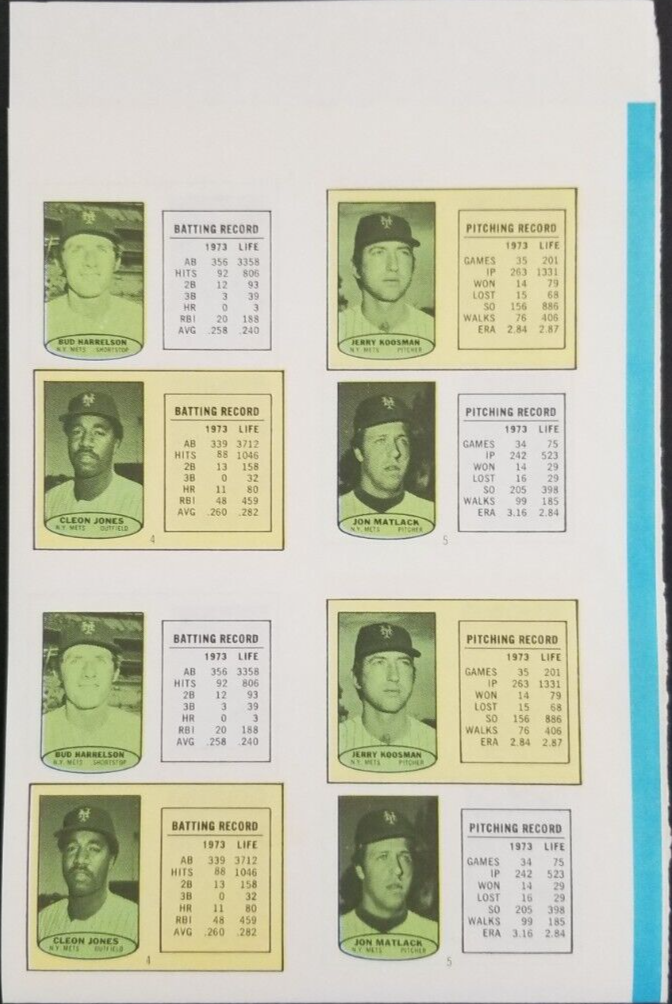
Except it wasn't and vast mounds of uncut stamp panels, in a 2x6 array, survived, often found with tightly cropped ends. Up until five or six years ago complete stamp production runs of the 24 different panels, all with close cropped left ends, could be found on eBay for a relative pittance, presumably from a never-folded large stash, and always offered in a nice, neat stack. As you will note, there are but ten players for each team, so this means 48 subjects were double printed. Complete sets in full or partial panel form are still offered, as are incomplete production runs of 22/24 full panels, with the best two HOF-subject rich panels removed. Mostly these seem to be partially disincorporated stock or pack contents, as the original stash, which was always sold in full 24 sheet production run form, seems to have dried up.

As for the albums, they are tough items today, especially if the team has one of the ongoing hobby superstars on its roster (think Ryan, Rose, Yaz) and it's not exactly clear what caused the obvious population mismatch between stamps and albums today. I've addressed the 1974 set previously but recently found some production items that are interesting.

First though, let's take a look at what was being sold. The pack is a typical one used by Topps for tests at the time and with no pricing (that would have been on the generic test boxes).  The assumption is these were sold for ten cents but with no extant test boxes or scans available, it's not certain.  In fact, Topps may have attempted a higher price point, or even multiple ones, dooming, or perhaps skewing, the test:


As mentioned above, the stamps were colorful and surviving panels usually found with the left ends cropped so tightly that no border is visible.  As the wrapper states, a dozen stamps were inside these were folded twice vertically. The pack inserted panels usually. have a typical wavy cut along the top and bottom borders, whereas the "stash" panels are symmetrical.

This is from the stash:


That's a fabulous sheet of course, as I count six hall-of-famers! This one is from a pack, surf's up with that wave!

You see that kind of cut, or worse,  on Bazooka Joe comics all the time.

As for the albums, whereas Topps used a somewhat drab orange color scheme for all the 1969 mini albums, they went with a much more eye-catching palette in 1974:

The facsimile signatures on the back page revealed who would be found with a space for affixing within:


Proofs are known:

That appears to be a proof for colors matching.  I think this one is too, even though both seem to have full color:


This gives you a flavor of the interiors:


The table of contents is a really nice touch:


The failure of this set put the kibosh on similar future issues of this ilk, until Topps introduced sticker and album combos in 1982, bringing in a  new style of small, sticky novelties.. 

Saturday, April 13, 2019

Boarding Process

A trove of Topps Presentation Boards was auctioned on eBay a couple of months ago and it was, to put it mildly, a diverse lot.  These do pop up from time to time but this batch was particularly large and also had a geographic reference to its location in Honesdale, PA (in an attic, no less), which is about 40 miles from where the Topps plant was in Duryea.

I'm not sure about the process of presenting with these boards-it seems likely they were meant for Topps brass in Brooklyn, but most seem to originate near Duryea so I could have that backwards.  Or they just ended up in Duryea for storage and went home with people at various points in time.  This latest batch looks to cover a period beginning in the mid 70's and running into the mid 80's.

Here's the full Monty-you can plainly  see the wide range of products and years:


Let's start with the baseball proposals.  The first is, without a doubt, what evolved into the 1974 Baseball Stamps issue.  It looks to me like the stamps (or stickers, depending) were already designed and the presentation was to nail down the album concept:


The stamps would ultimately be issued in a 2 x 6 array and the albums ended up being shrunk down from the proposal, which went as big as looseleaf pages.  We know Topps had been working since 1970 on a full size sticker release and it looks like the 74's got pretty close to realizing that concept.  What's unfortunate is that the stamp set seems like it failed-stamps were dumped or had issues in production and the albums were not produced in quantities to match.  In fact, the 1974 Baseball Stamp Albums are pretty tough to find these days while the stamp sheets are a breeze.

Meanwhile, we see an intriguing Hit to Win mockup that closely resembles the (different) contest cards inserted in the 1980 and 1981 Baseball packs.


Check out the Guidry mockup-Did Topps intended for the cards to also include a player insert or have a two sided insert?  Seems like the Guidry part of the pitch came very late.  Or maybe it was intended to show some detail from the Baseball Guidebook offered as a prize for hitting (scratching off) a single in the game.  Either way it's a neat, unique Yankees piece. Never seen the guidebook?  Here ya go:


This concept seems a bit mundane:


More intriguing, although out of my wheelhouse in terms of scope (I tend to end things here at 1980 so don't profess much knowledge beyond that year) and subject (Smurfs? No....) but the gum sure resembles some old Topps product like Rock's O' Gum.


To me though, the most interesting proposal had to do with a 3-D set:


Those are the fronts of two 1953-54 Topps Tarzan cards being used to show a new concept-check out the artwork for the proposed 3-D glasses:


That very much looks like Jack Kirby's work, or heavily inspired by it. Joe Kubert actually did the line art for the Tarzan sets (note-under investigation, see comments) so if it is by Kirby, it's a nice tie-in of two legendary comic book artists. Can anyone ID the superhero? He looks like a Marvel product of the times but my comic book knowledge is pretty much kaput these days. The original title is no longer with the board so it's anybody's guess what the product was supposed to be I guess.

Decades after they were created, the boards show the creativity and thought processes that went into designing and issuing a set of cards or inserts in the pre-digital design days.

Thursday, May 7, 2009

Stamping Grounds

Topps spent a significant part of the 1960's selling or inserting stamps into their baseball packs (and others, not addressed herein). 1961, 1962, 1964 (in guise as a Bazooka issue) and 1969 all saw stamp sets. After a little break, Topps tested another stamp series in 1974 and it was, in my opinion, the best of the bunch.

The wrapper reveals the test issue status of this set:


I believe that pack belongs to John Moran, who has a mind blowing collection of Topps goodies, but I could be mistaken (your blogmeister was less diligent about the origin of scans prior to last year).

As you can plainly see, the pack held, in addition to a delicious stick of gum, twelve stamps and one of 24 team albums. The stamps were panelized:


The clipped sides of this panel are common but they can also be found unclipped, which is a tougher deal. There must have been a major find of the clipped versions as you can buy full 24 sheet sets of them on Ebay almost at will. Full sized stamps should measure about 1" x 1 1/2".The albums however, at just under standard size at 2 7/16" x 3 7/16" are not common and quite difficult to locate:


The above album is fairly well centered, also an uncommon trait and miscuts abound, as we shall see below.

The back features an autographed ball of the dozen players within:


You're not seeing things, the scan is from the back of the Cubs team album, not the Braves.

The interior had a table of contents and the front part is impinged, a result of its assembly at the printing plant:


The inside followed a similar approach:


You can see typical cuts and colors below:


This colorful set is loaded with Hall-of-Famers and was part of the last gasp spasm of test issues from Topps in 1974. It would never be the same again.