Showing posts with label 1964 Bazooka. Show all posts

Saturday, October 11, 2025

A Red Letter Year

An accumulation of promotional materials here at the Topps Archives Research Complex concerning the 1964 Topps Baseball offerings has finally hit criticality and, after a comprehensive review, I can confirm it's a definite feast for the eyes.

1964 was the year Shea Stadium opened in Queens along with the World's Fair next door, and MLB held the All-Star Game in the borough on July 7th. The Mid-Summer Classic was hosted by the Mets in their brand spanking new ballpark amid all this wonderful tumult, as the National League squad won the star-studded exhibition. Topps clearly decided to take advantage and issued five colorful sets in '64, some of which specifically celebrated the event taking place practically (16 miles away) in their backyard.

The regular Baseball set is well known of course, and sported a design intended to show off the player photos unencumbered by graphics:


That popping out of Stallard's cap from the photo into the frame of the card was a feature of the set and most player cards exhibit this flourish. Now this is all well trod territory but I'm betting most collectors have not seen the 1964 gift box Topps came up with. I'm guessing this was offered after the season had concluded to burn off extra stock:


That image was provided by Friend o'the Archive Tom Daley and it's also appeared over at Sports Collectors Daily, which has some additional details, including a look at the sell sheet, which you should click over to see. However, there is another interesting box from 1964, one that displays Stan Musial, who had retired after the 1963 season, as a possible coin (and inferred card) subject on the front panel:


Musial publicly announced he was retiring in August of 1963, so his use here by Topps seems to have been a deliberate ploy to get the kids buying up packs to find him. It was an early series box (which we will see evidence of below) and the design was eventually changed:


The Baseball Coins were the sole insert for the year and we'll get to them in a New York minute. First though, I just want to highlight the special cello packs Topps issued in '64:


That's a pretty good deal for a dime I'd say; love the red and see-through readability! Here's a peek at two of the coins (not the ones in this pack):


The Baseball Coins look to me like they were issued in three waves. There were 120 early subjects, likely split into smaller coin batches that may have been "overlaid" with each other at various points. Here's an old auction ad from Leland's showing a full sheet, with description:


Some sources indicate the coins were found only in third, fourth and fifth series packs but this Salesman's Sample makes me believe it was really from the get-go:


Mantle, of course, was a first series card and the back of this sample really makes it clear the coins were there along with the cards; now! in fact:


Note the Musial coin image on that front panel!

Later in the season, Topps issued a "high number" series of 44 "All Stars", which were part of their multi-pronged All Star attack.  These had a special design, with blue backgrounds for the AL, red for the NL:


Yes, Lumpe was indeed an All Star that season...


...but many of the players in the All-Star subset were not.  Instead, Topps was going with players who had once or still were, All Stars. There's 44 players in the All Star subset, but 47 subjects in the master series as Wayne Causey was shown on the reverse of his coin as both an NL and AL player with the Athletics, and Chuck Hinton also managed the same trick, albeit with the Senators.  And of course, Mickey Mantle appears as a switch hitter on two different AS coins. Unlike Causey and Hinton though, the Mick has two distinct poses. I make that a 165 coin base set then, plus two variations but your mileage may vary. 

Hinton was a 1964 All Star but Wayne Causey never played on a major league All Star team. He was quite solid in 1963 and in '64 but I can't find any kind of information indicating he was selected and then could not participate; in fact he played in 157 games in '64 so I doubt he was injured and needed to pull out of the game. Maybe Topps believed he would be the representative for the Athletics, but instead that honor went to Rocky Colavito, who was having a really good season, so it's a definite headscratcher.

At least Topps was able to predict the NL starting pitcher for this sell sheet, which also features the phantom Musial:


We now turn to the Baseball Stand-Up set. This 77 subject green and yellow themed issue was not marketed as an All Star set but was essentially one in spirit.  The wrapper was a colorful beacon, in one and five cent form.  Here's the penny version: 


The sell sheet for this standalone set was pretty instructional, with this one straight from Woody Gelman's files:


Here's an uncut sheet of the set, which some notorious short prints. Coupled with the self-destructive nature of these cards, those SP's, which I covered in 2013 (!) can be tough indeed:

One set that did give an actual nod to the All Star theme was the one we refer to today as Giants or sometimes Giant Size All Star cards. The retail wax box was a thing of beauty:

By the way, that was not how Ford's card appeared in the set:


Whitey's does not, but some of the card backs reference events from the 1964 All Star Game itself. Check out the narrative on Johnny Callison's:


Talk about hot off the presses!  However, that attempt to harness post game energy flopped big time, and Topps had a gazillion leftovers. Reports from L.A. fans of the Sixties indicate they were sold at Dodger Stadium in made up packs of 25 for years and a well-known dealer purchased an immense lot of them in the Seventies.  You can find nice cards today with ease but don't be deterred by the numbers, it's one of the best looking things Topps ever put out.

A Baseball Photo Tatoo release also peppered the candy counters of the day and it's a little hard to find examples in nice shape. 


Here is the immortal Don Lock:


There were also twenty team logos mixed in:


I should probably revisit this set as it has a fair number of variations and nuances. For another day then but before we go, there's three more sets to deal with, one of which was 1964-adjacent and one of which was more traditional.  In reverse order, the traditional in the form of Bazooka's annual release:


Coupled with its amazin' box insert, long sheets of Bazooka Baseball Stamps:


These were advertised on the end flaps of the box, with ten different sheets available:


As if that wasn't enough, Topps also supplied fifty images for the 1964 Wheaties Baseball Stamps:


1964 was very much the year of Baseball and Beatles (with the mop tops not yet covered here in any kind of depth) for Topps.  Both were concentrated efforts that really helped fill the ol' coffers!

Saturday, July 30, 2022

Bazooka Bonus Blast

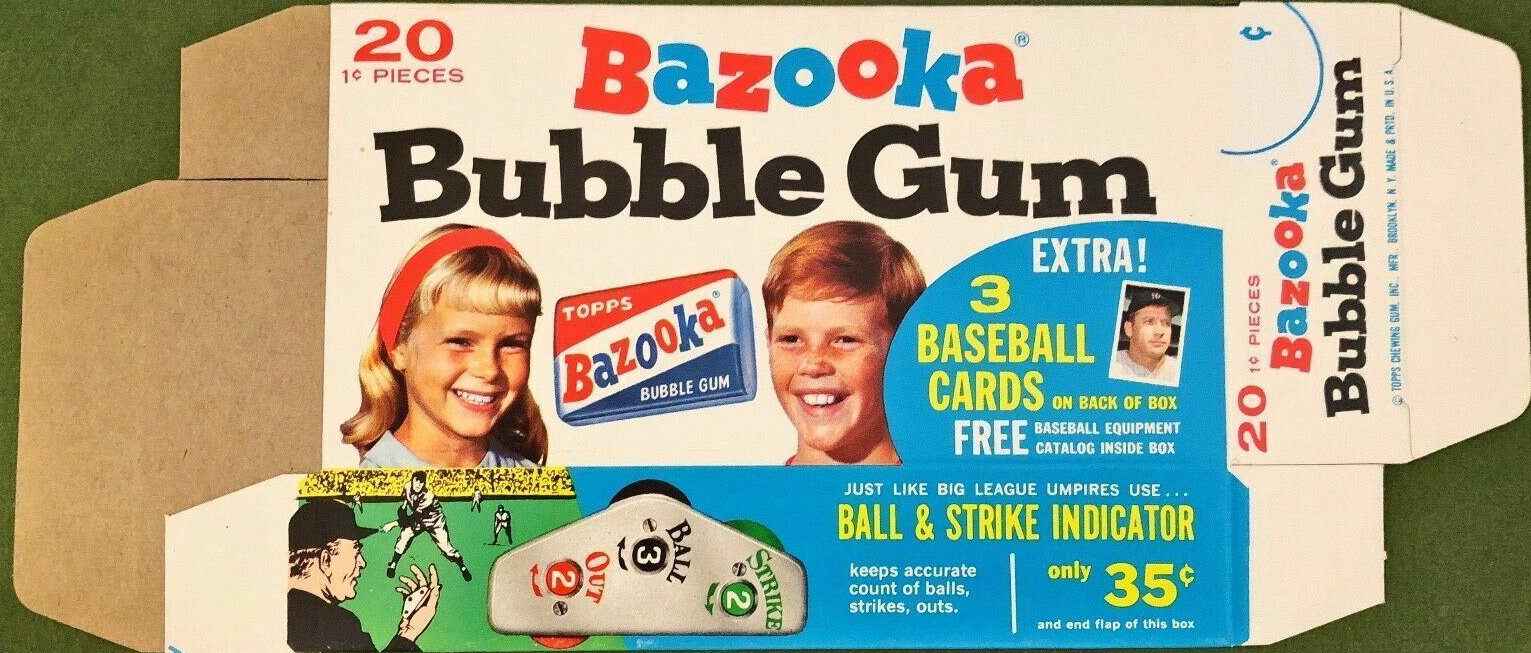
One of the neat little, almost inadvertent things Bazooka did with their party boxes - usually sold in groceries and supermarkets - was include an extra image or two on the splash panels with a small photo of a player included in the set that was being issued on the back of the box (and one one occasion, inside the box).  These were not meant to be cards but merely served as advertisements. Topps picked these subjects well as they chose some real superstars for these little pictures.  While the 1959-62 boxes were issued with a simple splash panel alerting kids to the baseball cards on the reverse, they were of an older style, with a cello covered window allowing a peek at the contents inside, like so (1960 version I believe):

 That changed in 1963 when they issued this bad boy:


In addition to introducing the country to the two tykes seen here, the splash panel for '63 has an image of what was purported to be a sample Babe Ruth card from the All Time Greats set, with five cards included within.  It's amazing what a little competition did to Topps over the years, spawning new products, some quite innovative, in order to pry attention away from their competitors, in this case Fleer.

Collectors of this set will quickly realize that image of the Babe included on the card inserts looked nothing at all like the one shown here.  Rather, we got an aging Ruth, fairly close to the end:


Hoo boy, I'll bet the kiddies were disappointed when they saw that!  Topps probably could not, or would not, license an image of Ruth from his playing days for a secondary set, so they improvised and used an image from his "farewell" at Yankee Stadium that they had deployed in the 1962 "Babe Ruth Special" subset that was issued in the wake of the M&M Boys chase of his home run record.* That subset at least had some period images and at a guess, Topps copyrighted the box before their licensing agreement with Ruth's heirs was up.

Check it out, it's a direct lift:


You can hear the speech here-Babe was clearly dying when he gave it on April 27, 1947 and his voice is absolutely shot from the throat cancer that was killing him.

1964 saw Bazooka include a sheet of 10 Baseball Stamps in the box, along with the three cards on the back.  The splash panel on the front didn't have a player image but one of the end panels advertising the inserts sure did, in spades.  Here's the splash:


And here's the end flap: 


Koufax and Mantle, not bad!  The Mick was back in 1965:


OK, so it's the same image they used the year prior. On that note, here is 1966, from my buddy Spike's Number 5 Type Collection Blog:


Yup, Sandy's a repeat from 1964, as are those darn kids!

In 1967 it's deja vu all over again:


Three times was the charm for that Mantle image.

1968 didn't yield a bonus image as the cards moved to the side flaps for reasons unknown; maybe they were hiding them from Marvin Miller or something.  


I sure hope those kids got residuals! 1969 saw a move to an All Time Greats format that may look familiar, although hard to tell if it's the exact same Ruth image on the box from 1963 due to some shadowing on the former, but it's pretty close if it wasn't:


There's four All Time Greats "plaks" on each box, two per side panel; they obviously aren't cards as there's no definitive border but they recycled the "plak" wording from a failed test set of the year prior and they're not those either! Still, I wonder if the Ruth "card" was meant to be the one they intended to issue in 1963 and Topps, clearly having licensed certain images due to the alleged Baseball Centennial in 1969, finally put it to use? This is the Ruth in question, 1969 version:


To their discredit, they reused the exact same box in 1970! 

I've previously posted about these 1969-70 boxes but it was a long time ago and an update is due.  So here is the full checklist for the 1969-70 boxes (and they are generally collected as full boxes due to their configuration). Apologies for the formatting:

BASEBALL GREATS (BOX BACK-LARGE CARDS)

1 NO HIT DUEL

TONEY*-VAUGHN*


FRED, HIPPO

2 ALEXANDER CONQUERS YANKS

ALEXANDER


GROVER CLEVELAND

3 YANKS' LAZZERI SETS AL RECORD

LAZZERI*


TONY

4 HR ALMOST HIT OUT OF STADIUM

FOXX*


JIMMIE

5 4 CONSECUTIVE HOMERS BY LOU

GEHRIG


LOU

6 NO-HIT GAME BY WALTER JOHNSON

JOHNSON


WALTER

7 TWELVE RBI'S BY BOTTOMLEY

BOTTOMLEY*


JIM

8 TY TIES RECORD

COBB


TY

9 BABE RUTH HITS 3 HR'S IN GAME

RUTH


BABE

10 CALLS SHOT IN SERIES GAME

RUTH


BABE

11 RUTH'S 60TH HR SETS NEW RECORD

RUTH


BABE

12 DOUBLE SHUTOUT BY ED RUELBACH

REULBACH*


ED


*- Player does not appear on an All Time Greats Side Panel.

ALL TIME GREATS (SIDE PANELS)

BOX

ALEXANDER

GROVER CLEVELAND

3

ANSON

CAP

9

BENDER

CHIEF

3

BROWN

MORDECAI

1

CHANCE

FRANK

5, 11

CHESBRO

JACK

9

COBB

TY

1, 7

COCHRANE

MICKEY

5, 8

COLLINS

EDDIE

7, 8

DUFFY

HUGH

4

EVERS

JOHNNY

6, 7

GEHRIG

LOU

4, 7

HORNSBY

ROGERS

2, 12

JOHNSON

BAN

2

JOHNSON

WALTER

2, 6

KEELER

WILLIE

1

LAJOIE

NAP

10, 11

MACK

CONNIE

10

MARANVILLE

RABBIT

10, 12

MATHEWSON

CHRISTY

3, 12

McGRAW

JOHN

5, 6

OTT

MEL

8, 11

PLANK

EDDIE

1

RUTH

BABE

5

SIMMONS

AL

2, 9

SPEAKER

TRIS

4, 9

TINKER

JOE

4, 11

WAGNER

HONUS

8, 12

WALSH

ED

10

YOUNG

CY

3, 6

There's a bunch of double printed All Time Greats, as you can see, with more than half the subjects appearing on two different boxes, in a mix and match panel scheme that must have made sense to Topps (or not).  The total is 30 different ATG subjects, with 12 single prints and 18 double prints. This is the full look:


And here's an uncut sheet of the full set that Huggins & Scott had some time ago, yowsa!

Topps had one or two more bubbles up their sleeve though, even as 1971 brought an end to this fine line of Bazooka package design cards.  With Koufax and Mantle in retirement, Topps went with a big name in 1971, from the Big Red Machine:


Johnny Bench may have been the hottest story in baseball in 1970-71, before interest was focused on Vida Blue before the midseason of '71 (no joke), then on Hank Aaron's home run chase.

I can assure you that those kids were still on Bazooka boxes well after the baseball cards were discontinued in 1971 and for all I know, they are still there today!

Bazooka cards are really not widely collected but Topps used some classic shots on them.  Check out this collection of 1966 panels that Robert Edward Auctions had a while back for proof of this:


* (Sorry, couldn't resist).