Saturday, July 30, 2022

Bazooka Bonus Blast

One of the neat little, almost inadvertent things Bazooka did with their party boxes - usually sold in groceries and supermarkets - was include an extra image or two on the splash panels with a small photo of a player included in the set that was being issued on the back of the box (and one one occasion, inside the box).  These were not meant to be cards but merely served as advertisements. Topps picked these subjects well as they chose some real superstars for these little pictures.  While the 1959-62 boxes were issued with a simple splash panel alerting kids to the baseball cards on the reverse, they were of an older style, with a cello covered window allowing a peek at the contents inside, like so (1960 version I believe):

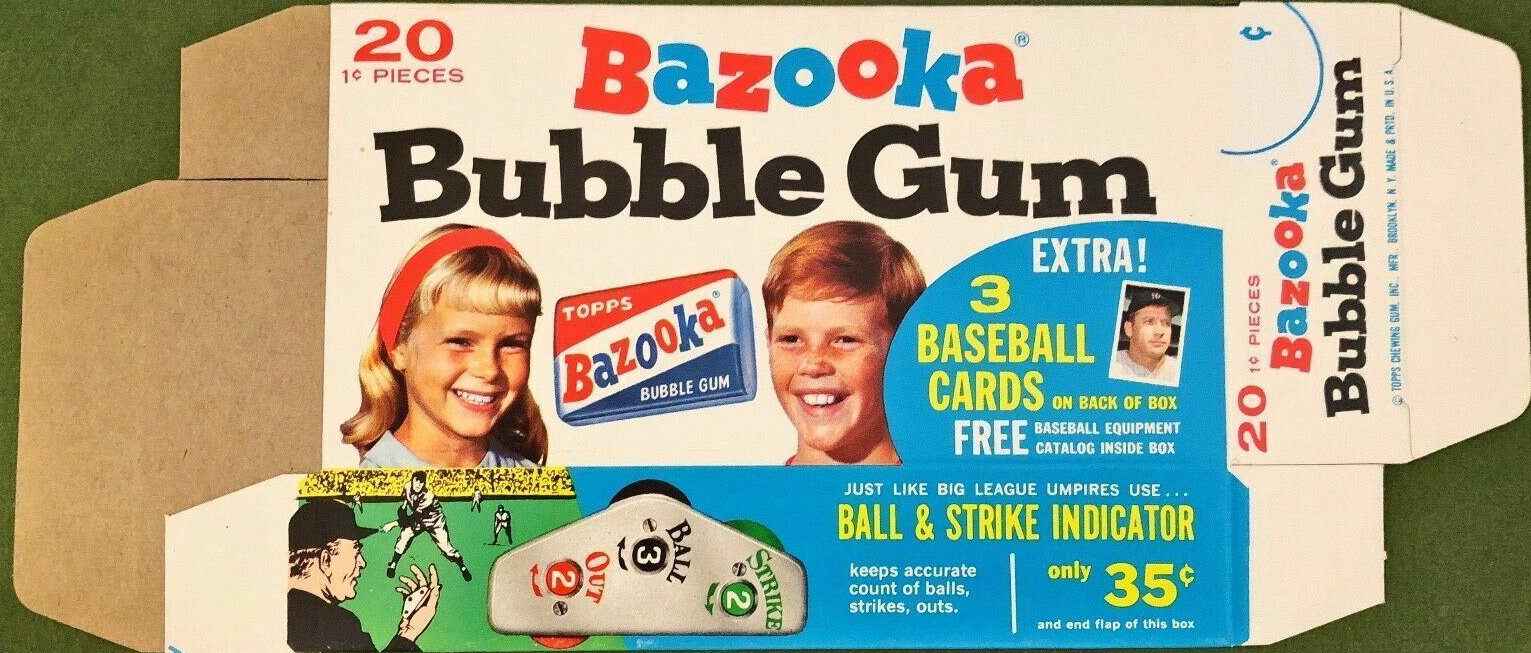
 That changed in 1963 when they issued this bad boy:


In addition to introducing the country to the two tykes seen here, the splash panel for '63 has an image of what was purported to be a sample Babe Ruth card from the All Time Greats set, with five cards included within.  It's amazing what a little competition did to Topps over the years, spawning new products, some quite innovative, in order to pry attention away from their competitors, in this case Fleer.

Collectors of this set will quickly realize that image of the Babe included on the card inserts looked nothing at all like the one shown here.  Rather, we got an aging Ruth, fairly close to the end:


Hoo boy, I'll bet the kiddies were disappointed when they saw that!  Topps probably could not, or would not, license an image of Ruth from his playing days for a secondary set, so they improvised and used an image from his "farewell" at Yankee Stadium that they had deployed in the 1962 "Babe Ruth Special" subset that was issued in the wake of the M&M Boys chase of his home run record.* That subset at least had some period images and at a guess, Topps copyrighted the box before their licensing agreement with Ruth's heirs was up.

Check it out, it's a direct lift:


You can hear the speech here-Babe was clearly dying when he gave it on April 27, 1947 and his voice is absolutely shot from the throat cancer that was killing him.

1964 saw Bazooka include a sheet of 10 Baseball Stamps in the box, along with the three cards on the back.  The splash panel on the front didn't have a player image but one of the end panels advertising the inserts sure did, in spades.  Here's the splash:


And here's the end flap: 


Koufax and Mantle, not bad!  The Mick was back in 1965:


OK, so it's the same image they used the year prior. On that note, here is 1966, from my buddy Spike's Number 5 Type Collection Blog:


Yup, Sandy's a repeat from 1964, as are those darn kids!

In 1967 it's deja vu all over again:


Three times was the charm for that Mantle image.

1968 didn't yield a bonus image as the cards moved to the side flaps for reasons unknown; maybe they were hiding them from Marvin Miller or something.  


I sure hope those kids got residuals! 1969 saw a move to an All Time Greats format that may look familiar, although hard to tell if it's the exact same Ruth image on the box from 1963 due to some shadowing on the former, but it's pretty close if it wasn't:


There's four All Time Greats "plaks" on each box, two per side panel; they obviously aren't cards as there's no definitive border but they recycled the "plak" wording from a failed test set of the year prior and they're not those either! Still, I wonder if the Ruth "card" was meant to be the one they intended to issue in 1963 and Topps, clearly having licensed certain images due to the alleged Baseball Centennial in 1969, finally put it to use? This is the Ruth in question, 1969 version:


To their discredit, they reused the exact same box in 1970! 

I've previously posted about these 1969-70 boxes but it was a long time ago and an update is due.  So here is the full checklist for the 1969-70 boxes (and they are generally collected as full boxes due to their configuration). Apologies for the formatting:

BASEBALL GREATS (BOX BACK-LARGE CARDS)

1 NO HIT DUEL

TONEY*-VAUGHN*


FRED, HIPPO

2 ALEXANDER CONQUERS YANKS

ALEXANDER


GROVER CLEVELAND

3 YANKS' LAZZERI SETS AL RECORD

LAZZERI*


TONY

4 HR ALMOST HIT OUT OF STADIUM

FOXX*


JIMMIE

5 4 CONSECUTIVE HOMERS BY LOU

GEHRIG


LOU

6 NO-HIT GAME BY WALTER JOHNSON

JOHNSON


WALTER

7 TWELVE RBI'S BY BOTTOMLEY

BOTTOMLEY*


JIM

8 TY TIES RECORD

COBB


TY

9 BABE RUTH HITS 3 HR'S IN GAME

RUTH


BABE

10 CALLS SHOT IN SERIES GAME

RUTH


BABE

11 RUTH'S 60TH HR SETS NEW RECORD

RUTH


BABE

12 DOUBLE SHUTOUT BY ED RUELBACH

REULBACH*


ED


*- Player does not appear on an All Time Greats Side Panel.

ALL TIME GREATS (SIDE PANELS)

BOX

ALEXANDER

GROVER CLEVELAND

3

ANSON

CAP

9

BENDER

CHIEF

3

BROWN

MORDECAI

1

CHANCE

FRANK

5, 11

CHESBRO

JACK

9

COBB

TY

1, 7

COCHRANE

MICKEY

5, 8

COLLINS

EDDIE

7, 8

DUFFY

HUGH

4

EVERS

JOHNNY

6, 7

GEHRIG

LOU

4, 7

HORNSBY

ROGERS

2, 12

JOHNSON

BAN

2

JOHNSON

WALTER

2, 6

KEELER

WILLIE

1

LAJOIE

NAP

10, 11

MACK

CONNIE

10

MARANVILLE

RABBIT

10, 12

MATHEWSON

CHRISTY

3, 12

McGRAW

JOHN

5, 6

OTT

MEL

8, 11

PLANK

EDDIE

1

RUTH

BABE

5

SIMMONS

AL

2, 9

SPEAKER

TRIS

4, 9

TINKER

JOE

4, 11

WAGNER

HONUS

8, 12

WALSH

ED

10

YOUNG

CY

3, 6

There's a bunch of double printed All Time Greats, as you can see, with more than half the subjects appearing on two different boxes, in a mix and match panel scheme that must have made sense to Topps (or not).  The total is 30 different ATG subjects, with 12 single prints and 18 double prints. This is the full look:


And here's an uncut sheet of the full set that Huggins & Scott had some time ago, yowsa!

Topps had one or two more bubbles up their sleeve though, even as 1971 brought an end to this fine line of Bazooka package design cards.  With Koufax and Mantle in retirement, Topps went with a big name in 1971, from the Big Red Machine:


Johnny Bench may have been the hottest story in baseball in 1970-71, before interest was focused on Vida Blue before the midseason of '71 (no joke), then on Hank Aaron's home run chase.

I can assure you that those kids were still on Bazooka boxes well after the baseball cards were discontinued in 1971 and for all I know, they are still there today!

Bazooka cards are really not widely collected but Topps used some classic shots on them.  Check out this collection of 1966 panels that Robert Edward Auctions had a while back for proof of this:


* (Sorry, couldn't resist).


Saturday, July 23, 2022

Swerls

I'm sorry to have to be typing this post but I wanted to to pay tribute to Steve Werley, a part time dealer of oddball cards, who passed away unexpectedly last month at the way-too-young age of 63.


I first ran into Steve at the Philly Show years ago as he was selling all the oddball stuff I love.  I remember buying a 1969 Topps Mickey Mantle Decal from him at the show (the only time I ever attended, many years ago) and would run into him at the Westchester Civic Center shows or the National thereafter.  Always smiling, he was good for a tale or three about the strange world of oddball cards and the people that collected them.  He fueled  my accumulation of a fairly large portion of Topps insert sets over the years, some of which I've since let go as I refine my set collecting to my own pre-teen time.

The last time I saw him was at the Chicago National in 2021, which was bursting at the seams and very hectic.  I was trying to figure out if I could piece together an entire run of Mets-only Tom Seaver cards and Steve had the same conclusion I had come to regarding some of the more esoteric Topps items such as the 1973-ish Pin-Ups and Comics: money aside, they were too rare to even source.  I did pick up some upgraded 1969 Decals from him to finally complete my set (completing the circle I had started with my first ever purchase from him) but that was the extent of things as wave after wave of people thronged his booth.  I regret not being able to speak more with him at the show.

RIP old friend.

Saturday, July 16, 2022

Blown To Bits

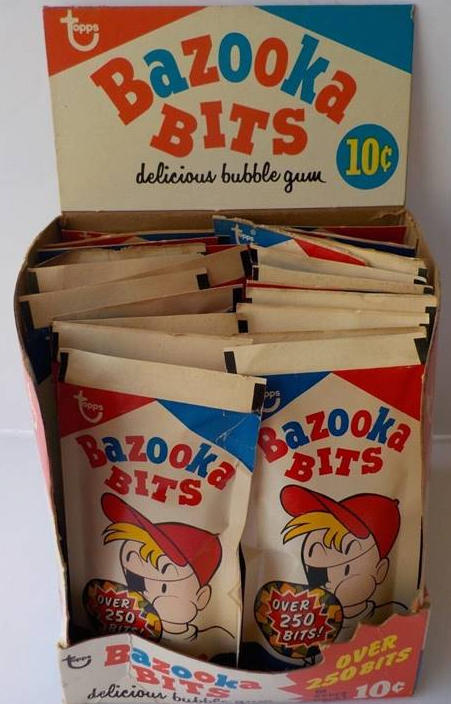
Something different to chew on today campers! Friend o'the Archive Lonnie Cummins unearthed an  interesting bit o'Bazooka history last month over at eBay.  The item in question is not something I had really seen before and was known as Bazooka Bits:


I would have been all over these as a kid, since I loved little Chiclets style gum!  

The sale of tiny candy coated bits at Topps date back to the very early 1950's, when they introduced a product called Block Busters that was eventually discontinued, with their remaining supply boxed up along with a neat Topps Baseball Button in 1956:


If you look at the pack illustration, you can see the little gum bits are quite colorful:


That is a bit more modern version of Bazooka Joe adorning the pack than was gracing the comics at the time, as Joe's principal artist, Wesley Morse, had passed away several years prior to these being offered.  The commodity code indicates 1970, and while I thought 1980 was also possible when I first saw these scans, they definitely date to '70, for a simple reason I will get into shortly. Before we go there however, I think that version of Joe might have been done by the same artist who created this puzzle for the 1972 Big Bazooka Cards but I'm not 100% convinced:


That awesome piece of uncut goodness can be found, with a  LOT more Bazooka related stuff, over at the Bazooka Joe Comics site.

The bottom indicia is unexciting:


So how do we know it's 1970 and not 1980?  Because Topps was burning off excess stock in their 1972 Hallowe'en offerings:


So did the product just not sell or did the folks over at Warner-Lambert (who had acquired original manufacturer American Chicle in 1962) that sold Chiclets intervene somehow due to their packaging?  Topps had tangled with them before (and resoundingly lost), so it's possible to my mind as this is a rare bit o'bubblegum history!

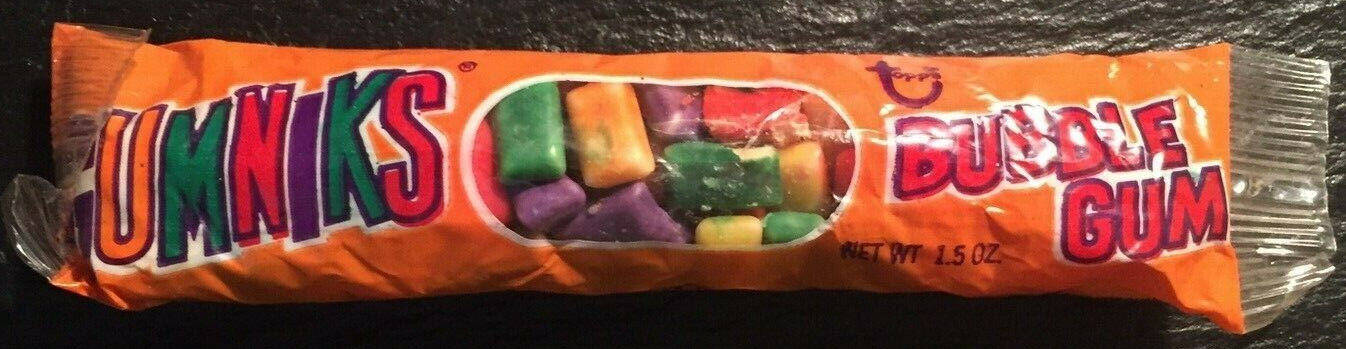
The Bits persisted for a couple more years, rebranded as Presto and Gumniks:


I never saw any of those either as a kid and I was on the lookout for this stuff! Our local ice cream truck carried a wide line of Topps products but not these.  They still look pretty tasty to me!

(UPDATE 7/18/22 - Friend o'the Archive Mark Newgarden advises these were spotted on Staten Island around the time of the original retail issue.)

Saturday, July 9, 2022

Giant They Are

Topps went all in on 1980 issues concerning The Empire Strikes Back, the second movie in the now ubiquitous Star Wars franchise.  Following the five series of standard sized cards (330 of 'em plus 55 stickers) and a host of ancillary issues released in the wake of the original Star Wars (now often called "A New Hope"), The Empire Strikes Back was issued in only three series but had more cards (352) and stickers (88) than the earlier release. Massively overproduced, they do not have quite the charm or attraction of the 1977 series. I'm not even here to discuss them today, just giving some background. The sets I do want to discuss are The Empire Strikes Back Giant Photocards. And that is sets, plural as Topps issued a test version of these 5" x 7" cards first. This was the height of Topps' fascination with cards of this size.

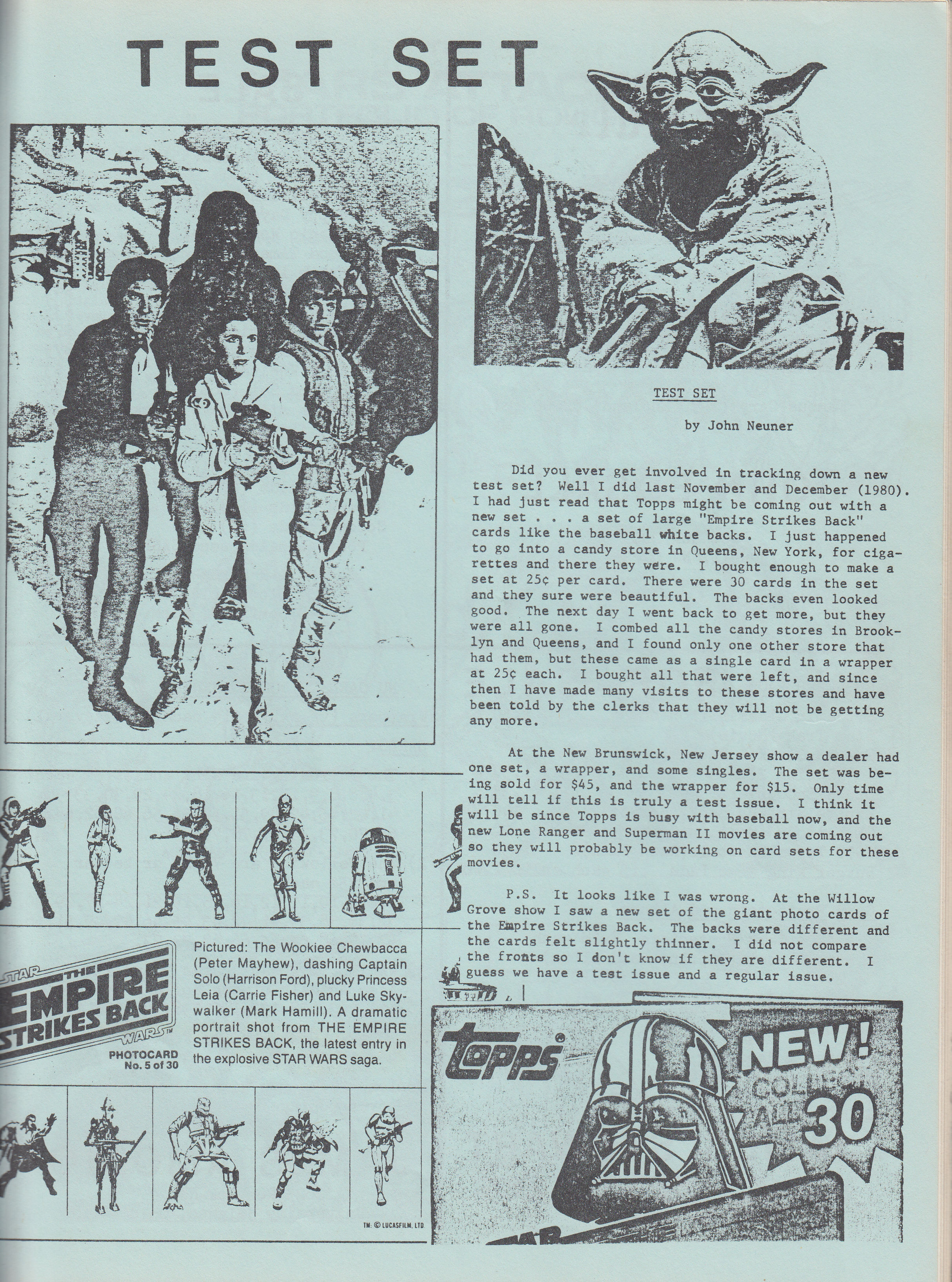
The 19th issue of Les Davis' The Wrapper (May 15-July 1, 1981) has the deets on the test issue from John Neuner (who looks like he had a bead on some Topps test stores in the NYC metro area); it appears like it was issued at two price points and - no surprise - dried up very fast:

The test set has the same 16 illustrations of characters from the movie on the reverse of each card and it's a tough one.  It contains all 30 subjects found in the regular issue and the wrapper seems to use the same graphics, at least on the front, between both sets.  Here is a test box, with a pack peeking out, with folds as described in the article:


And here is said wrapper:


The cards look great:


Here's the test card reverse:


The retail issue had a different box, of course, and the wrapper was crimped.  Here's the box, which looks kind of spare as Topps was getting these out right quick:


The retail set, per Neuner's article, is apparently on slightly thinner stock (I do not have a test type unfortunately, so have to take his word for it) and the reverses have been changed.  Instead of detailing what card you had (29 of 30 on the test example above), Topps went with two visual checklists and, while numbered thereon, dropped the numbering from the card itself!


Weird, right? Well it's a great looking set anyway!

Saturday, July 2, 2022

Highly Logical Outcome

As promised last time out, today we look at the press sheet array of the 1967 Topps Baseball high numbers.  This series set me on a path of unswerving nerdiness almost 40 years ago as I attempted to decipher a grainy photo of an uncut sheet and correlate it with the price guide short print designations of the day.  It would be many years before I realized Topps used a two slit (or sheet) press sheet encompassing 264 cards, with 132 cards per slit in a standard sized card array, 12 rows of 11 cards per slit.  132 card slits are called uncut sheets in the hobby, which is correct but doesn't account for all 264 cards, which I refer to as a press sheet. Within these parameters, cards sometimes became short or over printed as Topps changed the arrays from one slit to the other.

Why this happened is open to speculation but by the time 1967 rolled around I don't believe it was done to entice the kids to buy more cards looking for subjects that were suppressed in production. Rather, I think it had something to do with how they filled their various packaging configurations, at least in theory. Plus, I'd wager Topps really didn't want a lot of overstock or returns of the high numbers.

Many of the old price guide SP and DP notations were based upon the "tabulation" method where cards were observed as packs or vending boxes and cases were opened.  Depending upon the sample size, this was either accurate, or not.  I believe the idea of the 1967 Brooks Robinson high number card (#600) being super short printed - an idea which still somewhat persists to this day despite overwhelming evidence to the contrary - was due to the tabulation of a single 500 count vending box's contents.  

Well, there is still a wild card in the mix, which is a row or card's position in a sheet.  Corner cards,  those in bottom rows (but not necessarily tops) and the occasional random spot on the sheet do seem to have distribution issues sometimes and the 1967 high numbers are certainly affected by this. Topps must have had a way to segregate and pull certain cards, something that they had been able to do since at least the early 1950's, when various disputed player contracts with Bowman caused certain cards to be pulled due to court orders.

Putting that random production method issue aside for the moment, when this two slit brainstorm finally took hold, I searched for the second 1967 high number uncut sheet .  And I searched and I searched and I searched. Every example I found just showed the same sheet I had already deciphered as a young buck, like so:


It's an old scan but the basic row setup, with each letter representing a row and with the first, or head,  card in each identified, is:

A     Pinson

B    Ferrara

C    NL Rookies

D    Colavito

E    7th Series Checklist

A    Pinson

F    Red Sox Rookies

G    Orioles Rookies

B    Ferrara

C    NL Rookies

D    Colavito

E    7th Series Checklist

Then one day, over ten years ago, Friend o'the Archive Keith Olbermann sent along a partial section of a sheet with a different array-huzzah!  You can tell it's taken from the top left corner of an uncut slit:


That A row headed by Pinson is a match to the top of the other sheet but then the array changes.  So now we have a sheet that goes:

A    Pinson

F    Red Sox Rookies

A    Pinson

So a little odd but not 100% unexpected as the semi's seem to feature a 44x3 and 33x4 array and those Pinson rows get us to four. What to do now?

Well, I did an eBay count a couple of years ago and got this average count per row over 2,539 cards, with an overall average of 33 cards per subject:

A    77    Pinson

B    22    Ferrara

C    25    NL Rookies

D    22    Colavito

E    29    7th Series Checklist

F    34    Red Sox Rookies

G    26    Orioles Rookies

Row E has a slightly higher skew due having Brooks Robinson, a popular slabbing subject, in it and the checklist also being printed with the semi-highs (#531) but that Pinson row is such an outlier.  So where does this lead us? Well I thought here, using this pattern for the "other" sheet:

A    Pinson

F    Red Sox Rookies

A    Pinson

F    Red Sox Rookies

G    Orioles Rookies

B    Ferrara

C    NL Rookies

D    Colavito

E    7th Series Checklist

A    Pinson

F    Red Sox Rookies

Orioles Rookies


Or:

Five impressions:

A    Pinson

Four impressions:

F    Red Sox Rookies

Three impressions:

B    Ferrara

C    NL Rookies

D    Colavito

E    7th Series Checklist (contain Brooks Robinson)

G    Orioles Rookies  (contains Seaver Rookie)

But when you look at the PSA pops (from June 17, which total 42,165) it smooths out, just like with the semi's.  I'll save you all the math but when you factor out Hall-of-Famers, the Robinson and some other more widely collected cards, you get an average count per card of 405.  These are the per row averages using PSA's figures:

A    450

B    382

C    393

D    412

E    397

F    414

G    390

Ferrara is the lowest pop card at 293 and the White Sox Team is the highest at 530, factoring out all the "popular" cards but there is no discernable pattern, it's totally random.  The lowest pops are all over the place, as are the highest ones. The Seaver rookie leads the way among the glitterati, as you might expect, with 3,540 slaberoni's. Maybe the Ferrara was prone to damage or it's just not a card that's graded a lot, possibly due to centering issues. It occurs to me a production issue midway through printing could have occurred, requiring a quick fix of some rows on one of the slits, but good luck figuring that out if it even happened.

I once correlated the known SP and DP information as of December 2011 in a post and came up with 11 cards that didn't quite jibe among my source materials (i.e one source having an SP designation for cards from a specific row while another having the row as being full of DP's); all 11 cards that eneded up without overlapping SP/DP info were in the G Row. I still can't explain why the cards in this row caused set collectors the most reported difficulty (not counting the expensive Seaver card) other than confirmation bias playing a part, nor can I explain the relatively high A Row count, which is two standard deviations away from the mean where none of the other rows are more than one standard deviation away, although B is close on the short side and has the the lowest overall pop count average per PSA!

Summing up, the eBay dataset I used a decade ago was probably not robust enough. The PSA data suggest to me that rows A, D & F were printed 4x each and rows B,C, E & G were printed 3x each across the full 264 card press sheet, although A appears to be a bit of an outlier still (5% chance that it's random).  But it's not a guarantee and there could still be a 5x row, a 4x row and five 3x rows but there's too much noise I think to dissect this any further with the data at hand. I will say whatever old SP and DP data certain guides had in the past seem to be have been based upon incomplete information at the time. And it just feels like that Pinson "A" row is a fiver!

Saturday, June 25, 2022

Short Sighted

There's been several concerted efforts these past two or three years by some intrepid researchers over at Net54 Baseball trying to piece together various uncut sheets arrays for Topps series' where short prints either reside or are thought to.  I chime in on these threads sometimes and there's been some impressive debunking of various SP and DP theories as a result of a kind of crowdsourced look at miscuts and sheet remnants.  Since my interest in off-the-beaten-path Topps stuff started with trying to decipher the 1967 high number SP's four decades(!) ago, I love following these discussions.

The 1967 highs have been pretty much put to rest in terms of SP and DP rows and I'll get into that next time out as I've not posted anything on what I hope and believe are the final findings, but today I want to look at the 1967 semi-highs.  These span nos. 458 to 533 and include eight Hall-of-Famers. Like the high numbers in 1967, it's a 77 card series, which seems to be a magic number for Topps tomfoolery. Of particular note is the long held impression in the hobby that card #476 of Tony Perez was short printed, often the only one from the series identified as such in the guides.  A single SP in a full series is a rare thing with Topps and it implies the "broke the pattern" for some reason.  Before eBay and the internet, it was hard to prove or disprove such things.  Not so anymore.

You can pretty much assume, with a couple of exceptions, that any standard sized Baseball sets (2 1/2" x 3 1/2")  issued by Topps in series will not have short or double prints if the series count was 66 or 88.  The former gives you four impressions of each subject across a full 264 card uncut sheet, the latter three. Outside of those two, the only other series that is an even number is 110 , which Topps used to lead off the first every year from 1958-69, although once they started printing checklists as discrete cards (1961), those series run only 109 cards, with a preview checklist covering the next series tipped in. Those generally result in 44 (or 43 with the extra checklist added) over prints (vs. a more unwieldy-to-describe 88 - or 87 - short prints) in the series as the first wave in most years was produced in massive quantities, which seems to smooth out the press run.  Rule of thumb: if it's not detectable in the pricing, then there aren't short prints in the abstract sense, as there were too many cards produced in the series to matter.

The odd number series are where all the fun is, especially those that are 77 (76) in number.  55 subject series tend to be like the 110's in that they produce over prints.  There's only one 99 card series (the 4th in 1969) and then we get into the 1970-72 era, which had 132 card first series runs.  There's an anomalous 121 card series (the 5th) in 1971 plus the drawdown from 7 to 6 series in 1971 & 1972, before the bottom dropped out in 1973 with a mere 5 series as Topps went over to issuing all cards at once, although there is certainly some SP-DP fun thereafter. So we get some good, old-fashioned variety!

So here are the 77 card (76 in all cases) series:

1961 5th

1961 6th

1962 5th

1962 6th

1962 7th

1963 5th

1964 5th

1964 6th

1965 5th

1965 6th

1965 7th

1966 5th

1966 6th

1966 7th

1967 6th

1967 7th

1968 6th

1969 6th

1969 7th

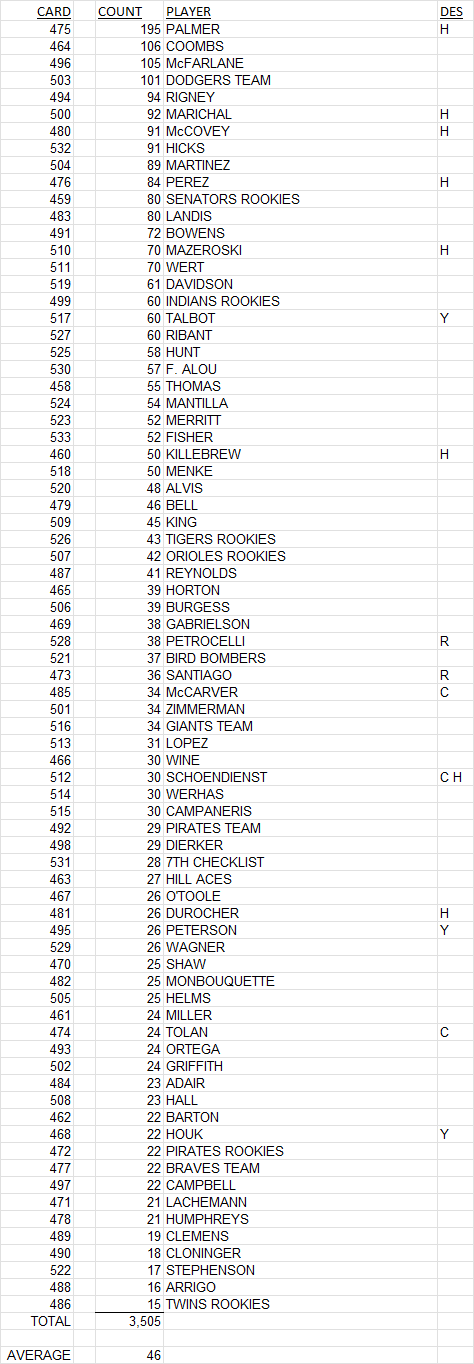
That's 20 distinct 77 card series!  I'll try not to step on all the work done over at Net54 so am limiting the discussion here to 1967.  I ran the semi-highs through an eBay search on June 13th and came up with this:


I designated the two World Series teams from 1967 (Cardinals and Red Sox), Hall-of Famers and Yankees to make sure to weed them out if they had weirdly high counts.  I wanted to see if the semi-highs were as strange as the highs when it comes to double printed and short printed rows.

It sure seems like the Coombs, McFarlane, Dodgers Team, Rigney, Hicks and Martinez should be in a "super print" row based on eBay's listings, while Palmer as a HOF skews some numbers in the Merritt/Santiago row it's been determined he resides in.  Palmer is really popular to grade for some reason and I don't think there is a true super-print row in the semi's based on his positioning and counts I will show below.  I still suspect the 67 highs had a production issue that really changed two planned row counts but believe the semi's were not similarly affected. I say this because of the PSA populations.

If you take the HOF'ers out for a minute, the top 11 counts from eBay are (with eBay to the left, PSA pops to the right):

Coombs 106 - 199

McFarlane 105 - 295

Dodgers Team 101 - 523

Rigney 94 - 230

Hicks 91 - 245

Martinez 89 - 276

Senators Rookies 80 - 260

Landis 80 - 303

Bowens 72 - 259

Wert 70 - 253

Davidson 61 - 237

The Dodgers Team probably skews high due to Koufax being in the team picture. 


But based upon research over at Net54baseball.com Hicks (91 eBay hits) is in a row with Menke (60) and Talbot (50), whose PSA pops are: 245, 253 and 279 respectively.  That is a major eBay disparity on Hicks, like Palmer.  Maybe there's commons that are so lowly literally nobody buys them?

Conversely, the lowest 11 counts are, with PSA pops to the right:

Twins Rookies 15 - 235

Arrigo 16 - 227

Stephenson 17 - 265

Cloninger 18-235

Clemens 19 - 227

Humphreys 21 - 225

Lachemann 21 - 194

Campbell 22 - 194

Braves Team 22 -251

Pirates Rookies 22 - 196

Houk 22-317

I think this relative smoothness among the two sets of counts means that 33 x 4 and 44 x 3 is the likely row setup for the semi's then over the 264 card press sheet array.  Nothing really jumps out when you look at PSA's figures.

Saturday, June 18, 2022

Foiled Again, or, Two Wrights Don't Right A Wrong

Topps was starting to experiment a bit with production methods and materials in the years leading up to their February 1966 plant and warehouse move from Brooklyn to Duryea, Pennsylvania.  For reasons that may or may not be linked, after this occured some really innovative products and almost-products being worked upon by Woody Gelman's New Product Development department for a period of six or seven years, right up until the company started reigning in costs to prepare for their IPO.  NPD were still getting their bearings though in 1965 when they popped out not one but two sets featuring foil embossing.

The most well-known of these embossed sets are the 72 inserts that came with the 1965 Baseball cards,  which I've touched upon these briefly in the past and won't dwell on here.  That set is heavily documented and I'll probably end up dissecting it more fully down the road in a sports inserts series I'm contemplating anyway.  Those cards were essentially credit card sized while today's subject, Presidents and Famous Americans, were produced as "tall boys" that measured 2 1/2" x 4 11/16".  Topps was enamored with using these larger cards in many of their mainstream 1964-65 issues, for reasons I cannot quite determine. 

The 44 subjects in the set include 35 U.S. Presidents and 9 Famous Americans. The run of Chief Executives includes Lyndon Johnson and with Grover Cleveland's two terms only requiring a single card, the first 35 cards in the set are presented in a straightforward chronological manner, with a short paragraph of description and the some indicia. The cards, which were blank backed, spread the subjects amid five colors, with black reserved for Presidents who had been assassinated, as shown here:


Presidents who did not die at the hands of others were issued with red, white or blue backgrounds and the Famous Americans were all done in green. There is no variation among colors and subjects, if Woodrow Wilson was blue, he stayed blue.

The wrapper, to my eye,  is one of the better ones produced by Topps in the 60's and the tall boy format let them go horizontal, unleashing Mount Rushmore to great effect:


The red, white & blue theme was also one dear to the Shorin family, the owners of Topps, going back to 1908 and Morris Shorin's American Leaf Tobacco Company, although no examples of any ephemera exist to show this, only family recollections. This patriotic livery is still on display today with Bazooka.

I'll not bother with a checklist for all 44 cards but will detail the 9 Famous Americans that close out the set:

36. Benjamin Franklin

37. Charles Lindbergh

38. Alexander Graham Bell

39. Alexander Hamilton

40. Albert Einstein

41. Henry Ford

42. Orville Wright

43. Douglas MacArthur

44. Frank Lloyd Wright

While one of the Wright brothers apparently got short shrift, the inclusion of another similarly surnamed fellow, the architect Frank Lloyd Wright, was unexpected:

(Courtesy The Wright Library)

Most of the others are no-brainers though and it's worth noting Albert Einstein was a frequently depicted Topps subject, going back to 1952's Look 'N' See set.  

As you can imagine, the combination of the tall boy sizing and foil embossing is not one that allowed higher grade examples to survive in any kind of quantity.  The set also seems to have been pretty limited in release and it's not the easiest thing to find these days. Demand is low and let's face it, the portraits look, well, kinda boring.  It's an odd duck of a set, albeit one that pulled together a few overarching themes at Topps in 1965.