Saturday, September 2, 2023

There's A Lot At Steak

If you read almost anything at all about the history of Topps and in particular Sy Berger, their one time Promotions Manager who ended up heading their Sports Department for many years, you will invariably run across the phrase "steak money." This is what Berger referred to as the initial payment to a minor leaguer who, in the eyes of Topps, had eventual major league potential. This was done in order to contractually bind the player to Topps, no small thing throughout the course of Berger's employment.  This "stake" was always described as enough to allow the new signee to go buy a steak, which makes it a homonym in this context. The amount of this initial check?  Five bucks!

Well, you can tell this is a tale reflecting prices from a long, long time ago as five dollar steaks at a decent restaurant haven't been priced at that level since the early 1980's (if not earlier). There is a famous story about Topps shunning Maury Wills, never offering him steak money, and the long standing grudge held by the 1962 National League MVP, who was also key member of three World Champion Dodgers teams, that led him to boycott the company until 1967. Wills is an interesting subject, who we will return to momentarily but first, why not show what these checks actually looked like.

The front is extremely precise, isn't it?!


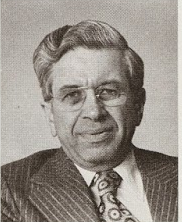
Well it's no surprise these were pre-printed as Berger and his scouts (primarily Turk Karam until he passed in 1963) must have carried sheafs of these around with them at Spring Training every year. Just fill in the date and name and all was well! The "signature" is that of Louis Walker, a long time Topps Treasurer who also had a seat on their board. Here's our man:


The date this version of the check was used would be after 1963, when ZIP codes were implemented. The 254 36th St. address was in use for decades by Topps, starting in 1956 and I believe until they moved their corporate office out of Brooklyn and into Manhattan in the mid-1990's.

The really interesting part is on the back, where once endorsed the player was legally signed to a Topps contract, most assuredly also carried around in volume as well by the various Topps agents. I believe this check-based arrangement is referred to as a Facultative Endorsement. Yup, it was an important five bucks!


Now, back to Mr. Wills, who in 1951 broke in with the Dodgers D-Level affiliate in Hornell, New York which was in the old Pennsylvania-Ontario-New York (PONY) League. He was scrawny but was always younger than the league's average age wherever he played, at least until 1962 when he was 28 and an established major leaguer. 

Wills progressed fairly quickly (albeit quite typically for the times) through the Dodgers minor league system, reaching AA-Level by 1955 then stalled out, with a demotion to A-Ball in 1956 following a subpar season.  I originally guessed 1956 or maybe 1957 was the year of the snub as Bowman was snapped up by Topps in early '56 when Wills was actively descending  the minor league ladder. In fact, he played with Cincinnati's PCL affiliate in Seattle for the 1957 season after they selected his contract from Brooklyn in the annual Rule 5 draft. The Reds sent him back to the Dodgers (with a brief stop elsewhere) in 1958 and he played for Spokane in the PCL until he was called up in the middle of the 1959 season to Los Angeles and sparked the Dodgers down the stretch, even garnering some down ballot MVP votes.

What actually happened though, according to a 2011 article in the Los Angeles Times, was that the "brief stop elsewhere" was due to Wills being given an opportunity to try out for the Tigers during Spring Training in 1959, on the condition of being returned to the Dodgers if he failed, which he did. Topps had Turk Karam scouting the Tigers camp as this was happening and he passed on Wills after being told by several Tigers staffers that Maury would never play in the bigs. He was sent packing back to the Dodgers organization where his manager in Spokane (Bobby Bragan) turned him into a switch hitter with almost instantaneous results and basically, Wills never looked back. When Dodgers shortstop Don Zimmer got hurt, Maury was called up and that, as they say, was that. He literally went from zero to hero in one magical season as the Dodgers took the Fall Classic in six from the Go-Go Sox.

The lack of a Topps contract didn't stop Wills from appearing in numerous sets before 1967. In addition to several regionals, he was a Fleer subject in their 1963 set, where his rookie card is one of the highlights in a fairly mundane issue and notes his prior season's MVP honors. He also was featured in couple of Exhibit sets. 

Looks like he was in a bottom row for Fleer in '63 if this example is anything to go by:


Topps bought Fleer's baseball contracts out in 1966 after, I believe, the Major League Baseball Players Association under Marvin Miller tried to offer the the latter exclusive baseball card rights for several seasons for a fee of $600,000. This seems to have occurred after Topps appealed a reversal of the sole count they were dinged with in a Federal Trade Commission complaint brought by Fleer several years earlier. It's thought by some that their 1963 set was halted not by a Topps lawsuit but rather poor sales, so Fleer looks like they wanted no part of the market going forward, at least until a decade later. 

Wills seems like he was just had his contractual rights assumed by Topps and appeared in their sets from 1967 until he retired following the 1972 season. His 1967 Topps card is a nice one:


Some revisionist history occurred in the 1975 Topps set, where the MVP subset required the use of a player's card from their award-winning season, which led to this:


Topps also used that ersatz '62 Wills card when they prepared a set for K-Mart in 1982. Prior to that, they offered a mea culpa of sorts in their 1977 set with this card:


Ironic, eh?

Saturday, August 26, 2023

Look Back In Lenticular

Bit-by-bit, little details emerge about the production of the 1968 Topps 3-D Baseball set, which as intrepid readers here know, I consider to be one of the finest limited releases sets ever put out by the company.  Prototypes, thought to be created specifically for Topps (more on that momentarily) were prepared by Visual Panographics of New York City, using a process they dubbed Xograph.  You've probably seen a reference to both on the backs of the Kellogg's cards of the era.  

It's those Kellogg's cards that muddy the waters a tad but everything I've ever seen in various auctions and writings of knowledgeable collectors indicates the 1968 3-D's and their various prototypes and proofs were prepared for Topps. So while things like this could theoretically fall into the category of "attributed to Topps" without more evidence, I think it's safe to call the prototypes and proofs Topps items. 

The issued cards have their quirks but like many scarcer Topps products, were born in a retail test pack:


Which in turn came in a box that was likely plain, with a just a price sticker affixed..  A retail box was designed but in all probability never used:

(both images above courtesy Robert Edward Auctions)

Note the lack of a commodity code on the box bottom, which sometimes happened as sets and marketing were being developed.  This lack of a code would also sometimes occur for items produced by a third party. The 3-D cards were designed to catch the eye and looked like this:

The Xograph logo is prominent in the lower left corner and the design would clearly be refined and form a template for the 1969 regular-issue Baseball cards. The reverse is blank, as this partial test pack content shows:


There would have been two cards within, plus the little easel seen at right, which is a scarce thing, and was gummed on the entire obverse:


It's long been theorized the cards were tested in Brooklyn before production was halted by Topps. Whether that stoppage was due to cost and/or issues with the materials used (some cards are found with "pull marks" visible), it seems any excess stock was bled off via a small coterie of hobby dealers, all with connections to Topps.

Pre-production items can be found but they are rare (and expensive):


It looks like autographs could have been considered as part of the design but it's not clear how that display was put together or by whom and the link to the item at Heritage appears to be broken. You can see a Tommy Davis card in the middle of the right hand column. He's one of many proofs known in almost final form, although he never made the set:


Apologies for all the cribbed images, I only own two of these, one of which is a sample with a stamped back.  You can clearly see two pull marks at the lower left of my Swoboda's obverse:


The back has a proprietary notice from Visual Panographics:


That style of ink-stamped back is also known in black:


It's not clear why two colors of back stamp exist.   I've covered this before but will note again that a Futbol protype was created as well. It seems a little strange but Topps as a major international concern at this point:


This has a similar back stamp in the "Swoboda style":

(both images above courtesy Keith Olbermann)

The size of the Futbol card can't be ascertained but it seems smaller than the Baseball prototypes based upon the cramped stamp. Another variant of back stamp in black has been seen though:


That back belongs to a Football front:


You can click over to see but two other Football pieces exist as well, one of which is another view of Starr and then this larger piece of Tucker Frederickson, described as being around the size of a 1974 Topps Baseball Puzzle:


Image sources vary, and it's possible none of them came from the Topps photo files. 

Now take a look at that stamp on the back of the Starr prototype, it's also seen here as detailed in a old edition of The Standard Catalog of Baseball Cards:


I wonder if that means this style of stamp, with its larger all caps "title" line, indicates a true proof vs. a pre-production concept sample? Or perhaps it was a door opener made up by Visual Panographics.

Now, we get to the main reason for this post.  What appears to be a fifth Brook Robinson card has popped up and was recently featured in a Postwar Cards Newsletter, along with another very special American League player, one M. Clough:


OK it's obviously Yaz, as anyone can plainly see.  Topps would sometimes do mockups and the like using weird or incorrect names so it's not surprising here.  The reverse of the Yaz prototype gives us a pasted on version of the "Swoboda style" stamp:


Which all leads to our latest Brooks Robinson prototype:


Notice the large tear or crack running up from the bottom border into Robinson's jersey.  I think four other versions of this card are out there (see here for more on these):

1) Wavy
2) Clean (The SGC AUTHENTIC)
3) Dog Ear
4) Stamped Back (STANDARD CATALOG)

The reverse of this particular B. Robby shows signs of having the "Yaz style" pasted on stamp:


You can see the tear here as well, which is a great identifying mark.  Hopefully additional protypes and samples will pop up and can provide more details about this endlessly fascinating set.

Saturday, August 19, 2023

At Present

I wrote a fairly extensive piece about four years ago covering the 1959-63 Topps Baseball Presentation Sets, which have long been rare beasts. Friend o'the Archive Don Johnson showed off some of his 1963 Presentation cards recently to a small circle of friends and I was lucky enough to get a viewing and some scans. Some other details have now come to light that are interesting and also add a bit to to the mystery of how these were produced.

The cards from these special sets have been described as being cut with a beveled edge and some are known to be "slightly" undersized. Well take a look at this John Goryl presentation card, pulled directly from one of the boxes:


Compare that to borders on this regular issue card:


Both of those are factory cuts!  I'll get deeper into the production process in a minute but that gives a new meaning to "short cut" doesn't it?  Here's the presentation back for Goryl:


And the regular issue:


Yikes!  But wait, it gets worse.  Here's the Yogi Berra card from Don's presentation set:


Yeah, that's totally off but until you turn it over, you may not realize by just how much:


Kind of ruins the whole extra gloss and bright colors bonus that comes with these! Now it's not all like that, many cards in these presentation sets measure up and look great-the boxes can yield PSA 8's and 9's.

Heritage Auctions just listed some presentation set cards and also featured the mailing box from the 1963 set:


As it turns out, it wasn't mailed to that Phillies executive until March 8, 1964:


Seeing this, I went back to the mailer I covered in my post from five years ago that sent a 1963 presentation set to a Yankees executive:


Same date!  This all begs a few questions:

  • Did Topps save up sheets from each series then cut them up well into the next year's production cycle?
  • Did Topps have new sheets printed up to take care of the presentation sets?
  • Did some executives write in after the fact to request a set?
  • Who cut these things? 

Better gloss seems like it's just a matter of applying a shinier varnish, while the more vivid colors can be attributed to a fresh stock of inks or a slightly more intense mix on them. But the cuts can be wild!

Before I sign off, check out the inside peek at the 1961 mailer:


The date can't be found on this, nor the recipient unfortunately but it illustrates how the cards were packaged (with exposed edges in the smaller boxes), and how tight a fit the outside mailer offered.

So once again, some questions on a Topps obscurity have been answered, which in turn have created new ones.  Just another day at the office at the main Topps Archives Research Complex and Vault!


Saturday, August 12, 2023

Iron Horseplay, or, Give A Hoot

Two killer (and fun) Topps pieces in two different auctions will be hammered later this week, each differing vastly from the other in subject matter but very much similar in scarcity. The checklists, incomplete for the moment (and possibly forever on one) for both are of interest to me as well.

As many readers here know, I have been trying to track down the final subjects in the 126 count "Small" version of 1955 Hocus Focus for years now, to complete what is now a 68-year-old checklist,. My last post on these had it down to 2.5 subjects (subset numbering was unknown for three subjects when I wrote it, with one of the fronts known).  Well all has been sorted out except for one final subject, thanks to this little bauble surfacing and now on offer the Love of The Game Auctions:


It's actually in a PSA slab now but I like the look of  the card outside of its holder.  Here is the reverse, it's #111:

Unreal!  When I started looking at this set in earnest while preparing my 2013 book on the early years of Topps, I was 17 subjects shy of completing the full list of subjects from nos. 97-126 (these 30 cards are the extension of the "Large" set, which concludes at #96). Now all that's needed is to find #97, which is possibly U.S. Grant (as Robert E, Lee is card #98).  Surely someone out there has knowledge or a scan!

The other fun piece is a 1953 painting that went unused in the Topps set that year, which has appeared in a framed piece on offer at Robert Edward Auctions:


These paintings come down through the family of Topps founder Phil Shorin and push the count of original art near 200 now (out of a possible 280+).  He must have been taken with the cleaner looking pieces, as only a couple have any trace of the rubber cement used in the production process on them. 

Now, take a look at the upper right corner painting:


Yup, it's Hoot Evers, a subject which, thanks to an old piece of correspondence from Keith Olbermann, was thought to exist as an unissued subject but had not been seen until now. I wonder if any more unissued subjects will ever turn up.  I suspect the odds are stacked against it but anything is possible in the Topps universe!

Saturday, August 5, 2023

All Mod Stick-Ons

I managed to snag some grail-like pieces a couple of months ago, in the form of Topps Mod Generation Stickers, believed to have been issued in 1969. While I've covered these previously (see here and then click down as far as you interest takes you) it's been using production items like transparencies and proofs, as these are truly rare birds since the test of these seems to have failed miserably. That failure, coupled with the built-in self-destruction offered by any kind of stickers, has led to a supply issue that's stretched well over a half-century now.

So here are 13 of these bad boys (and girls), in all their hippie-fied, psychedelic glory:


The detail on some of these is impressive. Check out the bead and fringe work on the halter top and the pattern on the bellbottoms Frances is wearing (and is that a marijuana leaf tattoo around her belly button?):


As you can see, most of these are full figures, with just a single portrait in the batch I snagged.  As expected, the backs are blank:


Something intrigues me about these beyond the look of the stickers though.  Topps generally (although not always) included some kind of card in their sticker packs to stiffen the novelty, even in a test pack, but I've never seen any reference to one for this issue. I'm not sure why that is.  Perhaps the answer lies in a couple of other obscure sets, neither of which has yet to yield me a type example.  Those would be Pop Guns (commodity code indicates 1971) and Goofy Goggles (said to be 1967), both roughly issued around the same time as Mod Generation and just as scarce. Both of these were sold in an elongated envelope, like the almost-perennial Flying Things, but I do wonder if one of them was planned to ride along.  Probably not but the idea intrigues me.

Saturday, July 29, 2023

A Real Rust-Up

As longtime readers of this blog know, I've been trying to document the various comics Topps included with Bazooka before Bazooka Joe became their ne plus ultra.  From roughly 1947 to 1949 Topps issued a seemingly long series of sepia five-cent comics featuring mostly funny animals and humorous characters from DC Comics. They mixed in some other, non-DC stuff during this period so things look pretty random sometimes.  The length and cast of characters for the DC series (or any pre-Joe comic for that matter) is indeterminate but seemingly extensive as they pop up more frequently (a relative term, these are hard to find) than most others of the period and new subjects often appear when this happens. 

Case in point, numbered and unnumbered DC series exist and all are from the foil-wrapper nickel rolls, which both pre-and-post date the DC's. The five cent foils ended with the second release of the Bazooka Joe's in 1954, which were duo-tone essentially, and followed on the heels of a sepia-toned Joe. Penny foils ended a little earlier, probably in late 1953 but I have not seen any sepia DC's in one-cent form (given the nature of the strips, this is not surprising) and Topps seems to have let a divergence occur between the one and five cents comics at some point during the DC run as some other issues could be found in penny and nickel pack versions. As for the five-centers, let's take a look at some of the DC's.

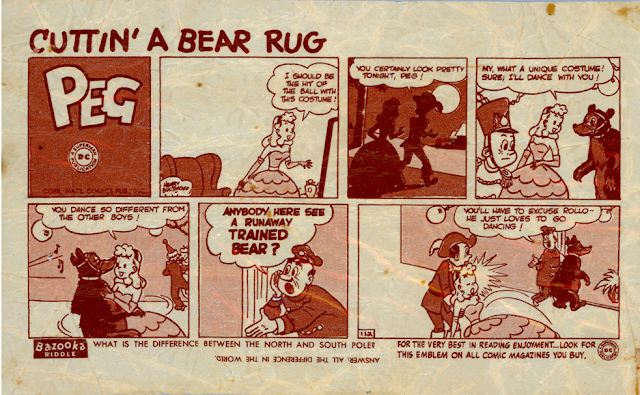
"Peg" no. 112. The series likely starts at #101 but that is very much unconfirmed and is also useless in determining if an even one hundred comics came before.


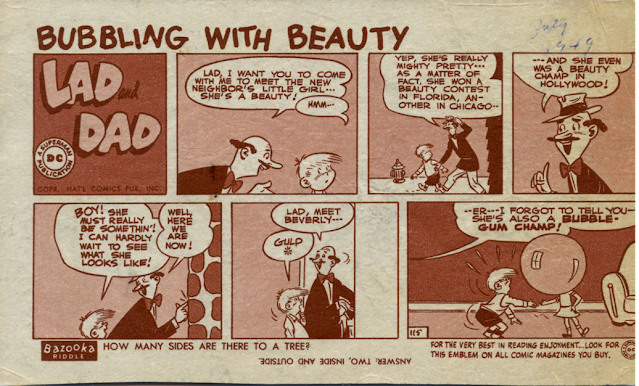
#115 finds "Lad and Dad" pushing a familiar Topps product in a way:


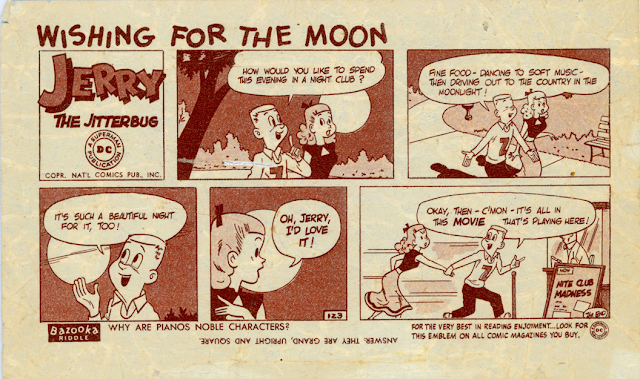
Dig that inked in July 1949 date!  "Jerry the Jitterbug" at #123 resembles, at least to me, a very milquetoast version of Harold Teen:


"Bonny" continues the fun and shows at least one subject appeared twice:


Note, however, the different style of the text at bottom as Topps used a tagline about saving Bazooka wrappers. Also, neither is numbered:


"The Dodo and the Frog" was a long running feature in some DC comic books and is my favorite of all the DC Bazooka's. It may be numbered in the lower right corner of the lower-right panel, can't quite tell:


"Chip" (two, even), "Gerry", "Rusty Rhino" and "Bronco Buster" s are all known subjects and BFF o' the Archive Jeff Shepherd; recently unearthed this beauty:


The lowest number I've seen is 107 and none have been found extending past the 120's; where and how long both the numbered and unnumbered versions come into play are open questions. I'm sure other characters exist beyond the ones above.  

These pre-Bazooka Joe sepia comics are very hard to suss out, especially the five-centers, until 1953 rolls around.