Saturday, March 26, 2022

O-Pee-Chee's en Regalia

Among the many irons I keep removing from the fire here at the Main Topps Archives Research Complex are those involving O-Pee-Chee, the Topps Canadian marketing partner starting in 1958 and continuing for 35 or so years before things got weird. Even before that they had a distribution agreement in place that may have pre-dated any card issues from the US. It was a complex arrangement in some ways but quite simple in others.  I won't get into the vagaries of it all today but you could fill a book (which I won't do either, although others have).  However not all O-Pee-Chee sets of that time originated with Topps; most did not but not all.

One such issue was the 1973 O-Pee-Chee Royal Canadian Mounted Police (RCMP for short) set.

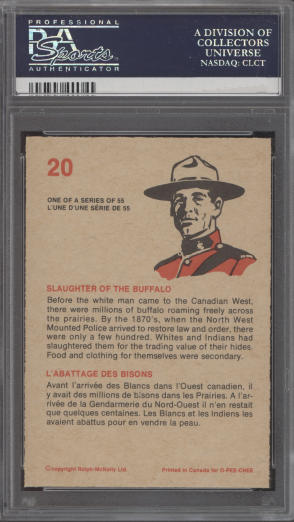
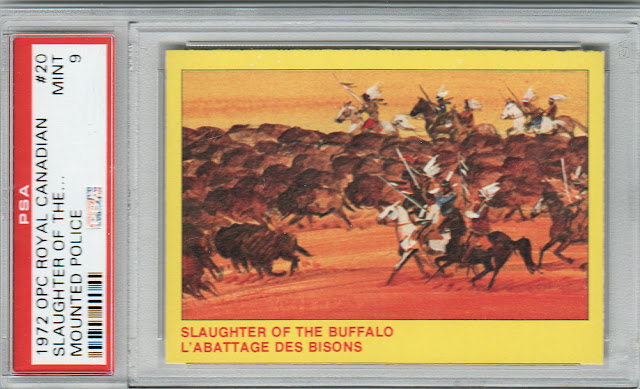
55 cards in length, it was issued to celebrate the 100th anniversary of the RCMP.  Here is a typical card, mine in fact, which is misdated by PSA:


All of the cards are bilingual, of course and a lot of effort went into the paintings that make up the fronts. They may have been licensed from Ralph-McNally Ltd. but I'm not sure if that firm provided the text, paintings or both but you can see they are mentioned in the indicia on the reverse:


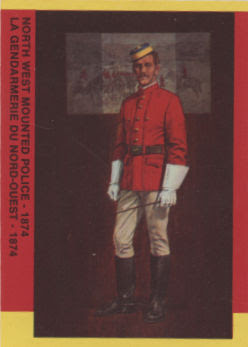
The RCMP cards are standard sized as was the insert, or "bonus" set, that rode along:


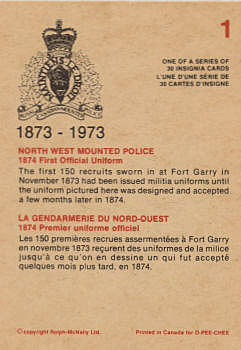
The reverse confirms the date of issue and the bonus set size of 30:


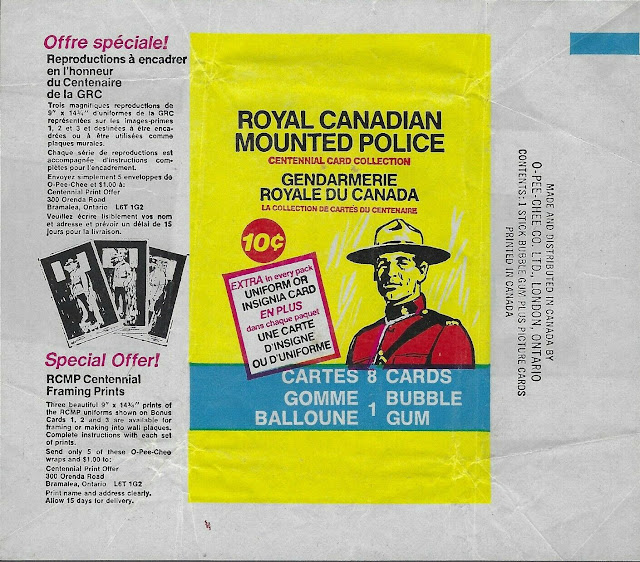
A colorful wax wrapper was used to retail the set


The first three bonus cards had artwork you could obtain as a larger premium; all three featured RCMP uniforms but I would have preferred, were I Canadian, to have had premiums of some of the card fronts from the main set. C'est la vie....

Saturday, March 19, 2022

Merson-ary

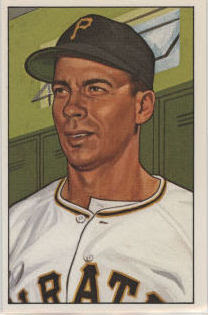
Back the to 1952 Bowman Phantoms today campers, as we look at another obscure player in this set that never was, Jack Merson.

Born in 1922 in Elkridge, Maryland, Merson would ultimately become an unlikely big league player even after being a stellar all around high school athlete, earning 15 varsity letters.  An infielder in the majors, he made a name for himself as a pitcher in high school but preferred playing the field. Showing  prowess in a semi-pro game in 1940 against a US Navy team (likely from nearby Bainbridge Naval Training Center) he was spotted by a Senators scout and signed with them.  He made it into 12 nondescript games with their Newport, Tennessee D-level club, hitting a paltry Ray Oyler-esque .135 to close out the season.  He wouldn't sniff another professional game until 1947, presumably being released after his low output debut.

Returning home he found a job in Elkridge, joined the local fire department and then enlisted in the U.S. Army in 1944. After completing basic training he was home on leave when he accidentally shot himself in the knee. He recovered from that and after his 1945 Army discharge found himself in semi-pro ball again for 1946 at the age of 24, although he shaved two years off and was thought of as a 22 year old. 

The Pirates liked what they saw and signed him; he debuted with their Class C Uniontown, Pennsylvania Middle Atlantic League team for 1947, playing Second and knocking the cover off the ball to the tune of .388 for the year. He remained in PA for the 1948 season, toiling for York in the Class B Interstate League and hitting a respectable .321 albeit with minimal power.

1949 saw him join New Orleans in the Southern Association but his average dipped 74 points and he may have suffered an injury that affected his swing. He was stellar in the field though and played some Third and Short as the Bucs tried to make him into a useful utility man. It seems to have worked as he was added to the Pirates 40 man roster in 1950 but he remained in New Orleans the entire year, getting his stroke back and hitting .290.

Triple A beckoned in 1951 and he spent most of the year with the Indianapolis squad in the American Association and quite puzzlingly, played only Second Base before being called up to Pittsburgh and debuting on September 14th.  He was 29 years old at the time but made the most of things by hitting a quite impressive .360 over 50 at bats. 

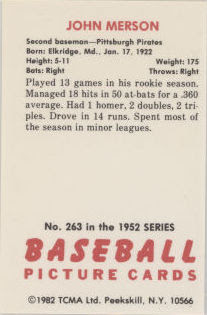
The verbiage on the back of his 1982 TCMA card was sparse:

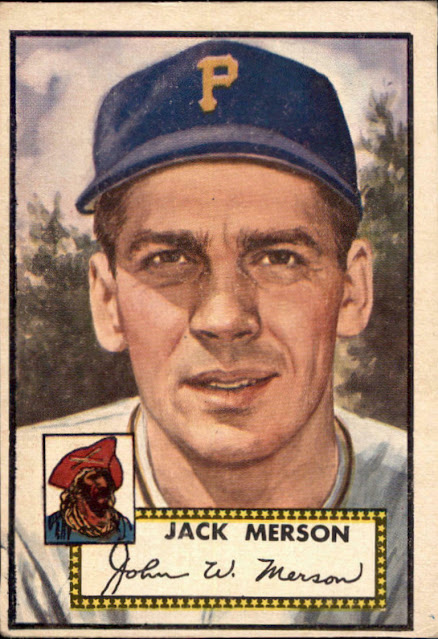
He made the 1952 Pirates as their starting Second Baseman, occasionally playing Third and he was on the ball early in the year but came back down to earth as the season wore on. He was hitting .246 when an errant pitch broke his right wrist in mid-August and was done for the year.  As you can imagine, this did not help his career but he was playing well enough (and more importantly was a warm body) to earn a spot with Topps, appearing in the high number "second series" that year, which must have spiked his Bowman card:


I swear, those trees and sky got the Bob Ross treatment and his even image looks painted to me, although likely over a B&W photo with some Flexichrome:


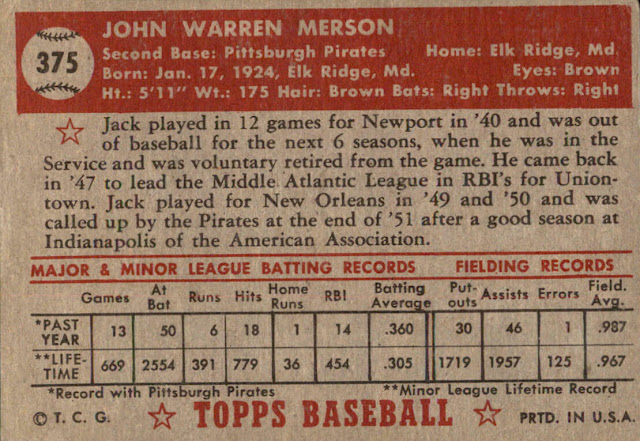
His fudged birthdate got by the Topps fact checkers, no surprise!

The Pirates traded him to the Hollywood Stars in the Pacific Coast League after the season but the PCL was subject to a major league draft and the Red Sox selected him. After playing exactly one game for Boston in 1953 he was optioned to back to the PCL, joining the San Diego Padres. He played there until he hung up his spikes after the 1956 season, earning a championship ring with their 1954 squad.

Merson returned to Elkridge thereafter and started up a couple of local businesses before becoming a prison guard. He died in his hometown in 2000.

With baseball back, I'll probably pause these profiles until the hot stove picks up again.

Thursday, March 17, 2022

Green Day

While I am by no means a collector of "modern" cards, every once in a while a newer issue catches my eye, usually due its the level of obscurity but sometimes just because they look neat.  One such set, somewhat appropriately today (in a special edition post), is the 2013 Topps Emerald Baseball Parallel.

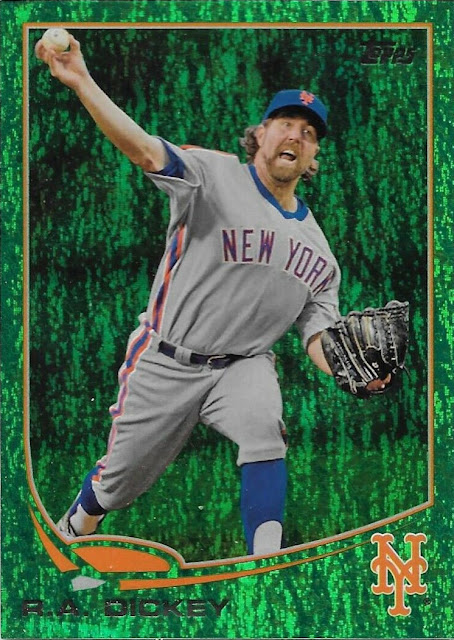
Inserted in both series 1 and 2, plus the update series of 2013 Topps Baseball at a 1:6 per (what-used-to-be-wax) pack ratio, these can be found quite easily and all 990 (!) are among the sharpest looking parallels produced under the Eisner regime.  Here's 2012 NL CY Young  Award winner R.A. Dickey in all his green glory:


Scans don't do these justice, they are Sidra-level spectacular.

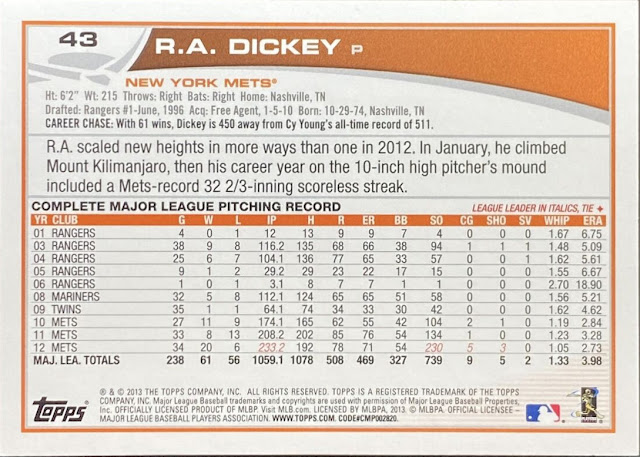
The back is the same as a regular Topps card:


Confusing things slightly are the presence of what some folks describe as Blue Emerald parallels, which are much more limited than the greens as they were inserted into special cello packs.  I think though, that these are really what most people call "Blue Sparkle" or "Blue Sapphire" cards as I believe an emerald needs to shine green, don't you? 

Saturday, March 12, 2022

Roger That!

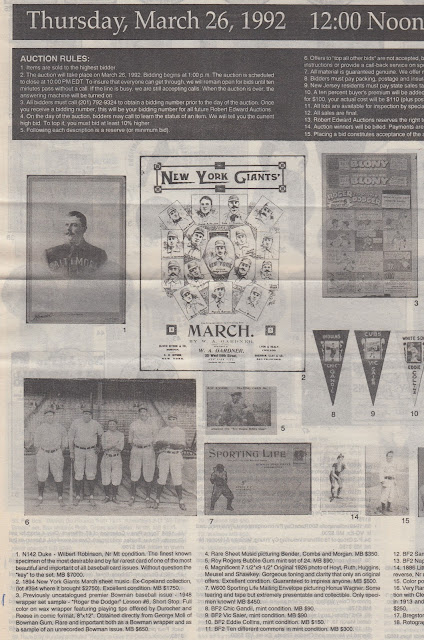
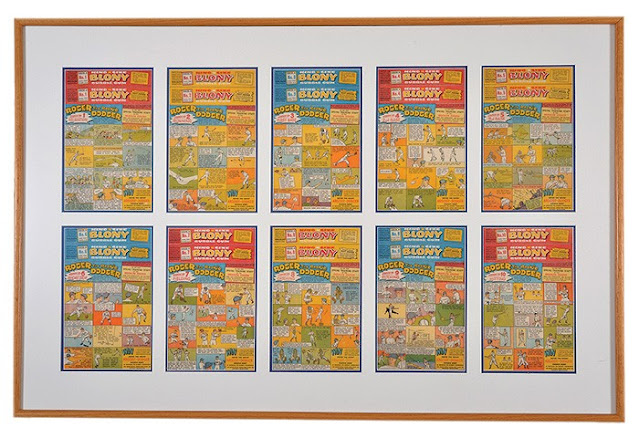
I'm on a bit of a Bowman kick of late and it seems to be centered upon unissued items.  Of particular noteworthy item is what's described as a 1948 proof issue that was meant for a five or possibly ten cent piece of Blony bubble gum featuring a comic strip called Roger The Rookie Dodger. As near as I can tell, the first indication this set ever existed was when a sample proof wrapper popped up for the first time in a now thirty year old REA auction:

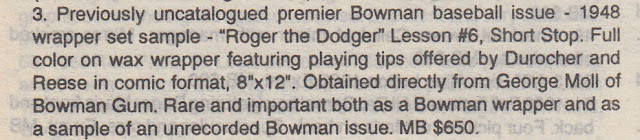
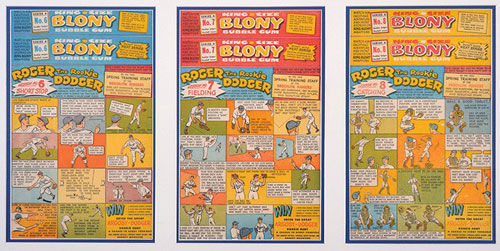
Here is a blowup of the blurb:

Leo Durocher and, as it turned out, his coaching staff (Jake Pitler, Ray Blades and Clyde Sukeforth). plus some players, would present tips for the younger ballplaying crowd to enjoy as they chewed away on potentially monstrous piece of bubble gum dubbed King Size Blony. As you can see Pee Wee Reese was also helping demonstrate the nuances of playing shortstop, although Durocher was no slouch at the position.  Indeed, he was Brooklyn's starter at the position in 1938 and 1939, before it was claimed by Reese!

The wrappers, which are flat as they were never folded, measure around 7" x 12" and would seem to have been intended as a loud retort to Bazooka's five cent roll, which had launched nationally during the summer of 1947.  The sheer size has me leaning toward a ten cent chew as that's a massive amount of real estate for a nickel gum wrapper.

However, the choice of Durocher was a curious one as he was coming off a year's suspension from Major League Baseball and whether or not that had an impact, the set never saw the light of day.  The REA description also indicates a planned series of Yankees-oriented comic instruction was being planned and it would be very interesting to know what they planned to dub it.   Presumably it would have been presented by the Bombers manager in 1948, Bucky Harris, and his coaching staff, which included Charlie Dressen, who later went on to manage in Brooklyn. 

The 1992 example is almost impossible to make out but thankfully a larger stash of a complete set of 10 was consigned to REA for their Spring 2014 auction

The originally auctioned single wrapper matches the one at the bottom left of the frame (and the one at left, below) but more than one example of it exists as the 2014 description seems to paint it as not being in a flattened, or proof, state. The proof wrappers (and the wrinkly single) don't seem to have been part of the Topps purchase of Bowman in early 1956 but rather are described as coming from the archives of George Moll, whose agency prepared Bowman's many sets over the years.


Too bad these never saw the light of day, they look fairly appealing and while the artwork appears a bit basic, they are colorful and there is a multiple Hall of Famer lineup; presumably other Dodgers players were used as demonstrators (it's not possible to tell from the scans) and their roster was well stocked in terms of Cooperstown enshrinees, so more HOF power seems quite likely.

As for the presenters (I think it says "Spring Training Staff" actually) and their cards from the years before 1948, Durocher of course is pictured on numerous cards from both his playing and managing days and Blades made a few sets as well.  Pitler and Sukeforth had some appearances in picture packs and the like but none of the four were in the 1948 Bowman Baseball issue.

What could have been.....

Saturday, March 5, 2022

Cookie, Cookie, Bring Your Man Home

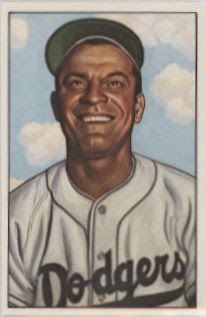
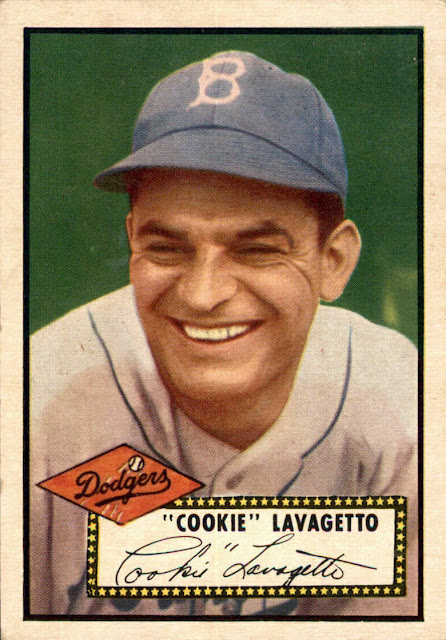
This week's entry in the 1952 Bowman Phantom biographies is not a player but rather a coach. Yes, Bowman included a handful of managers and coaches in the set, as they had in 1951 but by no means did all 16 teams get their field staff represented on a card.  Four coaches and three managers made the cut and Lavagetto would have upped the coach count to five but his appearance in the 1952 Topps high numbers (#365) looks like it precluded that.

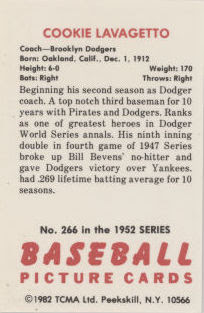
I'll dispense with the reproductions from BHN now and henceforth, so here is Cookie in all his 1952 glory, as reproduced thirty years later:


As noted on the reverse, he broke up Bill Beven's no hit bid in the 1947 World Series with a pinch hit double that plated two and won game four but the Dodgers ended up losing to the Yankees in seven, the second installment of a World Series skid against the Bombers that would reach five Fall Classic losses before they finally prevailed in 1955. If not for Cookie's smash, it would have been one of the ugliest no hitters in baseball history, although that would have been overshadowed by it being the first ever in the postseason.  Bevens walked 10 Dodgers but obviously had massive movement on his pitches. He did give up a run prior to Lavagetto's double, so it would not even have been a "no hit, no run game" but I am being pedantic.


He sure seems like he enjoyed having his picture taken:


Cookie was originally named Enrico, then when a teacher told him that translated to Henry or Harry, Lavagetto liked the Anglicized version so much eventually had it legally changed to the latter.  The son of an Oakland trash hauler, he got a seemingly late start in pro ball when he signed with the Oakland Oaks of the PCL in 1933 after a disastrous tryout with the San Francisco Seals was redeemed by a big pinch hit (hmmm....) off former big leaguer Pudgy Gould in an ad hoc charity game of semi-pros and professionals.  He ended up having an excellent season and was known as the protege of "Cookie" DiVencenzi, the owner of the Oaks after he signed, shaving a couple of years off his age in the process.  The sobriquet "Cookie's Boy" got shortened to plain old "Cookie" pretty quickly.

The Pirates picked him up for cash and a player to be named later in mid-September but remained with the Oaks until the 1933 PCL season wound down in early October. The Bucs were probably surprised to learn he had shaved not two but three years off his age; before that got revealed during spring training, some thought he was still a teenager. Primarily a Second Baseman who played a little Third, he got off to a quick start with Pittsburgh in 1934 then faded by midseason after an early June illness spelled him for a week.  He was a part-time player for the rest of the season and his final two years in Pittsburgh but was shifting to full time play at Third as Pie Traynor seemingly lost it overnight at the end of the 1935 season.

The Dodgers picked him up after the 1936 season in a trade that involved a couple other players, neither of whom distinguished himself for his new team.  The pungent Brooklyn air proved to be exactly what Cookie needed.  Moving back to Second, Lavagetto had a solid 1937 season for the Bums and then, after shifting to Third again in '38 made four straight All Star teams. Along the way he picked up his pilot's license, much to the displeasure of the Dodger's brass and skipper Leo Durocher as well. 

The Dodgers won the NL pennant in 1941 but for Cookie the next four years were spent in the Navy, where he enlisted and put his flying skills to use in service of his country as a aviation machinist's mate. He spent the war years in California, first in Alameda and then Oakland and played a lot of Navy baseball. He was transferred to Pearl Harbor just after war ended and managed a Navy team there that featured one Stanley Frank Musial.

After his discharge he returned to Brooklyn for two part-time seasons, having lost the balance of his prime years to World War 2.  The Dodgers released him after his World Series heroics but not until early May of 1948, suggesting a possible injury. He returned to the PCL for three more seasons, playing under Casey Stengel (it seems as part of an early platoon experiment) and Charlie Dressen, no doubt soaking up their wellspring of managerial wisdom. He returned to the Dodgers as a coach when Dressen was named manager in 1951 and quit when Chuck was bounced in favor of Walter Alston after the Dodgers lost the 1953 World Series.

Dressen and Lavagetto exiled themselves in Oakland for 1954 and then the Senators hired Dressen as manager in 1955 and he brought Cookie with him.  Three weeks into the 1957 season Dressen got fired and Lavagetto took over as manager.  He became the last manager of the original Washington Senators and first manager of the Minnesota Twins as a result.  


Yeah, that's the same shot!

Twins owner Calvin Griffith then had Cookie take a sabbatical (possibly due to mental strain) in early June then fired him after another few weeks once he had returned.  Sam Mele managed the games Lavagetto didn't and there must be a good story there but I can't suss it out.

He was a Mets coach under Casey Stengel in 1962-63 and then headed back to the West Coast after a health scare in early 1964 and coached for the Giants until 1967 before retiring from the game.  He passed away in 1990.

Saturday, February 26, 2022

Super Duper Souper

He's a pop culture footnote today but back in the mid 1960's, Soupy Sales was the king of children's TV for a couple of fun-filled years. Following fifteen years of TV hosting experience that ran through Cincinnati, Detroit and Los Angeles, ol' Soup (born Milton Supman) eventually moved to New York when his LA show came off life support and in 1964 launched a new Soupy Sales Show on WNEW-TV (Channel 5 to us natives).  This version lasted for two wacky and cream pie filled seasons and was syndicated nationally by 1965.  On New Year’s Day 1965, quite unhappy that he had to work after what sounds like a typical New Year's Eve of the time, he instructed his audience to go into their mom's purses and dad's billfolds and send him “those little green pieces of paper.”  

While the story has been conflated over the years to Soupy being summarily fired over this bit, it only resulted in his suspension from January 12-15, 1965. The Soupy Sales Show then resumed, presumably after airing a short spate of reruns, until the end of its syndicated and local runs on September 2, 1966.

Topps issued a set of 66 Soupy Sales cards in the midst of Soupy-mania.  Pumped and dumped, these were standard sized, black and white affairs with a facsimile autograph of Soupy in blue ink.  They are largely forgotten today and do not seem to have sold particularly well when issued and the cards may not have been marketed much beyond the Northeast. 


The backs, which are also black and white, used “Soupy Sez” graphics from the television show and featured copyrights for “Soupy Sales-WMC” and “T.C.G.” (Topps Chewing Gum).  This is a typical gag from the show (and set):


It appears that one batch of 66 cards was released with the reverses rotated 180 degree and then another batch was released the same way but with entirely different fronts. It therefore appears likely a master set would be 264 cards, two backs for each front, one of which is also then flipped 180 degrees. Some discussion and dissection can be fount over at the Vintage Non-Sports Forum.

Topps Vault, the major grading services and much of the collecting community thinks they were issued in 1967 (and the Vault even has at least one COA that says 1963!) but that date is impossible for several reasons.

For starters, the wrapper has no commodity code. 

These codes began appearing on Topps wrappers and display boxes in early 1966, tied to Topps moving their manufacturing and packing plant to Duryea, Pennsylvania while their executives, business and creative staffs remained in Brooklyn at Bush Terminal.  My determination that the set came out in 1965, which was the peak of Soupy-mania, is buoyed by this lack of a code. We'll revisit the set dating in a bit.

Color versions of a handful cards were produced, which are possibly unique and appear to be proofs made for internal use at Topps as they are blank backed. Who wouldn't want a shot of Soupy relaxing with a cigarette in his dressing room:


There are not many color proofs known and they are one of the great rarities produced by Topps. 

(UPDATE 2/27/22: Keith Olbermann advises he owns a color proof sheet, and also offers this eye-opening commentary from the front lines back in the 60's:

"My Dad and I went to see him at a Korvette's...and the throng was so great he got pushed through a plate glass window...the crowd pushed him against the window, which buckled and cracked and kind of folded outwards without fully breaking. So he didn't go completely through it, but at that point he, understandably, went home. As did we.")

Yikes!!

There is also a paper version that suffers from a paucity of published information.  Details on this latter issue are hard to come by but it is clear now that they came as an insert in a Soupy Sales wallet that obviously was meant to capitalize on the “little green pieces of paper” incident. I've covered the wallet previously but it's worth another peek:


There is also a gray version.  Here's the thing though, there is a facsimile card reverse on the other side of the wallet that still has Topps indicia:


Hold that thought...

Meanwhile, the wallets originally came with paper Soupy Sales "photos" in the photo window insert; when I acquired my yellow one two paper cards were hiding out within.  There are four differences between the Topps cards sold in packs and the wallet inserts.  

1) The wallet version are made of paper and have no gloss at all.
  
2) Soupy's "autograph" is also different as it was changed from blue to red.  

3) While the wallet photos have the same backs and copyrights as the regular issue cards, they use red accents on the reverse.

4) The wallet photos measure 2 3/8" x 3 9/16" which is close but not identical to a standard sized Topps card (like Soupy's) that measured 2 1/2" x 3 1/2":


As a neat tie-in the regular issue cards have a prominent “Wallet Size Photos” tagline on the wrappers and retail box lid.  There is no checklist known for the paper issue and it's unclear if all 66 cards were reproduced this way.

The wallets were churned out by Standard Plastics, who made various things out of vinyl you may remember if you are of a certain age, such as die-cast car cases. A vinyl Soupy lunchbox was also produced along with a pencil case and what looks like a photo album or maybe a notebook: 


Now check these out, clockwise from top left: wallets, pencil case, photo album (or notebook), lunchbox in a salesman's book page:


Here are similar products made by Standard Plastics, from their stationery division as it turns out, which makes me think these were sold in stores that didn't necessarily just sell toys:


Mattel bought Standard Plastics in 1966 and then made it their parent company at some point. I have no idea why but Mattel also bought the Ringling Brothers & Barnum & Bailey Circus in 1971 so who knows what was going on in their boardroom?!  Soupy may not have moved much product given the arc of his mid-60's "fad-dom" and the wallets can be found with a little patience.

There was more though and in 1965 Topps produced a Fan Magazine of Soupy (the first of two issues for this short-lived publication) and a publisher called Wonder Books put out a series of books with Soupy stories, at least one of which was written by children of Topps executives Woody Gelman (his daughter Barbara, who was a magazine art editor) and Abram Shorin (Robert Shorin). 

The Topps Fan Magazine has images of some of the cards reproduced within, which further nails the card sets as being from ’65. In addition, the retail box bottom uses the old “Brooklyn 32” address for Topps and not a ZIP Code (introduced mid-1963). The Topps pre-ZIP code address on their retail materials was not used on any post-1965 product and the wax wrapper drops the “32” so it would not surprise me if this is the last Topps box that used it. 


I've covered the magazines before, you can click over for a look.

Soupy resurfaced a couple of times as a host of his own show on the tube after 1966 and was a steady guest panelist on game shows in the 60's and 70's.  He was in a bunch of movies, had a radio show for a spell, cut some albums here and there and was one of those guys that was around show business seemingly forever.  His two sons with his first wife Barbara Fox, Hunt (on bass) and Tony (on drums) became rock musicians and were in bands with David Bowie (as part of Tin Machine), Todd Rundgren (Runt) and Iggy Pop among others (if you ever heard that cruise ship commercial with "Lust For Life" they comprised the rhythm section). Soupy died in 2009 but his memory certainly lives on among some of us, although he seems like one of those performers who could be lost to time once we Baby Boomers turn the keys over to the kids.

Saturday, February 19, 2022

The McChanical Man

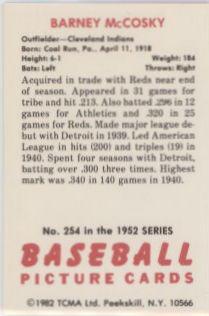
More 1952 Bowman Extension Series (from TCMA 1983 in case you forgot) bio today, as we look at Barney McCosky, a player somewhat akin to Ferris Fain in offensive skill with high contact rates and a stellar OBP.

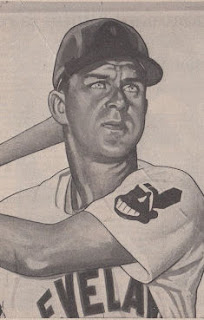
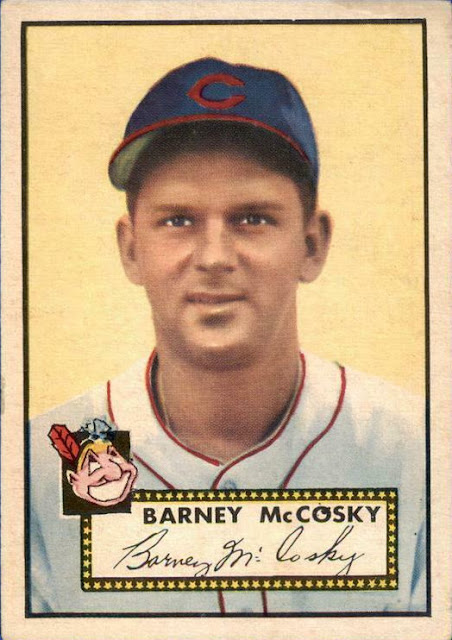
Here is our progression for McCosky:


As noted, he could hit:


Pennsylvania-born in 1917 but reared in Detroit from the age of 5 and signing with the hometown team after his high school graduation, McCosky made his minor league debut with Beaumont in the A1 level Texas League in 1936. Beaumont, despite being playing at a level below the top-ranking (at the time) AA minor leagues, was the main feeder team for Detroit. 

He struggled and after 20 games was demoted three levels to the class-C Charleston (West Virginia) Senators of the Middle Atlantic League, where, despite their team name, they affiliated with the Tigers.  McCosky then tore off a league leading .401 batting average to finish the year with a very loud bang. He stuck with Beaumont in 1937, and put in two solid seasons toiling in the summer sun of Texas, then earned a roster spot with the Tigers in 1939 after a breakout spring training game against Whitlow Wyatt of the Dodgers.

McCosky wielded a hot bat and roamed center field for his first three seasons in Detroit and helped lead the Tigers to a 1940 World Series appearance, where they lost to the Reds in 7. A back injury during the 1941 season would prove to be his undoing as a Center Fielder and he was displaced to Left in 1942 by the much older Doc Cramer, who had arrived in Detroit via a trade with the Senators. He joined the Navy after the 1942 season and was discharged in October 1945, too late to rejoin the Tigers as they won the 1945 World Series without him (and earned Cramer a ring).

He did not hit well in his 1946 return and Detroit, shockingly, traded him to the Athletics in mid-May for future Hall-of-Famer George Kell. The trade reignited his bat and he also returned to Center for the remainder of the season. He produced at a high level through the 1948 season for Philly but spent those two years in Left as his back injury flared up, tamping his speed.

McCosky then missed all of 1949 with, you guessed it, back trouble after bending down to grab a baseball during the first day of spring training and not making it back to the vertical.  Surgery followed and three of his vertebrae were fused together, which was possibly a career-ending move then (and now).  He fought back though and made the 1950's A's roster but his bat and speed were sapped, the latter for good.  He had his contract sold to the Reds in early May of 1951 and hit a solid .320 before joining Cleveland when they claimed him off waivers in late July.

He struggled through the rest of 1951 and by 1952 was relegated to pinch hitting duties for the most part. McCosky managed to make the opening day roster in 1953 but the Indians released him in July, after he only made 22 pinch hitting appearances and didn't play a lick in the field.  He ran a business with his wife in the Detroit area for a decade then became an auto salesman for many years thereafter, passing away in 1996.  He is memorialized to this day by the Barney McCosky League in Detroit, a co-ed instructional program for kids under 17. You could characterize him as an all around good guy who didn't bemoan his bad luck from what I have read. He was a favorite son of Detroit, if you will.

Barney appeared in a number of nationally issued baseball card issues of the 40's and 50's, including 1951 Bowman but I have to believe his semi-late his appearance in 1952 Topps (#300) did in any chance of a Bowman card that year.


McCosky, a textbook leadoff man of the WW2 and postwar era, finished with a lifetime batting average of .312 but through 1948 it sat at an even more impressive .320, with 68 triples attesting to his speed.  If not for the three years of military service, he would by my estimation, have been considered the second or third greatest Center Fielder in Tigers history, after Ty Cobb and maybe Curtis Granderson. As it is he's in the top 10, possibly the top 5 even.  Don't believe me?  His 154 game averages from 1939-48, which covers seven seasons played while he missed three full campaigns in his absolute prime, were like so:

BA .320

Hits 192

Runs 98

Doubles: 31

Triples: 10+

Walks: 72

Ten years of that and you are in the Cooperstown discussion. As Larry David would say, preh-tay, preh-tay, pret-tah, pretty GOOD!