Showing posts with label Joseph Shorin. Show all posts

Saturday, March 11, 2023

Past Times Were Good Times

Well I'm still dredging up old scans (and some new ones) here at the Topps Archives Research Complex and recently found a handful of  trade journal photos featuring the Shorin's, the original and long time owners of Topps, at least until Michael Eisner came along.

Here's an item from March of 1940, taken at the Wholesale Candy and Tobacco Salesmen's gathering at the Commodore Hotel in Manhattan, a place where I have attended many functions myself over the years. I swear that folding screen behind the group was still being used when I was attending soiree's there in the 90's.  The roughly 1300 attendees were mostly what is referred to as "jobbers" (wholesalers) and they were a vital cog in the Topps sales machinery. Candy and tobacco were inextricably linked as distribution channels at the time and Topps made their bones through such relationships.  

Here's three quarters of the Shorin boys, along with a coterie of Topps salesmen, they are seated second (Joseph), third (Abe) and fourth (Phil) from the left:


Phil looks a bit like Ira to me but there's very little non-wirephoto quality imagery available of either man, nor of Abe for that matter. As President, Joe Shorin was in many more photos than the rest of the boys. Here's a better shot of the three from the dinner:

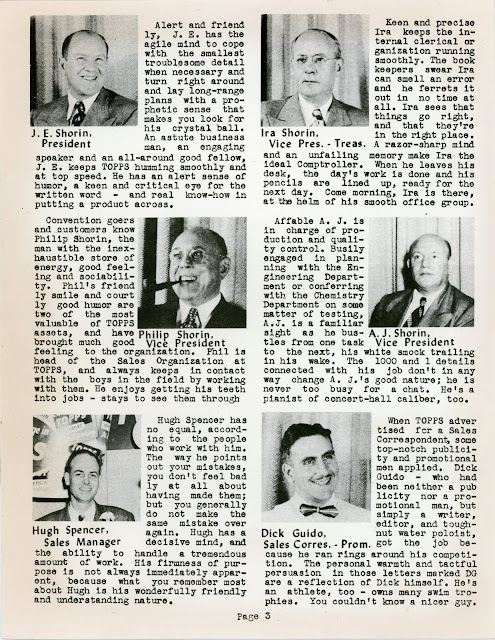
Here check out this page from a Topps Topics promotional brochure circa 1948, maybe you can tell better than me:


You can definitely see Phil here though, at right in a snapshot from the National Candy Wholesalers Association trade show in June 1949 and holding his ever present pipe:

This was just prior to the deployment of the one-cent version of Bazooka (the nickel roll had launched two years earlier) and you can see on the banner behind Phil that Topps was still pushing their flagship gum along with the bubble gum's nickel roll. The fellow on the left is Al Bagle, who also worked for Topps.

Backtracking slightly, Topps would go pretty heavy on the PR in the late 1940's and this photo, part of a press release package, is typical as it shows the Topps board having some goofy, bubble blowing fun as they meet, which I'm sure was a planned and well-staged exercise. In this case, taken from a Minneapolis newspaper in September of 1948, these images and some expertly massaged text sometimes ran in Sunday magazine sections:


I believe the fellow on the left blowing a bubble is Dick Guido, who handled Sales Correspondence and Promotions (and who presumably was Sy Berger's boss in the early days) for the company and was featured on the Topps Topics page above.  Note the Tatoo tourist pouch just beyond his left hand, last seen here.  There's one at the head of the table as well.

I'll leave you with a grainy blowup of the pouch:


Boy I'd sure love to find one of those!

Saturday, October 17, 2020

The Organization Men (and Women)

Friend o'the Archive Keith Olbermann sent along a really neat Topps item recently and I think you'll all agree it's one of the more amazing pieces to be discussed here. I've previously shown an example of Topps Jamboree, a newsletter designed for the wholesalers and jobbers Topps relied upon to distribute their products but this particular item seems geared to the far-flung Topps salesmen around the US.  I'll get into dating in a minute but let's gawk at this wonderful piece first.

Here's a nice shot of Topps HQ in Brooklyn and a letter from Sales Manager Hugh Spencer to kick things off:


I can't find a good reference to John Dromey, at least the one who would have written the below piece but he wrote for an industry trade magazine called International Confectioner and that's where this story originated, in a longer form:


Take Mr. Dromey's exhortations with a grain of salt in places.  I'm not sure about the American Leaf Tobacco Company (ALTC) being the largest wholesale tobacco company in the US but they did have an impressive presence nationwide, or at least east of the Mississippi River.  Their scale is hard to measure though as so little is available on the company. The "Profitable Sales Aid of Silence" tagline though is 100% accurate-it's how the Shorin's operated for decades, i.e. letting their products do the talking.

The referenced real estate venture had at least one very major hiccup in 1933, when the building housing the ALTC (and apartments on the upper floors), a joint venture of their father's with another family (the Rabkin's), went bust and 7 Debevoise St. was foreclosed upon. This act makes the comments about ALTC reasonably suspect to my mind as well, although prior to the Depression things may have been quite rosy in both empires.

The filling stations though, which went by the American Gas Stations (AGS) moniker, are much more quantifiable. They certainly were doing well enough to get bought out by the Standard Oil Co. of New York (Socony) or what we would now call Mobil, in 1938, although latter day family accounts and those of others differ on just how well things were going. 

A 1939-40 New York City tax photo documents one such station; all seem to have been located in Brooklyn  although I have a recent report of one possibly being in Queens.  This may be one of the few photos showing the operation as any other tax photos I could find showed the switch to Socony Sobol Brothers) had already occurred. AGS sold Socony products so the oil major must have had a pretty good idea of what they were buying.  Around fifteen AGS station existed at their peak.

Similar chains around New York City (such as Sobol Brothers), were also being gobbled up at this time by much larger companies. AGS should not be confused with the American Oil Company (AMOCO), which was originally a brand of Standard Oil's but got trust-busted into an independent in 1911.  They later re-associated though and both Standard and AMOCO stations co-existed for many years before various mergers somewhat reunited them. The AGS stations were rebranded as Socony's Sobol's after the deal closed (Mobil had bought them too!) and I'd imagine would have been filtered down to Mobil stations eventually. One location was still active (as a BP IIRC) until five or six years ago and one or two others may still be service stations.

The "American" theme, which featured red, white and blue prominently, would be reflected in Bazooka's livery once the product was launched in 1947.


Now we get to some Shorin's.  I think I've only seen one other picture of Ira and maybe two of Abram over the years. Joe looks like Joe and Phil looks like a super-villain!


We see some offspring next.  Joel Shorin would end up as President of Topps and Phil Shorin's role must have been expanded at some point (I'm not as up to speed on the third generation as I am on the original nuclear families). Check out young Sy Berger!


The references in Berger's bio lead me to think this newsletter is from the second half of 1948 as I believe his first son was born earlier that year and the other jobs described match up with that dating. Eddie Shookoff's son gave me a valuable interview for my book and I believe Mel Bohrer was a car pool buddy of Woody Gelman and Sy Berger's for many years. I suspect Phil Jr. and Sy also interacted quite a bit as Berger had some involvement in procuring premiums from Japan after the war. Charles Zubrin also featured prominently for decades at Topps. 


I want to match up some of the initials of the secretaries below to some Topps correspondence I have but it's a back burner item:

As the "Changemaker" is still front and center and with no reference at the end to the penny tab version of Bazooka (that being a mid-1949 effort), I think my latter part of 1948 date estimate stands up pretty well. 

These "house organs" are hard to find and I have no idea how long this publication ran. I'd love to find more copies of this one and Topps Jamboree.

Saturday, November 17, 2012

Like Father, Like Son

Well, I've shown his father and his son (although I thought it was he until corrected) but to date nothing of Joseph Shorin proper.  Joe Shorin, you may recall was the President of Topps Chewing Gum from its inception in 1938 until his death in 1959. Prior to that he had run American Gas Stations for the Shorin family  and today would be the equivalent of a gregarious CEO I think, as he appeared frequently in photo ops and acted as a panelist on things like radio game shows. His childhood antics were also the inspiration for Bazooka Joe.

I have some grainy photos of him but finally managed to snag an original press photo, dating I assume from 1959 when it was issued to accompany his obituary in the papers:


That is the face that launched a billion pieces of bubble gum folks!

Monday, April 4, 2011

It Runs In The Family

A little over three months ago I started an in depth research project into the origins of Topps Chewing Gum, which turned into an article for Les Davis' The Wrapper after it became apparent to me that the official story of the company's beginnings was, in large part, made up. The further back in time I went, the more I found. Now that Les is on to selling his next issue (with another story by yours truly, this time concerning Warren Bowman) I can delve into the back story even more. Some of this repeats parts of the Wrapper article, some of it updates same and some of it is newly discovered since then.

The oft told story of family patriarch Morris Shorin founding the American Leaf Tobacco Company in 1890 and then, in a fit of desperation brought on by the Depression, betting the family fortune on chewing gum and installing his four sons to run Topps may have first been promulgated to the masses around 1972, when the company went public with a stock offering. The origins of this tale seem to go back a few more years though, when Topps was doing some PR work in the wake of a lawsuit brought by Fleer in the mid 60's but I am still digging into that particular aspect of the story and will report my findings here at a later date.

As detailed in a prior post, the American Leaf Tobacco Company was founded in Boston in 1890 by members of the Salomon family, two years before Morris emigrated to the U.S. from Russia. Furthermore, I am finding increasing evidence that Morris did not fully control ALTC until 1908, when he secured a bank loan for its purchase. Now, it is not unusual for corporations or individuals to embellish their history, indeed it occurs to this day. What surprised me though was that the true origins of the company paled in comparison to the true origins of Morris Shorin.

Morris arrived in the U.S. in July of 1892  1891 with the last name of Chigorinsky and he was legally known by this name until 1919, as were his wife and children, of which there were five sons, not four, at least until 1918 when his eldest, Moe, died in October of an unspecifed chronic ailment. There will be more written on Moe at some point but it is worth noting he was born in Russia and did not arrive in the U.S. until 1904. It is also worth noting the name change to Shorin happened after Moe's death and probably not until the surviving Chigorinsky boys had completed their active military service during the Great War.

I have recently spoken and corresponded with some family members on the Jablow side and there is a notion that Morris took the Chigorinsky name as a joke almost, albeit an inside one, as it reflected both the cigar industry and his ethnicity. It is possible though, that he was indeed a Shorin before immigrating as there was a well-known merchant family of that name in Russia for many years prior.

When I wrote the Wrapper article I was laboring under the impression that Morris had come to America with his wife, Rebecca (nee Jablow) and young Moe; I have to confess I am not 100% convinced of this anymore although there is some lingering uncertainty among the Jablow descendants on this point. Census records for the family give differing accounts of events over thirty years' time which does not help matters but it is clear to me now that Moe was not a child of Rebecca's and that Morris and she were married (in the U.S.) in 1896.

Morris Chigorinsky was most probably well off (in a relative sense for immigrants) when he arrived in the U.S. in 1891. He initially had a cigar business that employed some members of the Jablow family but I cannot determine if this was how he met Rebecca. Over the years though, various Jablow's and their offspring would figure in the operation of Topps. Thanks to Carol Jablow, I was also able to obtain a picture of Morris and Rebecca as I had not been able to find one anywhere until she came to my rescue. Here is Morris first:


That was taken from a larger still showing them both, probably in Miami in the late 30's or early 40's:


From 1897-1903 the four "Shorin" boys (Abraham, Philip, Isador and Joseph) were born and around this time, or maybe a little later, Morris was in business with a man named Louis Metz (also referred to as Melz), in a location at the bustling intersection of Throop and Flushing Avenues in Williamsburg, Brooklyn that would have been ideal for a retail shop. City directories that I have been able to access on a limited basis do not give a business name unfortunately, so I cannot determine if they operated under the American Leaf Tobacco Company monicker or not. The ALTC did have operations as far away as St. Louis by this time, I just can't tell if Morris was involved with any of them. Confusing matters further is the dissolution of ALTC as a New York Corporation in 1903, which doesn't necessarily mean much as Topps would later go into and out of a corporate ownership structure in the early days of World War 2 without affecting operations.

Morris may have struck off on his own around 1906 (not sure yet) but in 1908 ALTC capitalized in New York and Florida with operations in the Sunshine State centering around a prime tobacco growing area. The firm would grow rapidly, establishing Brooklyn headquartes on Debevoise St. in Williamsburg although there is some debate among the Jablow descendants as to the extent of trouble it experienced during the Great War. My own observation is that the firm did well despite the war as Morris Shorin purchased a fine home in a well off section of Crown Heights around 1918, after renting in various locations up and down Tompkins Avenue in Bedford-Stuyvesant for many years. Ira and Joseph went on to college and I suspect the other two boys did as well; even the ill-fated Moe had attended New York University for a while.

The late 20's saw the family purchase American Gas Stations, as recounted here recently, an entity that was run by Joseph Shorin whereby he gained valuable insight into how to run a successful company. Topps just released an insert set entitled the History of Topps and the first card is, fittingly enough, of  Joe Joel Shoirn, his son nephew:


This is a good place to stop for today methinks. Much, much more to come on the Shorin and Jablow families and their involvement with Topps Chewing Gum, including the founding of the firm, shortly. In the meantime, if anyone out there has more details on these early days, please contact me. And thanks for the corrections folks!

Thursday, March 10, 2011

Fuel For Expansion

A couple of posts ago I delved into the early history of the Shorin family and American Leaf Tobacco Company (ALTC) as a followup to my article in Wrapper #257. Therein I mentioned that in addition to the more well known ALTC, the Shorin's also owned a chain of gas stations in Brooklyn in a period roughly spanning the Depression. The chain was called American Gas Stations and the company was founded in 1928.

American Gas Stations (AGS) may have had the financial backing of Morris Shorin but it appears his youngest son, Joseph, who would have been about 25 at the time, was in charge. Joseph Shorin would eventually end up being President of Topps Chewing Gum but he had the benefit of the decade he spent running AGS to draw upon. Joe Shorin graduated with a degree in Business Administration from New York University in 1925 and attended St. Lawrence Law School, which despite the Canadian sounding name had a branch in Brooklyn at the time.

Information on the company is scant but I suspect it was set up as a partnership. The first location may have been a couple of blocks north of Ebbets Field at 1619 Bedford Avenue in Brooklyn, which ended up as the eventual headquarters of the whole operation. Here is a matchbook showing their logo and some gas station addresses:


(Scans courtesy of Michael Moran)

I've never been able to find an American Leaf Tobacco Company logo but wonder if it had the same red, white and blue color scheme. It would make sense.I'll get to the locations in a minute but take a look at the logo first, which is highly stylized and slyly incorporates the initials of the firm:


I was able to determine two of the locations shown on the back of the matchbook were purchased in early February of 1938 by AGS. By the time Joe Shorin sold the company to Socony-Vacuum (later Mobil) in 1939 they had seventeen stations so they were snapping up locations at a pretty good clip in '38. I am still doing research but the sale of AGS seems to have been initiated by Socony-Vacuum.

The American Leaf Tobacco Company was sold just prior to AGS I believe and while I do have some details on why I think ALTC was sold and did not wither away in the depths of the Depression, I will save those comments for another time.

Joe Shorin was knocking down whatever existed when he purchased his properties for AGS and building a distinctive style of building for each station; red brick with white trim was the color scheme and I have to think a touch of blue would have shown up somewhere in the design. I am told they were quite easy to spot back in the day. One AGS station still remains, at 1815 Ocean Avenue between Avenues M and N, although it has been painted over and is now called Tomat Service Center (NOTE 11/19/12-it appears to have been torn down and replaced with a Sunoco storefront):


View Larger Map

More pre history of Topps to come folks!