Showing posts with label 1959 Topps Baseball. Show all posts

Saturday, April 11, 2026

Topps Topics: Studies in Uncut Sheet Arrays - 1958 to 1960


Presenting part two of an ongoing series examining the use of short prints and double prints by Topps in their vintage era; part one can be found HERE. Today Mark Pekrul is looking at the 1958 to 1960 press sheets for the annual Topps Baseball sets. Mark, who posts as “deweyinthehall” on Net54 Baseball  has dug into these along with a couple of other stalwarts over there and worked to reconstruct most of the print arrays for all Topps Baseball series from roughly 1955 to 1970.  This work has essentially been compiled independently of anything I’ve posted previously. Mark maintains a website that covers Topps Baseball sets from 1965 to 1994 in some commendable depth as well,  CLICK HERE to be transported.

As a reminder, from 1957 through 1995, all Topps standard-sized (i.e. 2.5 x 3.5 inches) sets (baseball, football, hockey, basketball and non-sports) were printed on sheets containing two large blocks of cards, 11x12 cards each.  Creating groups of 132 cards each, in many cases this gave us complete set counts which are very recognizable today – 132, 264, 396, 528, 660 and 792.  Some early hockey and football sets, as well as many non-sports sets, had only 66 cards – exactly half of 132.

When we hear the term “uncut sheet” today, we typically think of a roughly 2' x 4' sheet of 132 cards. However, a full standard-sized uncut sheet was twice as large, and included 2 groupings of 132 cards (as above).  The margins were white (even for sets with colored borders, such as 1971 or 1962) and contained various notations including positioning and cutting guides and other errata.  They eventually even featured commodity codes, just like Topps used for cases, boxes and packs.

Down the middle ran a thick white space called the “gutter” – full sheets were sliced down the gutter before each half-sheet, or ‘slit’, was then fed into a cutter. 

Each slit contained 12 rows of 11 cards.   For ease of reference, we can label the rows A-L and columns 1-11. Any card position can then be designated as A-1 (far upper left), L-11 (bottom right), and so forth, as shown below.

             SLIT A                                                                      SLIT B

And away we go…

---

1958 Topps Baseball – 494 Total Cards in Set

Series 1: 1-110, 110 different cards

1958 was the first of many times a set’s first series would contain 110 cards.  To accommodate 10 different rows of 11 cards on a 24 row full sheet, it was necessary for each row to appear twice and for either one of those rows to appear four additional times, two to appear two additional times, or four to appear one additional time.  

In later years, for which we have images of 110-card sheets, we know it was the rule that four rows would appear one additional time each.  While we have no images of 1958’s series one sheets and reconstructions have yet to be made, we do have several partial sheet images.  This permits us to identify with a high degree of certainty that two of the four over-printed rows, in which each card will appear in quantities 50% greater than the other series 1 cards, are arranged thusly, as per the head card in each:

Don Drysdale (25)

Jim Landis (108)

Don Mossi (35)

Del Ennis (60)

Billy Hoeft (13)

Bobby Richardson (101)

Hank Aaron (30)

Tim Thompson (57)

Duke Snider (88)

Early Wynn (100)

Willie Mays (5)


and

Jim Rivera (11)

Von McDaniel (65)

Giants Team Card (19)

Bob Lemon (2)

Billy Hunter (98)

Al Kaline (70)

Cal Neeman (33)

Billy Pierce (50)

Don Zimmer (77)

Gil McDougald (20)

Morrie Martin (53)

 More research is needed to identify which other two rows were overprinted.

Series 2: 111-198, 87 different cards.  What should have been the 88th card, #145, Ed Bouchee, was never issued due to, um…legal problems he encountered in January, 1958.  Card #115, Jim Bunning took #145’s place on the series 2 press sheet, in addition to its own, and was printed in double the quantities of the other series 2 cards. 

Series 3: 199-286, 88 different cards

Series 4: 287-374, 88 different cards

Series 5: 375-440, 66 different cards

Series 5 was arranged in the 66-card pattern, and each slit was identical.  Here is an image of slit B, which also shows column 11 from slit A, with the gutter in between:


Series 6: 441-495, 55 different cards

As it is a 55-card series, one of the five rows had to have been printed only three times, to the other four rows’ four times each.  While we have images of each series 6 row, they are all disembodied from sheets or slits, and we do not have enough information to know which row of 11 cards was short-printed.

The series 5 press sheets do contain a curiosity, however.

Here are two rows – anything seem unusual?


Notice how the All Star cards of Stan Musial (476) and Mickey Mantle (487) appear three times each on the same row.   Musial was a key last minute signing by Topps and we can only surmise that they wanted to provide kids with a greater chance of obtaining cards of two of the most popular stars of the day by making each of these cards available in greater quantities than the other series 6 cards. 

While no images exist, we know that for some of its total print run series 6 included only the usual one of each per row, and that the four other spaces were taken up in one row by Carroll Hardy (446) and Preston Ward (450) and in the other by Billy Harrell (443) and Gary Geiger (462).   So, these four are seemingly available in lesser quantities than other series 6 cards and possibly in far lesser quantities than the Mantle and Musial All Stars.


1959 Topps Baseball – 572 Total Cards in Set

Series 1: 1-110, 110 different cards

As with all other 110-card series, we know that 44 of these cards were over-printed by 1/2, but we have no images or reconstructions to allow us to know which specific cards these were.


Series 2: 111-198, 88 different cards

Series 3: 199-286, 88 different cards

Series 4: 287-374, 88 different cards

Series 5: 375-440, 66 different cards

Series 6: 441-506, 66 different cards

Series 7: 507-572, 66 different cards

Series 2-4 were arranged in the 88-card pattern, and those in series 5-7 in the 66-card pattern.

1959 was Topps’ largest set yet.  They increased from 1958 by nearly 100 cards, and added a 7th series.  Topps sets would include seven series from here through 1970.


1960 Topps Baseball – 572 Total Cards in Set

Series 1: 1-110, 110 different cards

Series 2: 111-198, 88 different cards

Series 3: 199-286, 88 different cards

Series 4: 287-374, 88 different cards

Series 5: 375-440, 88 different cards

Series 6: 441-506, 66 different cards

Series 7: 507-572, 66 different cards

The 1960 set was constructed in exactly the same manner as the 1959 set.  Again, because we lack imagery from series 1, we cannot tell with certainty which 44 cards were over-printed and exist in quantities 50% greater than the other 66.

---

Stay tuned, it get really interesting as we approach the expansion era.


Saturday, January 6, 2024

A May-September Marriage

Happy New Year folks!  Today I want to dip into the recent past, December 9th, 2023 to be exact, wherein I examined some of the subtleties of a 1959 Topps Baseball 3rd series proof sheet. Friend o'the Archive Keith Olbermann recently posted some images of a 7th series proof sheet on Net54 Baseball and was kind enough to send me some higher-res scans. I don't want to usurp the discussion on Net54 but do want to look at some of the production details, just like last time.

Here is the front side, with all 66 cards showing, including the Bob Gibson rookie and Roy Campanella's Symbol of Courage tribute card among its very colorful array:


As with the 3rd series, there is production detail on the sheet itself:

The reference number for the third series sheet was G-803 and we're all the way up to G-1174 here.

While it seems like the high numbers were issued just in August and September most years, their preparation clearly was undertaken in May, at least in 1959. Since the 3rd series was being prepped in March, it seems like a new series was being created every three weeks or so.  With May seeing work this advanced on the high numbers, even allowing for final printing in say, June, there seems to be a bit of a lag built in. This surprised me as it may indicate sheets were stored onsite at Topps Warehouse/HQ in Brooklyn (or in another nearby warehouse of theirs) or even packed and held for a spell.  There's a reason that gum tasted so stale even in a newly issued series!

Intriguingly, this sheet has the backs as well:


That looks really cool, I must say.

Topps made an attempt in '59 to track some trades and options by adding a short statement to the text on the reverse.  The earliest these appear is in the 4th series, referencing transactions from March. They disappear from the 5th and 6th series then reappear in the seventh series of high numbers. There's some subtleties to these, which I plan to examine quite soon but today I just want to look at card #541, which features Gary Thurman.

Thurman's regular issue card has his May option described like so:


With the proof version looking like this:


Clearly a work in progress.  The typeface, font size, color and the use of quotes all differ from the issued version. Topps wisely abandoned such updates the following season. The proof stock is not nearly as white as the regular issue's, which is a little odd.

Spoiler alert-Thurman did NOT regain his 1956 form (and he seems to have actually had a better year in 1957 if measured by WAR). His failure to replicate things may have been because, despite the birth date used by Topps, he was actually born in 1917 and in 1958 turned 41 midseason!

Little details like this fascinate me and also lay bare the amount of work that went into issuing a set of Baseball cards.  Work on their flagship set would begin annually after the end of the World Series and then the set would roar to life as Spring Training and the regular season got underway. It was an entirely mechanical process with many, many time-consuming steps along the way. And until the 1973 oil crisis or thereabouts, it worked out to a mere penny a card for the consumer!

Saturday, December 9, 2023

Tickled Pink

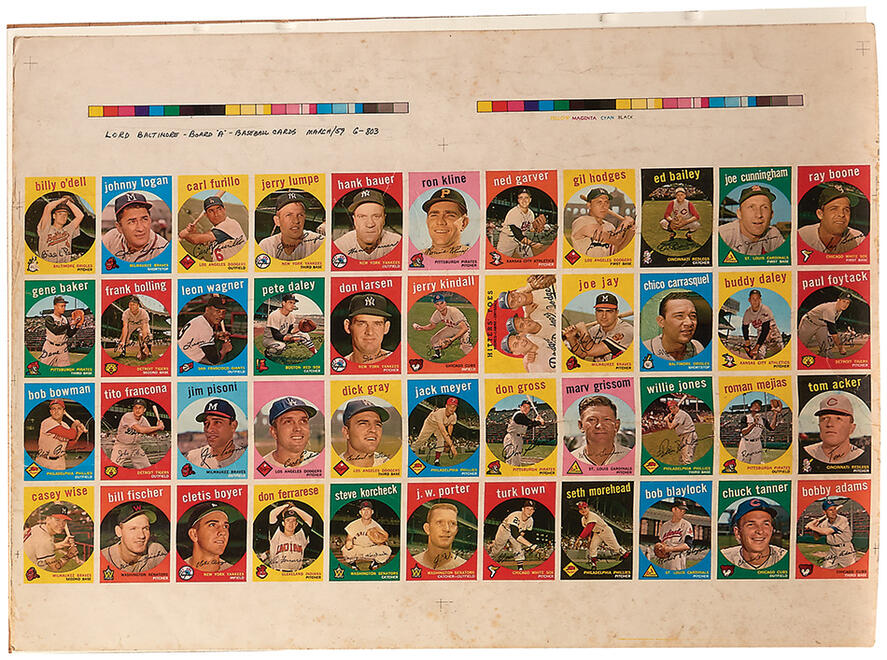
Friend o'the Archive John Moran recently pushed some 1959 Topps Baseball partial proof sheet scans through to Net54 Baseball, where a clutch of dedicated sleuths are piecing together Topps press sheet arrays (i.e. the A &B slits) for the years covering 1956 to 1969 (and maybe a little bit on either side of that). I'm not here to steal their thunder but one of the scans posted there had some really interesting details that are not often seen on the partial proofs that have entered the hobby over the years:


You can plainly see this was a Lord Baltimore Press production. Also quite prominent are the color keys and some alignment crosses at left, center and right (The crosses are also visible at the bottom).

I'll blow up the entire left side waste area above the cards and below the key to make the discussion easier:


I often talk about blocks of cards on a press sheet being arrayed in an ABA/BAB pattern across the two slits when an 88 card series was being printed. Each letter represent the same 44 card block on the slits, but the Board "A" reference is merely coincidental here (I think) as Topps also would prepare and proof their art work in batches of 44 (or 55, 22 or even 33), depending upon the configuration of the series being printed. I assume this is because each slit had at least one batch on it and they could move around the films shot  by the printer or each accordingly. You can see the proof date, or at least the month (March) and what I assume is a batch order number (6-803) or some other such reference. It's not clear to me if that's a Topps notation or one from LBP but I suspect the latter.

The cards on the A Board run from nos. 201 to 285, entirely consistent with a 110 card first series, followed by two series of 88 cards each.  It's a little weird that Carl Erskine's name does not appear on the proof. I know he voluntarily retired on June 15, 1959 so the printing predated that but occurred during spring training.  Perhaps he was contemplating retirement before the start of the season and caused Topps some pause? Or it's just a goof-up.  Here's the finished card:


Board B would have had the other 44 cards from the series, including Fence Busters (with Ed Mathews and Hank Aaron), Early Wynn, a couple of team cards, a second year Maris and some not-so-hot rookie cards.  Kind of a meh series overall, talent-wise, isn't it?  In fact the whole set only has a couple of big name cards but it's a release that I've always liked the looks of thanks to the big blocks of color and well-designed backs.

So a neat little bit of Topps printing history there-too bad there's no complete record but of course, what else would those of us who dig this stuff do if there was?

Saturday, November 20, 2021

Ersatz All Folks

Hey kids-kind of a "so good it could be real" post today, so hang on for a fun ride!

Here's a couple of esoteric Topps sales stimulators I found from an old Morphy Auction some time ago.  These are of the neater items I've seen in the ersatz-promo vein.  The first is a "Baseball Certificate" which very much resembles an admission ticket of yore-because it actually was one!  It's hard to read but it indeed bestowed a granstand seat to the bearer.  This may have been from a Bazooka contest but I'm having trouble tracking which one so perhaps it was instead from a distributor contest, something Topps ran with regularity.

Next up, we get this fantastic item from two years later, hawking the first Topps Baseball inserts (Baseball Stamps) and the standalone albums used to house them:

That was clearly designed to look like a Western Union telegram and given that Thanksgiving is almost upon us, this one seems apt to show as an example (plus it was sent on the exact day I was born!):


Western Union killed off telegrams on January 27, 2006 in case you were wondering why you hadn't received one lately!

Topps would up their game considerably in 1962 with faux fiat currency.  I can't find any promotional material for these, which doesn't mean there wasn't any of course, but it's MIA right now.

Baseball Bucks came first and were an entirely separate product from the flagship Baseball, sold in one and five cent retail packs.  This is a typical example, tilt and all:


The change of seasons brought Football Bucks of course, which might be the most miscut-prone issue Topps ever produced.  These were pack inserts with the regular issue Football set:


And if you lived in Canada Hockey Bucks also saw daylight once a pack of Hockey cards was opened, although they had a decidely North of the Border look. These are not the easiest things to find:


Still tilted after all these years!

Saturday, May 25, 2019

It's All In The Presentation

After digesting Bowman in early 1956, Topps would ride the cresting age curve of baby boomers by cutting back on ancillary sets such as 1955's Double Header and 56's Baseball Buttons--the latter truncated as a result of said purchase--and concentrating on cranking out their regular baseball and football issues.  Simple card designs were the norm in the years following as the marketplace, devoid of any major competitors for a handful of years, was reset by Topps.

1959 though brought resistance from Fleer, who were able to snag an exclusive contract with Ted Williams and also brought out a big seller with a Three Stooges set. Topps, as usual, responded once it became clear measures had to be taken.  They added some (gorgeous) baseball and football cards to the back of their Bazooka party boxes and rapidly cranked up their PR and marketing apparatus.  The end result of the latter was the "Elect Your Favorite Rookie" campaign and the inaugural Rookie Banquet, held after the end of the baseball season.

Topps would really start bulking up their response to Fleer in 1960 and continue with a growing onslaught of extra sets and bonus inserts through 1963 before they prevailed against their Philly based baseball card issuing competitor in court and downshifted a bit in '65. During this period, yet another campaign was also waged, with Fleer offering ballplayers extra funds if they provided a copy of their Topps contract. Fleer was signing up players at a furious clip, although not under as many exclusives as Topps, at least at the major league level. Topps began firing back with their own campaign, this one primarily at more of an executive level.

The annual Rookie Banquets were one likely part of this campaign; I've written extensively about them and it's worth clicking over via the labels at right if you want to bone up. The other thing I think they did was start sending out Presentation Sets of their baseball cards every year. These went to various team executives, key ball players and other such luminaries.

Sy Berger is on record saying he gave presentation sets to Willie Mays and it would be very interesting to see what players actually got these from Topps.  Was it just superstars?  Of interest in particular in this regard, is Joe Adcock receiving a set in 1963, which was much later consigned to auction. Adcock, no longer a major name in the sport, was famously part of the 1963 Fleer set and is semi-short printed therein (replaced by a checklist, or vice-versa).  He is also in the second series of Topps that year. Coincidence?

Not very well known today, these sets were issued in five boxes annually, each with roughly 114-120 apiece inside and designated a "Limited Edition" by Topps.  Here's the breakdown by year of set lengths and how they divide out:

1959: 572 cards with 114.4 per box average
1960: 572 cards with 114.4 per box average
1961: 587 cards with 117.4 per box average
1962: 598 cards with 119.6 per box average
1963: 576 cards with 117.4 per box average

The boxed sets were all issued at once, like so:


It's a little hard to see but each box states "XXXXX Collectors Set 1959" with "XXXXX" being First, Second, Third, Fourth or Fifth as filled.  Here's a better shot, with one example from each year through 1962:

To state the obvious:

1959 Red
1960 Black
1961 Green
1962 Blue
1963 Brown

Here is the '63, with a couple of side views thrown in:


These have never been plentiful and a few sets (very few) were auctioned here and there in the 90's but most all have been broken up and only the empty boxes pop up now, and infrequently at that.  The reason these have all been pillaged is that the cards within are super high quality in general, although some pinching of the inner and outer-most cards has been noted by (lucky) prior owners.

Friend o'the Archive Don Johnson, who has seen several cards liberated from the 1962 boxes and owns a '63 presentation set, describes the presentation cards as "stunning, jawdropping......you name the adjective." He goes on to say they are "a little smaller" (more on this in a second) but also "outrageously glossy and colorful".

The smaller dimensions seem to be the result of a different cutting method being used when compared to how the "regular" cards were sliced. Anthony Nex, yet another Friend o'the Archive, describes the cuts as a "bevel" and I have seen a couple of references to this phenomenon over the years.  The end result is some of these get rejected by PSA when submitted for grading as not meeting minimum size requirements.

I have also heard the gloss referred to as being similar to the gloss found on the 1980's Topps insert "All Star" and "Rookie" sets, which would make it very noticeable indeed .

A couple of auctions have featured mailing cartons that give a glimpse as to who might have received these treasures.  Here is a 1963 set with its Topps labeled mailer, slightly blurred address-wise by Heritage Auctions:


Here is a better view of the label:


Hamey, as almost none of us will recall, served as the Yankees General Manager from 1961-63, succeeding George Weiss.

Here's another 1963 set addressed to Clarence Campbell, the President of the National Hockey League from 1946-77:


O-Pee-Chee was issuing Hockey cards in Canada at this time, using Topps supplied materials, so maybe this wasn't as big a stretch as it seems. Friends in high places.....have influence in many corners. And to answer an obvious question, I am unaware of presentation sets for any other sports.

Keith Olbermann advises he recalls the son of Irv Kaze bringing Presentation Sets from 1961-63 to work one day in the 80's.  The elder Kaze was the Angels Director of PR in those years and those sets ended up with his son. A lot of these sets probably went directly to the kiddies in the house when dad got home from work.

Some slabs from PSA and SGC identify the entombed card as being from a presentation set. Here's a 1961 Bob Friend.  You can see that despite the many superlatives one could assign to these, at least one derogatory adjective, namely "snowy", can also apply!


There's clearly a lot more to learn about these sets and the ways they were manufactured and distributed. If you know anything, drop me a line.

Thursday, June 10, 2010

Route to 66

Still drifting toward the 60's time trippers! Time though now to quickly look again at 1959's print runs, helpfully aided by a recent SCD article on this set. I wasn't aware we were both doing our own year-by-year reviews actually so I may veer off elsewhere for a bit for the rest of June-we'll see since predicting how this blog will be created post-by-post is like trying to get a grip on my 401(k), both being moving targets. 

I had completely forgotten about the odd, alternating pattern of gray and white backs in each succeeding print run and in reading the SCD piece it became apparent that Topps did indeed print two 66 card semi high series in '59. Courtesy of SCD, the print runs have the following patterns: 

1st White 
2nd Gray 
3rd Gray or White 
4th Gray 
5th White 
6th Gray 
7th White 

This confirms the 110/88/88/88/66/66/66 press runs too and shows how the 5th and 6th series really could not have been printed together or in some combination with each other. I'm not going to regale you with scans of each flavor but the jumping around of the card stock indicates to me either: a) Topps was having production problems due to the large amount of single color on each card or some other problem that was only rectified in the final series and their non-conformist number blocks when compared to the previous 506 cards or b) more then one firm printed the cards due to high demand.

From what I have been reading of late, Topps printed cards at various locations in Brooklyn and also printed cards in Philadelphia at Zabel Brothers. The Zabel Brothers story is starting to reveal itself to be sure but Philly seems to have been a focal point Topps' non-Brooklyn printing since 1951, as described here in too many posts to link. I still believe Topps sometimes printed cards in Rochester, NY when there was a need for whatever reason but that is still tenuous and I think that practice may have ended a little after they bought Bowman. 

While they did not just slap together a high number series in '59 like the year before (which we know due to the seventh series checklist starting at #496 and not #507) the nosebleed section still was littered with rookies and no-names for the most part, in addition to the All Stars and a few other special cards. Seven series must have kept their sales force busy! I showed a '58 penny wrapper last time so feel the need to show it's baby brother:


Monday, May 31, 2010

Gray Area

As we journey into 1959, Topps was starting to standardize how they printed their baseball cards. 1958 saw a real slapdash final series (6th) and what I believe were four 110 subject printings made to look like five 88 card series prior. After their efforts to conclude that season's set, the Topps braintrust look have have really started planning out the best way to issue their cards.

I found a 66 card proof sheet on my hard drive that is the key to seeing how the 59's were printed:


You will note this block of cards spans 66 numbers, from #375 (Niemann) to #440 (Burdette). The checklists on the back of the team card in '59 would have us believe the 4th series ran from #353-429 and the 5th series from #430-495, so this group is smack dab in the middle. #495 was also the last number in the 1958 set, so I think that was an intentional move by Topps as they were going to expand the set by 77 cards for '59.

However, the high number series in 1959 was printed as a 66 card run:


identifiable by the black number block on the reverse, as well as the cream stock:


Compare this with the last card of the prior run, with a green number block and gray stock:


From #1-506 the blocks are green, as was the text; I think the black looks much better. I wonder if the ink color was changed when Topps started printing the 1959 football cards, which also have black ink and may have been a move to expedite printing of the omega and alpha series of each respective set.

The gray stock also helps us pin down the production cycle as cards 199-286 can be found with either type of stock. This once again point to a 110 subject press run to start the year, followed by an 88 subject second run to get to #198. 88 cards again through #286 and the another 88 gets us to #374. Since we know #375-440 is another run (totaling 66) then we have a 66 card gap to get us to the true high number run starting at #507. This gives us print runs as follows:

1st 110
2nd 88
3rd 88
4th 88 *
5th 66 *
6th 66 *
7th 66

I have a sneaking suspicion that Topps printed some combination of the 4th, 5th and 6th runs above together so have marked them with an asterisk but don't have the uncut sheets to prove it. They end up at at #440 though, through the "5th" run, which trues up in the real world as the previews would get get too far past the press runs otherwise. This is where they caught up in 1958 as well. I have to think a bit more about the implications of two 66 card semi-high series being printed separately.

The Checklists give us a fictional account:

1st #1-88
2nd #89-176
3rd #172-264
4th #265-352
5th #353-429
6th #430-495
7th #496-572

No matter how you look at it, the checklists on the back of the team cards showed series that only existed in the minds of the creators of the cards. Look at the 7th Series checklist to see:


Those black number blocks begin after 11 with the green blocks if you go by the official count. I do not believe those 11 cards from #496-506 were printed with the rest of the high numbers but if you are selling cards the kids are already buying those 11 before the last series comes out. Boy, I'l l bet they wanted to complete that run badly!

Here is a checklist card from the third printing (the card stock variation run):


And just for fun here is the 3rd Series checklist with an error with the two rightmost columns are transposed:


You get the idea. Topps was using the Theory of Checklist Relatvity once again but with a bit more forethought than in '58.