Saturday, March 4, 2023

Nuggety Goodness

After the recent, somewhat choppy look at the various Venezuelan Topps tattoo issues here of late, I've stockpiled some interesting scans that have absolutely nothing to do with each other.  So today I'm just going to wing it with some interesting Nuggets O'Topps related stuff.

You may recall the early card dealer Sam Rosen and the matchbooks he had designed every year for the annual Rathkamp Matchcover Society conventions starting in 1948. Well 1956's effort has now revealed itself, along with a very slight address change just down the street from a prior location, from where he was also selling aftermarket baseball and other trading cards :


Convention Committee Chair?  Sam seems like he was the kind of guy that would relish the role and was an eminently logical choice as the show was held in his hometown and he liked to have a good time with the boys.  I love stern visage and, even moreso,  the chair made out of a matchcover but watch that cigar ash Sam!  Some of his past made the reverse:


I'm hoping the 1957 and 1958 versions will eventually pop up as I suspect he would have had some made up for each do; he would pass at the end of 1958 so that year would be the absolute possible end of these.

At the end of a matchcover convention, I'd imaging you would want something to freshen your breath after all the cigars and cigarettes that had been smoked.  What better way then with some Scents gum, as seen here in a scan provided by Friend o'the Archive Jason Rhodes:

Scents looks very much like a reboot of the original Topps product, a one cent gum tab aimed at adults, then reformulated to mimic C. Howard's Violet Gum. Take a look at the box and gum it copied:


(Courtesy C. Howard)

Topps was adept at ripping off candy-coated gum, that's for sure.

And how about those Niners?  No, not the football team, the actual '49ers where the 100th anniversary of the California Gold Rush informed a 1948-49 sales promotion we've seen bits of previously:


Sales promotions would rapidly pivot to Bazooka after this as the ubiquitous one cent tab had been introduced before 1949 was shown the door. 

See ya next time!


Saturday, February 25, 2023

The Edge Of Nineteen

Another month, another batch of 1960 Topps Venezuelan Baseball Tattoos!

Eight new subjects have come to light and, as a bonus, we now have a scan of Early Wynn. Here's the skinny:


Tony Gonzalez (Topps made an s out of the z) was Cuban and had played two seasons for Havana in the minors (quite ironically a farm club of the Reds at the time) and was a 23 year old rookie with Cincinnati in 1960.  He is a Venezuelan only subject and quite a curious one at that.


Dick was firmly established as a major leaguer by 1960 and would win the MVP that season.  He was also in the U.S. issue.


Frank Lary was a heckuva pitcher for the Tigers until he hurt his arm in 1962.  Known as the "Yankee Killer," he was also in the U.S. issue.


Juan Pizarro (with one z and two r's) was Puerto Rican and is a Venezuelan only subject. He bounced up and down between the majors and the minors for the Braves for three seasons before sticking for good in 1960.  He did play for Caguas in the Puerto Rican Winter League in 1957-58 and 1958-59 and pitched very well for them.

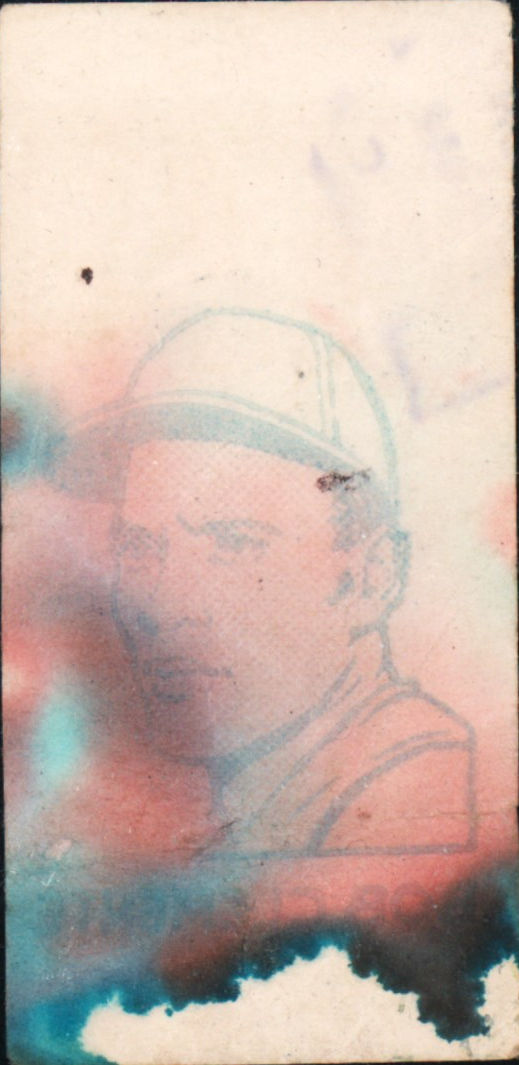
Two more recently came over my transom and are quite shot, UV light was needed to bring out the images:


That's Gene Woodling if you can't tell.  There's others of known subjects that are even worse than that but some are just little abstract works of art at this point.  Here's a bigger name though:


Stan the diffuse man! We do have one more to show of course:

Early shows up late!  There's two more are out there though.

Pedro Ramos has shown up in an SGC pop report, although there's no scan available.  It's yet another subject that's only in the Venezuelan set and he is also another Cuban player.  SGC being SGC, I would like to see a scan someday to confirm. (UPDATE Noon 2/25/23: Just in, Mr. Ramos):

He's in nice shape too! The big news however, is the nineteenth subject:


Trashed, but it's a Clemente!  Venezuelan only, Puerto Rican national.

Bob Allison
Ruben Amaro (Venezuelan only)
Luis Arroyo (Venezuelan only)
Bob Clemente (Venezuelan only)
Rocky Colavito
Don Drysdale
Nellie Fox
Tony Gonzales (Venezuelan only)
Dick Groat
Harmon Killebrew
Frank Lary
Juan Marichal  (Venezuelan only)
Ed Mathews
Stan Musial
Juan Pizzaro (Venezuelan only)
Vic Power (Venezuelan only)
Pedro Ramos (Venezuelan only)
Gene Woodling
Early Wynn

In terms of Venezuelan-only, Venezuelan-born subjects (none have appeared so far, although it was a slim field back then) I can't believe Luis Aparicio isn't in the set (he is not in the U.S. issue).  At a guess, I would think at least 20 or 24 subjects were produced and Aparicio really should be in the set given his nationality and stellar play but until any more bubble up that's just speculation.  It sure seems like there should be some more star power as well.

As to the year of issue, the 1961-62 winter season sure seems like the best bet at this point. The Caribbean-centric non-US players are very intriguing and may hold some clues as to how these were marketed but I'm hearing the pipeline of these has closed, who knows when (or if) more information will come out.

Saturday, February 18, 2023

Additional Guidance

Well, my lament last month about missing out on the full set of 1971 Bazooka box back set prosaically titled A Children's Guide To TV Football has been partly assuaged by the fact Friend o'the Archive Lonnie Cummins snagged a scan of these last year, which now allows a full checklisting of the set.

This is the macro view:

You can see that there's three subjects with full illustrations, one with a referee's hand and flag on the left opposite a brutish football player on the right and another eight with a football coach and player on the left and a spotter with binoculars on the right. I managed to show each variety in the previous post about this set due to dumb luck last time out. As I mentioned last time out, Topps did not put a lot of effort into this set, which would become a bit of a trend with Bazooka in the 1970's.

The full checklist is like so (top left description is listed after the subset designation):

1 Football Lingo - Automatic
2 Football Lingo - Broken Field Runner
3 Football Lingo - Audible Coverage
4 Football Lingo - Game Plan
5 Football Lingo - Interception
6 Football Lingo - Killing The Clock
7 Football Lingo - Belly Series
8 Football Lingo - Prevent Defense
9 Officials' Duties -Referee
10 Officials' Signals - Running...Into The Kicker
11 Officials' Signals - Touchdown
12 Officials' Signals - Crawling

There's a few more early Bazooka sets I want to corral, it's  a slow but ongoing project and results will be posted here as things are uncovered.


Saturday, February 11, 2023

South American Soiree

Maybe it's the Caribbean World Series just concluding, or just some random luck but there's more to report on some Venezuelan issues, circa 1960-61, this time on the non-sports side.

The recently discovered batch of 1960 Baseball Tattoos out of Venezuela were not the only tattoo issues licensed by Topps (and possibly another entity) down there. Thanks to Friend o'the Archive Josh Alpert, we now know that Woody Woodpecker and Superman were also subjects of local interest and marketing, although there is a bit of a twist with ol' Supe.  Check out the three wrappers shown here:


These are in addition to a Popeye Tattoo that's I've known about for quite some time, thanks to Lonnie Cummins:

We've seen the Baseball Tattoo wrappers a few times recently but today I want to focus on the application instructions and indicia these various issues sported. The "floating image" version on the Baseball and Woody Woodpecker tattoos, although obviously in English, first popped up on the 1949 Topps Tatoo wrappers and was used into the 1970's, when this style of packaging was finally eliminated. This would be the preferred style going forward in the U.S., although the 1955 Davy Crockett Tatoo wrapper had no instructions, presumably as Topps was trying to pull a fast one with the release, which capitalized on the Disney TV series and movies without actually using any copyrighted or trademarked material. And this after issuing two licensed Crockett card sets! 

The 1959 U.S. release of the Woody Woodpecker Tattoos (a tough set BTW), used the floating images,  so it was redesigned here for some reason, which is kinda weird. Woody and Popeye both reference the licensor and indicate Topps in the indicia, making it clear they were produced in Venezuela.

The really interesting one to me though is the Superman Tattoo wrapper. It clearly uses the U.S> release's graphics but unlike the other two wrappers, there is no Topps copyright.  Instead, it indicates manufacture in Venezuela by La Corona Y Sport, a local confectionery company who either produced or advertised on the album intended to house the 1968 Topps Venezuelan Baseball cards and may have produced some of the prior albums (which have no attribution on them). Topps clearly had a relationship with them and the vagaries of marketing Superman in a foreign country must have led to this odd partnership.

Here's the U.S. Superman Tattoo wrapper:


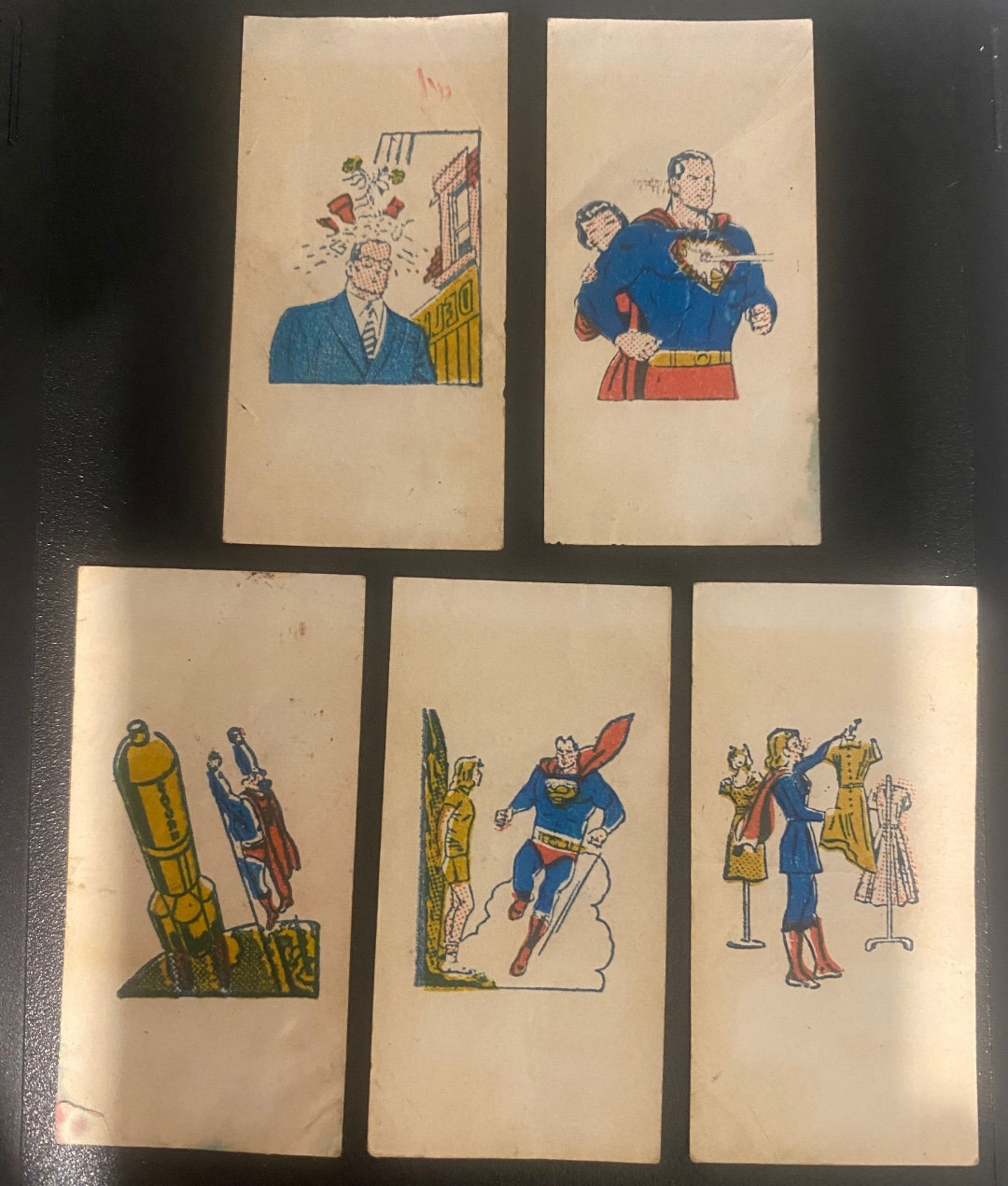
It's a little hard to read but National Periodical Publications, which issued the Superman Comics, shared a copyright with Topps.  I'm sure there's a long, convoluted story there.  Here's some tattoos from the set:


I wonder what kids made of that dress shop image with what must be Supergirl in the lower right?!

Let's not forget Woody, here's a batch of his from Venezuela to boot:


I'm not sure what there's an anchor in this set but there is! Perhaps it was a mistake carried over from Popeye.

I am very much wondering what other tattoo sets were licensed by Topps for issue in Venezuela and suspect some more will surface.

Saturday, February 4, 2023

Wintry Mix

There's a bit of an update to last year's NYE post regarding the 1960 Venezuelan Baseball Tattoo issue, thanks to Josh Alpert, who is the foremost collector and chronicler of the 1959-68 efforts Topps made in that country.  He's offered his take on the set, as it's comprised so far at least, and his comments are illuminating. He's also provided scans of the other eight known  players, which I will show below his comments.

As to the roster of US players, Josh says: "I would imagine they originally produced all the stars - Mantle, Mays, Koufax, but my guess is they are all long gone.

The timing of the issue is probably 1960, with this as part of his reasoning: "Colavito was traded to Detroit April 17, 1960. If they were a 1961 issue, I would think he’d have been drawn in Detroit colors, not Cleveland’s."

Josh also had a very interesting observation as to the scarcity and packaging: "In the US, the tattoos were sold as a stand alone product with a piece of gum. The Venezuelans almost certainly didn't have the machinery to mechanically package the tattoo around a piece of gum. I think this explains the smaller size of the tattoo, it corresponded with the size of a piece of gum, and they were packaged with a piece of gum (as they advertise), probably wrapped in cello and sold individually. This seems more plausible to me and helps explain the extreme scarcity. Almost no one would have kept them if they came with a piece of gum. Someone buying a single piece of gum would have likely opened the gum on the spot and either thrown away the wrapper and tattoo, applied the tattoo, or used the tattoo for the spent gum. They don't have nearly the collectability as the cards, it's likely no one even gave it a thought to collect them- except at least one person, clearly, who collected them intentionally and saved a small handful that we know of."

And now, the new/old scans:


Bob Allison won the 1959 American League Rookie of the Year voting as a member of the old Washington Senators.  He's not thought of as a big star today but he certainly was during the first half of his career. Note there is no production rip in the tattoo, unlike the American versions.


Amaro presents a bit of a conundrum.  The Tatoo set was produced in Venezuela but he was Mexican and played in that county during his winter ball days.  Mexico wasn't even a participant in the CWS until 1970 but as it turns out, from 1961 to 1969 there was no Caribbean World Series after Castro dissolved all the professional Cuban leagues in 1961.  Amaro is one of the three known players to only appear in the Venezuelan Tatoo set. His inclusion is curious if the set was only marketed in Venezuela but there's no evidence of any other country being involved in the distribution.


Another big name at the time, Colavito's Cleveland colors prevailed, per Mr, Alpert, despite his trade to Detroit at the start of the 1960 MLB season. Topps being Topps, even if the set was issued after the 1960 Major League season ended, the colors may have been left alone. But going with the year of U.S. issue seems apt as well.

Drysdale made his first MLB All star team in 1959, so was a solid choice. The staining and unique paper loss along the bottom right edge match up almost exactly to the Allison example above.

Fox was  another well known player who had a fabulous 1959 season that led to the AL MVP award. Total no brainer.


Killebrew finally put things together in 1959, so the set ended up with two Senators players!


His nickname was the "Dominican Dandy" so it's pretty clear where Juan Marichal pitched in winter ball. As pointed out in the original post, Luis Arroyo, the third non-U.S. checklisted player in the set, pitched for Puerto Rico.  I would expect some Venezuelan League subjects were included in the set but so far none have surfaced.


Another no brainer for inclusion to my mind, Mathews was destroying MLB pitching season-after-season by the time 1960 rolled around.

Hopefully an Early Wynn scan will pop up soon.  Josh Alpert has just advised a Vic Power has now shown up, so he's a second Puerto Rican born player that was not in the U.S. set and some other subjects have just been identified as well, too late for this post (watch this space). 

Here is the latest checklist then, 11 in number and I have been advised they generally measure 1 3/16" x 2 1/4", which is smaller than the U.S. version's dimensions of 1 9/16" x 3 1/2", with some variance in the size possible:

Bob Allison
Ruben Amaro (Venezuelan only)
Luis Arroyo (Venezuelan only)
Rocky Colavito
Don Drysdale
Nellie Fox
Harmon Killebrew
Juan Marichal  (Venezuelan only)
Ed Mathews
Vic Power (Venezuelan only)
Early Wynn (photo seen, not the tatoo)

You can take this link with a heaping amount of salt as it's from Wikipedia, but it details MLB players who have appeared in the Caribbean World Series, although far more played in the various Winter Leagues. There's a lot more to be uncovered regarding the Venezuelan Tattoo sets but it's just part of a larger history that's still revealing itself.

I'll keep updating as more information comes in.

Saturday, January 28, 2023

A Colorful Past

Topps ran vigorous ad campaigns for their early products as they plowed profits back into the company to encourage growth.  Ads for Topps Gum were legion in various magazines, buses and subway cars in the 1940's and Bazooka joined the fray in 1947 with the launch of the nickel roll.  When the first Topps novelty project, Tatoo, was unleashed in 1948, there was no letup.  Let's take a look at some of their ads for the product launch today.

Color was the name of the game as Topps used multiple hues on the gum itself: 


I haven't been able to track down the specific titles yet but that sure looks like a centerfold from a comic book. (UPDATE-it's actually  a 1/3 page Sunday Comics ad per Mark Newgarden) The year would be 1948 and it may have run in some Fawcett titles, based upon an early alliance with Topps, but I've had no luck so far with further tracking.

They ran trade ads as well:


It may seem strange but "As Natural As Freckles" was surely coined to drive home the idea that Tatoo was a safe product, which it was as there are still to this day regulatory requirements for inks that come into contact with any food items (they have to be vegetable based and thus limit the color palette). The window streamer is colorful too, of course, and is a fairly close match to the center spread ad above. Sorry for the left/right divide, it's not stitching properly in my graphics editor:


But for me, the best promotional piece for Tatoo is this one, even though it ties in other early Topps products:


Now that is one colorful ad!  The Party-Pak Topps Gum canister at upper right was a short lived product, eventually replaced, albeit not in kind, by the familiar 20 and 25 piece Bazooka party boxes that were ubiquitous in supermarkets and groceries in the 1950's and 60's.  Party-Paks were sold at Sears candy counters from the looks of things in these two photos provided by Friend o'the Archive Lonnie Cummins, although I'm sure it was offered in many other locations:


I'm not positive and it's a little hard to count but I believe there were 60 pieces and at a guess the suggested retail price was 49 cents.  Check out this other Sears photo, which shows the 1948 Tatoo canister (100 count) at right and the Party-Pak, which is clearly smaller and is seen a little left of center.  There's a nice run of Bazooka nickel rolls on the counter below them too:


Tatoo was also offered in something called a Tourist Pouch but the only time that's ever come up, so far as I can tell anyway, is in an old picture, presumably from a sales sheet, that was reproduced in one of Chris Benjamin's Sport Americana Non-Sports Guides. You can see it says "Tatoo Tourist" on the side of the retail box:


Tatoo sold well enough that it was slightly reconfigured in size for confectionery vending machines of the day (the 1948 original was for counter sales only) and then saw yet another relaunch a scant few years later, attributed to 1953 but that date is hobby lore at present and not confirmed. The "1953" issue was in an obviously larger size and this all bears further investigation. And then beginning in 1955 Topps started keeping a brand or two of mostly character-driven tattoo sets in circulation well into the 1970's. 

Saturday, January 21, 2023

Some Jive In 1965

DISCLAIMER: Well, when I screw up, I screw up and I managed to mangle the status of two cards on this sheet.  As per the updates below, this sheet does NOT contain #368 and DOES contain #386. Not only did I transpose two digits, I also messed up my original notes. I'd say just enjoy the visuals!

I generally spend the end of a calendar year reorganizing things at home and on and in my various devices and cloud accounts. True to form, I've pulled up some things sent to me in years past that I never got around to discussing at the time.  Today's excursion in exhumation takes us back almost 60 years, to the 1965 Topps Baseball set. 

This was the final Baseball set Topps packaged out of Brooklyn and its always been one of my favorites, with some really nice photography, excellent use of color and a pleasing blue reverse.  I managed to unearth a full 1965 proof sheet featuring 5th and 6th series cards from an old REA auction that went for a relative song.  Here she is:

This behemoth is blank backed and is a little beat up but I'll bet it framed up really nice.  There are seven discrete rows of players, so we have a 77 subject sheet, meaning there's some kind of extra or short printing going on and sure enough, that's how things turned out.

Using the player "heading" each row, like so...

A Bateman
B Blanchard
C Drabowsky
D Bertaina
E Shaw
F Alou
G Jackson 

...we get the following pattern of rows:

Left side (A Slit):

A
B
C
D
E
A
F
G
B
C
D
E

Right Side (B Slit):

B
C
A
F
G
B
C
D
E
A
F
G

That yields the following distribution:

4X Rows: A B C

3X Rows: D E F G

In terms of Hall-of-Famers making an appearance on this sheet, Luis Aparicio (#410) is the one 3X print, the rest (Al Lopez, Carl Yastrzemski, Harmon Killebrew and Willie Stargell) are 4X subjects.

There is another twist though.  I note the 5th Series Checklist runs from #353 to #429 while the 6th Series Checklist spans #430 to #506.  This is why REA describes this as a 5th and 6th Series sheet since the numbering plays out as follows:

361 (5th Series Checklist) (UPDATE 5/7/23: I should have mentioned this appears twice).

368 (UPDATE 5/7/23-kevvyg1026 as per his comment, has better eagle eyes than me, #368 is not on this sheet )

371-385

(UPDATE 5/7/23-kevvyg1026 as per his comment, has better eagle eyes than me, #386 is on this sheet too) 

387-446

So that's two stand-alones, 15 cards before the next missing number occurs (386), then a 60 card run to land at 77. The 5th Series Checklist is easy enough to explain as it originally appeared on the prior press sheet, which would primarily have included the 4th Series plus a smattering of cards from the "5th Series" here.  This is because Topps lagged their checklists when compared to the press sheets by "previewing" the next series, which meant some cards from the later series had to be printed with what was ostensibly the prior series.  I have to admit I thought it would be cleaner than this with consecutive numbers missing but in sure Topps fashion, it's not and seems a little sneaky to me.