Showing posts sorted by date for query blony. Sort by relevance Show all posts

Saturday, October 4, 2025

Sharman Gets Squeezed

The first Topps Basketball set was issued to commemorate the 1957-58 NBA season. Its eighty subjects offered a gaggle of rookie cards and was the first nationally issued set to solely feature pro hoops stars since Bowman's 1948 effort.  The Topps Vault offered some of the player contracts over the years and they contain some intriguing details. Here, take a look at Bob Cousy's:

Frank somebody was the Topps agent but I can't make out the last name (anyone know?). As per paragraph three, Topps clearly contemplated issuing Basketball cards in the following years but they ended up with 10 Million leftovers at the end of the season, or enough to make 125,000 sets! So that killed any thought of that and Fleer would be the next NBA partner in 1961-62 (and also failed to issue any follow-ups for more then two decades). The mention of Blony along with the expected Bazooka in the wording is not something I've seen before, but Topps was working hard to promote the bubble gum brand they had acquired in the Bowman buyout. They even highlighted it on the back of the wax packs:


Question time: which player is featured on the front of the pack?


There's only three players who used that number in 1957-58: Dick Atha, Ernie Beck and Larry Friend, all of whom are in the set and none of whom are posed like that.  It could just be generic but drop me a line if you have any thoughts.

The vault (I was unaware they slabbed some of their stuff when it was active) also had the check as cashed by Cousy:


Bob Cousy still walks this planet at the age of 97.  Did you now that after he retired from the Celtics following the 1962-63 season, he came back and played a handful of games with the Cincinnati Royals in 1969-70? You could look it up.


Here's a closer look at that back side.  The endorsement:


And the clearance stamps:


Not all contracts were created equally though.  Here's Bill Sharman's:


He only got half of what Cousy did! Clearly Topps never got this message:


Tom Heinsohn got squeezed as well:


Sy Berger snagged those two. Cousy was probably the biggest star in the league but Bob Pettit also got $100.  The other two contracts I've seen, for Dolph Schayes and Rod Hundley both show $50 payments.

Hundley, in fact, was signed in October 1956, while all the others here were from September and October 1957, so Topps was contemplating the set for some time:

Note, however that Sy signed the contract over a year later.  The Topps check was also issued in 1957, a couple of weeks before it was formally executed.


More offical Blony action! I'm sure there's more to this set's story but for now, the boilerplate is all we have.

Saturday, June 29, 2024

Cocktail TIme

Every once in a while I like to bring Bowman into the mix here since its been a Topps brand since 1956.  The name didn't really get much use after the acquisition until a set of Baseball cards using the brand was released in 1989 and eventually became a big hit for Topps.  The Blony bubble gum brand was also put into various uses by Topps through some time in the early Seventies. But I'm not here to talk about all that, instead I'd like to look at some older Bowman gum products.

Warren Bowman was a very interesting man who had already worked at a number of professions by the time he was 30. In 1927 he moved his fledgling confectionery company from Lansing, Michigan to Philadelphia after introducing a chewing gum called Ju-Ce-Kiss.  I managed to find a scan of a wrapper but it's a rare one:

I really like that $50,000 tagline!

While I don't really want to look at Blony for this post, as I have covered it somewhat previously and plan to do a much deeper dive at some point, Warren Bowman had it in the marketplace not long after moving to the City of Brotherly Love and in May of 1932 had formed and capitalized Gum, Inc. who had a decade long run as the premier manufacturer of bubble gum cards before World War 2.  Blony was introduced around this time as well.

Bowman had his ups-and-downs, even at his own firm but kept cranking out bubble gum until the war throttled his sugar allotments.  He rebranded as Bowman Gum, Inc. in August of 1943 and pivoted to "adult" gums under the "Warren's" name as the conflict raged. In 1943 he came up with Cin-A-Mint, intended primarily as a post-smoke palate and breath cleanser.:


You can see corn syrup and artificial flavors were in use:


The same year saw "Fruit" Cocktail gum, another wartime mélange:


Then 1947 saw a Mint Cocktail gum introduced:

Breathtaking was only one superlative:


Bowman also re-established his bubble gum line in 1947, with Bub:


All sorts of ingredients in this one!


1948, of course saw the reintroduction of Bowman's trading cards, as the U.S. returned to a normal manufacturing footing.  Bub was around for a bit and in 1950 saw this particular combo offered:


Nice marketing idea:


I hope to delve into the many vagaries of Bub at some point down the road as well but will leave off for now.

Warren Bowman exited his company in 1951 and moved to Florida to develop real estate and work on various food products and packaging innovations before passing away in 1962 at the age of 67.

Saturday, August 20, 2022

Banners Day

BFF o'the Archive Jeff Shepherd auctioned off a couple of old Bazooka Point of Sale banners recently and while I didn't bid, thanks to the overflowing archives here, they were two things of beauty to be sure.

First up, for the Fall 1949 launch of the penny packs of Bazooka ("tabs" in the confectioner's parlance), Topps created a wonderful banner with the original Bazooka Joe shown, as he often was, blowing a bubble containing the pack.  Given the year and the fact there was a contest to win a pocket knife, it was most likely run by Sy Berger, who was in charge of such things back then.  10,000 knives was likely a number they knew would never be reached as 100 comics was a whole lotta gum packs.

Topps used these knives for premiums over many years and they resemble (or more likely, are) the ones used by the U.S. Military during the war and issued for many years after with bespoke nameplates; the Boy Scouts were one such organization that did that..  Berger had connections for surplus goods, so this all ties in nicely with what I know about such things.

The banner is a beauty:

Jumping forward ten years, 1959 brought a really colorful banner detailing the premium pennants Bazooka was pushing at the time (and for another ten years at least).  Five Bazooka wrappers was a much more manageable amount than the 100 required a decade earlier:


That September 15, 1959 deadline makes me think this banner debuted when the 1959 Major League season opened in April.  Why Blony didn't get more than a passing mention in the copy is beyond me,

Mail in offers were useful for Topps as they could do market research based upon the origins of the redemption requests.  With a product launch in 1949 and the two big league west coast team moves very recent in memory - and notions of expansion more than hot rumors in 1959 - these were both marketing and sales tools.

Saturday, March 12, 2022

Roger That!

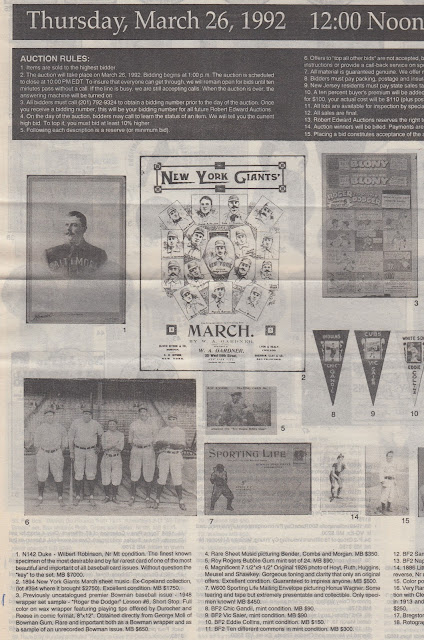
I'm on a bit of a Bowman kick of late and it seems to be centered upon unissued items.  Of particular noteworthy item is what's described as a 1948 proof issue that was meant for a five or possibly ten cent piece of Blony bubble gum featuring a comic strip called Roger The Rookie Dodger. As near as I can tell, the first indication this set ever existed was when a sample proof wrapper popped up for the first time in a now thirty year old REA auction:

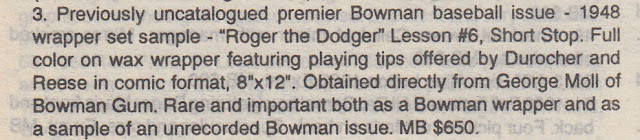
Here is a blowup of the blurb:

Leo Durocher and, as it turned out, his coaching staff (Jake Pitler, Ray Blades and Clyde Sukeforth). plus some players, would present tips for the younger ballplaying crowd to enjoy as they chewed away on potentially monstrous piece of bubble gum dubbed King Size Blony. As you can see Pee Wee Reese was also helping demonstrate the nuances of playing shortstop, although Durocher was no slouch at the position.  Indeed, he was Brooklyn's starter at the position in 1938 and 1939, before it was claimed by Reese!

The wrappers, which are flat as they were never folded, measure around 7" x 12" and would seem to have been intended as a loud retort to Bazooka's five cent roll, which had launched nationally during the summer of 1947.  The sheer size has me leaning toward a ten cent chew as that's a massive amount of real estate for a nickel gum wrapper.

However, the choice of Durocher was a curious one as he was coming off a year's suspension from Major League Baseball and whether or not that had an impact, the set never saw the light of day.  The REA description also indicates a planned series of Yankees-oriented comic instruction was being planned and it would be very interesting to know what they planned to dub it.   Presumably it would have been presented by the Bombers manager in 1948, Bucky Harris, and his coaching staff, which included Charlie Dressen, who later went on to manage in Brooklyn. 

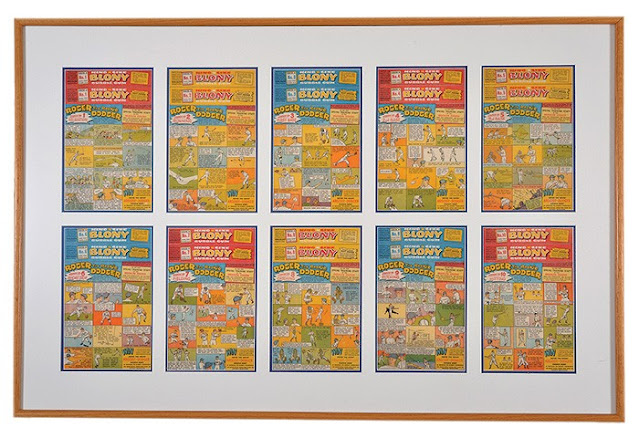
The 1992 example is almost impossible to make out but thankfully a larger stash of a complete set of 10 was consigned to REA for their Spring 2014 auction

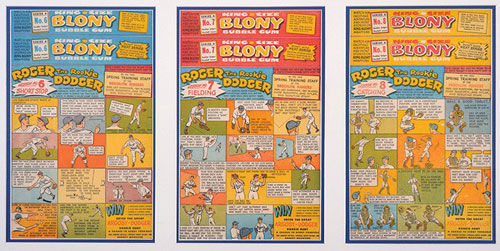
The originally auctioned single wrapper matches the one at the bottom left of the frame (and the one at left, below) but more than one example of it exists as the 2014 description seems to paint it as not being in a flattened, or proof, state. The proof wrappers (and the wrinkly single) don't seem to have been part of the Topps purchase of Bowman in early 1956 but rather are described as coming from the archives of George Moll, whose agency prepared Bowman's many sets over the years.


Too bad these never saw the light of day, they look fairly appealing and while the artwork appears a bit basic, they are colorful and there is a multiple Hall of Famer lineup; presumably other Dodgers players were used as demonstrators (it's not possible to tell from the scans) and their roster was well stocked in terms of Cooperstown enshrinees, so more HOF power seems quite likely.

As for the presenters (I think it says "Spring Training Staff" actually) and their cards from the years before 1948, Durocher of course is pictured on numerous cards from both his playing and managing days and Blades made a few sets as well.  Pitler and Sukeforth had some appearances in picture packs and the like but none of the four were in the 1948 Bowman Baseball issue.

What could have been.....

Saturday, October 16, 2021

Planes Of Existence

Last week's post about standard sized Topps sets that might have been designed with their Giant Size issues in mind has led me to the 1957 Planes set.  Seemingly unremarkable, this 120 card aviation themed issue continued a commitment by Topps to feature airplanes and other flying craft in wide-ranging sets.  They did it in all different sizes too: with Wings in 1952 (Giant Size), a Hocus Focus subset in 1955 (in two sizes, no less: OG gum tab and one never-seen-again size issued in panel form inside nickel packs at 1" x 1 9/16") before coming out with the 240 card Jets set (a "tweener"the same size as Scoop and Look 'N See) in 1956.  Jets was designed using real black and white photos --almost a Topps first barring the 1954 Baseball inset photos--that could be saved in collector albums themed to the set.

So it's unclear to me why Topps went with an illustrated set just a year after Jets had apparently sold through the roof. Perhaps they were held back, or maybe using real photos proved too costly; possibly they just didn't want another B&W avaition set but it's kind of a head-scratcher.

Planes look more like Wings than anything else:

I daresay the reverse somewhat resembles that of Wings from a half-decade earlier. Here's Planes:


I spot checked that Aviation Photography Pix indicia and it's only on certain cards. More on that in a sec but first, here's a Wings reverse:


However, there is a twist as Planes was also issued with Blue Backs!


If you are keeping score, the 1951 Baseball Candy Red and Blue Backs and the 1953-54 World On Wheels set can also be found with similar red and blue reverses, although the Blue Backs are a different subset than the Red Backs in Baseball Candy. Unlike World On Wheels, the Planes blue does not match up with that of the 1955 All American set's reverse inking (another Topps mega-mystery).  And that Aviation Photogaphy Pix indicia does not only appear on one color or the other but it definitely was sporadic. I'm not sure why other than Topps possibly ripped off the other images from various Jane's books on aviation like they did with Wings (hat tip to Pete L'uhosch and John Stupek and a few other folks for that little bit of info).

The story on Planes is that it was printed in two 60 card series and that cards 9 and 65 were arrayed on the "wrong" sheets.  This was a common ploy Topps used for early sets with an issued checklist, which were still a novelty in 1957 and just like what they pulled with Jets (inside back cover of the album held the list) a year earlier to keep kids looking for a "hole" that didn't yet exist.  Todd Riley, who knows as much about such things as anybody, believes #9, which is considered to be a "scarce" card, is only as scarce as other cards from the second series 2.

Here is the Planes checklist card, which was "pushed" into the packs as it was printed separately, as was the Topps method at the time. You can tell as the card stock isn't gray like the issued set it chronicles.


Here's one of the two checklist backs:


As they were also wont to do at the time, a Big Blony checklist back also exists:


There's no value difference on the checklists but red backed Planes cards are 2-3 times tougher than the blues. No one knows why both colors were used, although some speculation among hobbyists back in the day intimated Topps was testing Bowman's printing facilities with one of the colors.  I highly doubt that but it must have been intentional if the set was indeed issued in two series, as all cards from 1-120 can be found with either color. 

In 1963 Topps licensed the second series to Stani of Argentina, a long running South American business partner for a set dubbed Aviones.  Stani cards are renumbered from 1-60 but follow the exact order of the second series of Planes, with one notable exception as #65 is not in sequence as #5 in the set but it is replaced by...#9!

Check out a Stani reverse:


The blue on the Stani card above is washed out due to the scan, it's a little darker than it shows but not as dark as the US blue. Note that, in additon to the differences in language, some other subtle differences also crop up:


I don't believe a checklist card was issued with the Stani set, nor were any red backs. The Stani cards may also have been retailed in Mexico.

Saturday, February 20, 2021

Letters Imperfect

Some correspondence from Topps has presented itself of late on eBay and what better thing to do than cadge some scans and share the results here?!

First up we get a dunning letter from Joel Shorin, son of Topps executive Phil Shorin and who would one day run the company himself:


Messinger's Variety Store (or more properly 5¢ to $1.00) was a mainstay for a very long time on Glasgow Street in Clyde, New York where Scottish influence once held considerable sway, so much so that the town was named for the river in Scotland.  It served the small town on the former Erie Canal about ten miles south of Lake Ontario from 1936 to 2001, or in other initials from mid-FDR to early-W, which is about 65 years if you're counting.  Clyde itself prospered as a stop along the canal, which opened in 1825, but its population has hovered around 2,300 souls for quite a while it seems. Clearly a letter mailed there without a street address would make it to Messinger's without much fuss in 1948 (and probably 1998!).  

Donald and Messinger his wife Thelma also had a variety store outpost in Williamson, New York until about 1974.  Here's a peek at the Clyde store's counter and candy racks from the Rochester Democrat & Chronicle on July 4, 1994:


The Messingers promptly paid up by the way, Thelma must have been in charge of the books:

If the invoice for the order was sent on September 9th, Topps must have been very much on top of their receivables!  Check out this sweet Topps bank deposit stamp on the back of the the check:

Many old checks in the years before electronic clearinghouses would admonish people not to fold, spindle or mutilate them. Perhaps one reason for this was due to the hole-stamped method of noting the check had been cleared and cashed.

Things were far more relaxed ten years later when this little gem was sent out:

That's actually the Topps letterhead, circa (early) '58.  I say "early" 1958 as "The Atom" on the front of each Bazooka penny tab was replaced by "Topps" mid-year.  Blony was the province of Archie comics, to wit: 


Yes, this rode along with a 1958 Topps Baseball Team Emblem premium! I covered those in February of 2010 and if you click through, you will see at least one 1958 pack insert promoting those had the new Bazooka gum tabs with "Topps" now prominent; perhaps as a preview or (more likely) already rolling out as Topps used up a supply of out-of-date letterhead.

Topps helpfully noted  on the flipside of this letter that several premiums could be yours for enough comics and/or change:


Those were pretty hefty buy-ins for the time and this seems like a direct marketing and audience survey form post-MLB stabbing westward as it took only a mere wrapper and SASE to get the original felt emblem premium.  They may have been burning off excessive stock of some premium items as well.

Is it just me or is e-mail just not as fun as postal letters?

Saturday, January 23, 2021

Ring-A-Ding-Ding!

We visit Pennsylvania today kids, courtesy of our friends at Topps and a piece of their history that remains in the Keystone State and one that escaped.

The escapee first-I recently picked up this sheet sheet of Topps shelf labels that looks like it might have covered their full retail confectionery line from 1978 or so:


I was able to roughly date this piece, measuring roughly 11" x 14", due to the lack of additional Ring Pop flavors and the curved Topps logo, which was killed off for 1981. Ring Pops were introduced in 1979 (some sources say 1977) and are still made by Topps in Scranton, Pennsylvania; these messy and sticky bits of faux jewelry may be the last product they haven't outsourced. This is where the magic happens:


Sure hope they fixed the "t" in that logo! (EDIT 1/24/21-I just found a reference in the 1976 Topps Annual Report that this 33,000 SF building had been acquired and was expected to begin candy production by the start of the second half of their fiscal year.  The Topps Fiscal Year ran from March 1st so presumably it was purchased in 1975 and began production by October 1976).

I was surprised to see the former Bowman flagship Blony on there but I suspect that it was still a popular regional brand in the Philadelphia area and environs, if not Pennsylvania proper and parts of the region to the southwest once considered coal country. I certainly never saw it on Long Island.

Here's a help wanted ad from the Scranton Times that appeared last August that indicates Ring Pops are considered a Bazooka Candy Brand these days even as the iconic bubble gum is now manufactured under license:


Maybe there's still an opening, although employee reviews seem decidely mixed.

I never heard of The Pits or Munchy Mummies but was a major consumer of Gold Rush back in my younger days.  The little bags were useful for storing small objects and coins. I have no idea if they still make it but would be sad if it turns out they don't. This was The Pits:


Grubbits has all the deets on Munchy Mummies. Other than those two and Blony, I believe I sampled at least one flavor of every brand on the sheet as a kid!

Saturday, June 15, 2019

Saw It In The Funny Papers

Topps had a tradition of reselling and/or rewrapping excess inventory just about from the get-go, with their first bulk discount occurring in early 1950, as this ad I've previously posted from Billboard (4/29) shows.  Sorry for the yellow highlights, I can't find my original scan to convert it back to good ol' black and white:


Topps ran that ad for a few issues in the late winter and early spring of 1950, no doubt burning off returns or unsold inventory.  I suspect they had lots of their original penny tab packs - with a single tiny card inserted between the inner and outer wrappers - left over as they transitioned to a larger size card (the second of five within three years) and more sanitary packaging.

That Novelty Pack had a couple of nickel packs as well (Golden Coin and Flip-O-Vision) removed by the time Hallowe'en rolled around that year and 30 tabs were offered in a smaller configuration.  I believe this is the first of the annual Topps Hallowe'en campaigns and the first mention of "Fun Packs" by them:


They clearly had a lot of volume to move-that gum must have been stale as those packs were all sold in 1948-49!

1950 is clearly documented Fun Pack-wise but 1951-64 is not!  I'm not sure how Topps sold their bulk discounts for Hallowe'en in that span but suspect it was mostly leftover penny packs.

In 1965 (possibly a year earlier according to the TPG's), we see the beginning of the more traditional Fun Packs, where they got their own wrappers. These usually held individual cards and a slab o'gum but in at least one season, cello packs of the ultra-rare Flash Gordon cards lurked within.


I believe that pack was used through 1966 but it's most commonly referred to as 1964 or 1965. I have not been able to find a dated version of it as of yet but here is a 1965 Hallowe'en catalog page showing the above style pack:


As an aside, the top left bag, dubbed Flavormates, is interesting.  I believe the twist wrapped pieces just say "Bubble Gum" and Topps didn't file for a Trademark on this brand until 1969 but had been selling it since 1963. Too bad there's no Blony on the page, it would run the full gamut of Topps bubblegum if it was!

By 1967 (more likely 1966 I think) the Fun Pack design had changed:
That curved Topps logo on the Fun Bag only started appearing in 1966 and the below wrappers clearly cap the above style in 1967, although they may be a version without a commodity code out there.


Here's the yellow version (with a 1968 Baseball card within).  I think the orange sliver above is an oversaturated scan of the yellow:


You can see the commodity code ends with an 8.  The Brooklyn address would change the year following, resulting in a code indicating 1969:


Note the address change to Duryea, which led to a new copyright filing and design.

I'm not sure when these stopped being used.  Topps would sometimes use a regular issue pack with two cards in it for some of the Fun Bags, as they would designate the bulk package, and possibly even some cello's, which I seem to hazily recall getting in my trick or treat bag as a kid around 1970 or so. These 1974 Football packs had the two card monte going on; I believe Creature Feature and Kung Fu also got this treatment.


1976 brought a new and very colorful design.  This top one has a 1977 Football card within so they got multi-year use out of these:


The color permutations are super groovy and these are described in my notes as containing 1981 or 1982 cards while still retaining the 1976 commodity code:


The Fun Bags could also hold regular issue wax and various types of cello packs and I think that practice became more common as the 1970's and 80's wore on. I'll look at those in a follow up post some time soon.