Saturday, January 14, 2023

You'll Shoot Your Eye Out Kid

OK, today's title is a total Christmas Story cop, with the holiday season firmly in the rear view even, but as we shall see, it's apropos.  I've been mining my old G-mails for content that will span a couple of special projects and am finding all sorts of treasure, much of it from BFF o'the Archive Jeff Shepherd.  Today's adventure brings us a Bazooka Premium Catalog, with a distinctly rugged and masculine tilt.

Dating from 1955, kids could mail away for these and get a better look at some of the premiums offered, although most of these seem beyond anything offered on the newly launched Bazooka Joe comics:


Those illustrations offering fabulous prizes were no joke, there's some major stuff within, much of it apparently military surplus:

We've seen the folding camp knife before and it would appear again and again over the years.  It wasn't a Topps exclusive, there must have been millions of these floating around, with a nameplate that would allow for branding by any entity.  Things get progressively sharper through, that sheath knife looks lethal and that axe looks like it could get you through any kind of wilderness campaign or viscera. For 1,125 comics it should, yikes!

A clear escalation occurs when we get to the last page and what looks to be the world's best cap gun, requiring a mere 1,875 comics.  The notation about choosing a a boy's or girl's leather craft set in no way diminishes the adolescent male vibe here and things conclude with some heavy metal; this surely one of the most industrialized premium offers ever seen from Topps:

The cash to comics ratio in force certainly had some reasoning behind it and you can get a rough idea of how much premium "overhead" was calculated for every piece of Bazooka, also bearing in mind they had some very nice retailer and wholesaler premiums on offer for the adults. Dividing $3.75 by 1875 yields .002 cents per penny gum tab, ignoring the 45 comics also needed to seal the deal.  The ratio on the craft kits though, .75/375 is also .002 though, so the cost of acquisition must have been baked in to any and all Bazooka products.

I did some sleuthing on the Ramar Jungle Gun and the history is an interesting one. Ramar of the Jungle was a syndicated TV program that originally ran from 1952-53 (or '54, sources differ), airing 52 episodes in all, then it was shown in reruns through the end of the decade and beyond.  Four movies were spliced together from the TV footage, two of these premiered in 1953 and the other two in 1955 and there was extensive merchandising as well.  There's a lot more to the story, which I'll leave to others, so the Bazooka offering therefore reflected an active toy campaign tie-in.  The cap gun was really something to behold:


I was thinking some of the offerings in this catalog were sourced from other companies and offered at a higher "rate" than the military surplus items but their yield is also a .002 rate, as are the craft kits. The master Topps strategy here in terms of the cash-to-comics ratio indicates they must have done some heavy duty math to get to the numbers used in the catalog.

Saturday, January 7, 2023

A Child's Garden Of Turf

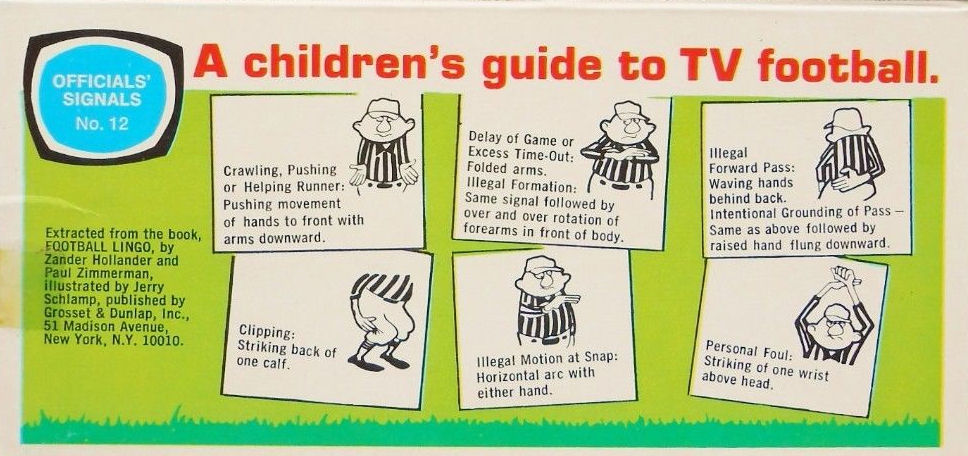
Well, the final week of the NFL regular season concludes tomorrow and what more opportune time to explore an obscure Bazooka package design set called A Children's Guide To TV Football.  Issued in 1971, presumably due to the launch of Monday Night Football the season prior, ACGTTF represented a new direction of sorts for Topps after they killed off the printing of baseball cards on the back of Bazooka party boxes and fumbled an attempted football card set thereon, all in 1971.

There were 12 box backs created, some primarily text-based:


That's pretty basic, even for this period at Topps, where they were gearing up for their March 1972 IPO. That first public offering of their stock had been preceded by a massive consolidation of their various family business and co-ventures, among other costs saving moves and I suspect this set was part of the associated belt tightening. Here's the commodity code:


I had originally thought this set came out after the 1971 Bazooka Football cards but that set's box has the same commodity code, which is....interesting:


The front of the box allowed for either option:


Compare this to the 1971 Baseball box and back:


I'm not sure what the -02 box looked like but note this is the year Topps had planned a 48 card Baseball set for Bazooka, then pared it down to 36 subjects.  There's no box associated with the longer set but it's entirely possible I'm missing an interim one that was prepared but never deployed. 

ACGTTF is really hard to find so my question is, did Topps also plan to issue the Children's Guide initially then pull back and go with a traditional football set? Or were they just not considered worth saving, being so esoteric?  Both? Neither?

Here's another:


And yet another:


I have not been able to find all 12 subjects and the checklist I have so far is sparse and represents only the above three specimens:

No.1 Football Lingo

No. 9 Officials' Duties

No. 12 Officials' Signals

You will note the set derives from a Grosset & Dunlap book (published in 1967) called Football Lingo, written by Zander Hollander and Paul Zimmerman, with illustrations by Jerry Schlamp. Hollander wrote 8-10 sports related books a year, many of them annual paperback guides in his Complete Handbook series and if you are a certain age you may recall them being offered by Scholastic. Hollander also wrote for Howard Cosell when the nasally one received his first big broadcasting break and that connection to Monday Night Football is an intriguing one in light of this set. 

But Schlamp is our link here as his illustrations look to be adorning the Officials' Signal box but not necessarily the Officials' Duties box. I base this upon the similar Basketball Lingo book cover art and you can see why as the ref on the latter looks a lot like those officials on No. 12:


There is a Baseball Lingo book as well, of course; check out the look of the ballplayers:


I've only seen multiples of the Football Lingo Bazooka box and wonder, after considering all of this, if this was a set designed on spec and then rejected by Grosset & Dunlap?  It certainly could have been a failed test as well but the sharing of the commodity code with the 1971 Bazooka Football set makes me think it's possibly the former. Topps was not shy about getting rejected products out into the world, it just took a little time and stealth.

I know at least one full set exists, thanks to a recent auction (which I missed, curses!) but the lot description only showed the box fronts for some reason. Hopefully one of our readers won the lot and can advise accordingly.


Saturday, December 31, 2022

A Winter's Tale Or Two

Good stuff here today kids, as a smattering of 1960 Topps Venezuelan Baseball Tattoos surfaced recently, which is a akin to a Brigadoon sighting I'm sure. Previously, I was aware of a Don Drysdale example and I think two others were out there but that's not confirmed. Obviously, they are scarce as hell.

Luis Arroyo was one of the subjects in this batch but here's the thing, he doesn't appear in the US checklist:


Here's the outside, which is a much batter scan than the roached out Drysdale I posted in 2013:


So the obvious questions are:

1) How many subjects are in the Venezuelan set? (the US set has 96 subjects)

2) How many subjects from the major Caribbean, Central and South American Winter Leagues did Topps create for the Venezuelan release?

At a guess the Venezuelan Tattoo set contains less than 96 subjects (of which only 55 are actual ball players in the US release).  My reasoning is that, since Topps did not replicate their entire 572 card 1960 Baseball set for release in the country, issuing only 198 cards (essentially the first two series), why would they issue a full tattoo set AND add players?  As to who was added locally, well who knows at this point? Much more information is needed and they would add a couple players to replace checklists in the card sets, but now I see there is another question:

3) What year saw the release of the Venezuelan Baseball Tattoos?

If you look at Arroyo, he was essentially a journeyman in the U.S. until 1961, when he plied his screwball into a monster year for the Yankees and finished 6th in the MVP voting as a relief pitcher! However, a native Puerto Rican, he had played locally since 1946 and appeared in 19 seasons overall in his native country, beginning with Ponce in the Puerto Rican Winter League.  He later appeared numerous times with the ostensible Puerto Rican National teams in the Caribbean World Series. In 1948 he began his U.S. Baseball odyssey and despite a 1955 call-up to the Cardinals that led to an All-Star nod and, of course, his 1961 breakout year, Arroyo mostly bounced up and down until 1963 and also in-and-out as he sometimes pitched summer ball in Puerto Rico instead of playing in the minors. 

He was a big deal in the Caribbean and quite well known in the Winter Leagues and their associated World Series tournament but did Topps make up a tattoo because of that or because of his big 1961 season with the Yankees?  If the latter, it points to this being a 1961 or even a 1962 release, which seems quite possible given the straddling of calendar years for their Venezuelan issues.  A full checklist might help answer all three questions but I'm not too optimistic we'll ever see or develop one fully. What we do have is the following:

Ed Mathews, Nellie Fox, Rocky Colavito were in this latest batch, photo ID-only Early Wynn and Juan Marichal are also not in the US checklist but alas, without a scan right now. Marichal and Mathews are said to have have two known examples, per Joe Morris, who tipped me off to all to this. So this is the ur-checklist, all of seven (ten) subjects in length at present (Update Jan. 2, 2023-Friend o'the Archive and advanced collector Larry Serota advised of two additions to the checklist, Bob Allison and Ruben Amaro and thinks the set was issued after 1960 as a standalone, with a cello overwrap). (Update Jan. 5, 2023-Harmon Killebrew is now a confirmed subject):

Bob Allison
Ruben Amaro (Venezuelan only)
Luis Arroyo (Venezuelan only)
Rocky Colavito
Don Drysdale
Nellie Fox
Harmon Killebrew
Juan Marichal  (Venezuelan only)
Ed Mathews
Early Wynn

I'd love to see some uncut sheets from the U.S. release but cannot find any presently.  That might help narrow down how many subjects were produced in Venezuela.  Or not!

Happy New Year all!

Saturday, December 24, 2022

Siren Song

Well, I tried my darndest this year but I don't have any new things to show that relate to Christmas from our good friends at Topps.  Early efforts made by the company to sell Christmas themed items around 1950-53 seem to have gone poorly and much of what I am aware of otherwise consists of things like corporate greeting cards. So instead I've turned to good old Bazooka Joe and a bit of an anomaly involving everybody's favorite mascot.

Check out this Bazooka Joe Club Membership kit ephemera:


The anomaly may be easier to spot when the introductory letter is blown up:


Yes, "Young America's Favorite" Bubble Gum was being used with the A&BC plant address in Essex, England!  Topps had previously done this "YAM" thing with Bazooka in Canada too, as part of their packaging and promotions in that country.  You would think it should say "Young England's Favorite", right?

Based upon the mailing address on the letterhead, I make this out to be be circa 1970-71 or so, when Topps was trying to kill off A&BC after zombie-fying the venerable UK company they had done business with for years. It could be a little later even as A&BC lost this plant to a fire around 1972 or 1973. Topps took the company over by 1975, calling Bazooka the "World's No. 1" but also switched to a different Essex address, so it can't really be later than that. 

The "whistle" or siren ring is missing from this lot, but it looked like this:


The membership card looks like it had the cipher for the secret code used in the letter:


I took the liberty of translating it, although it's a real Ralphie Parker moment in actual fact (hey, I got a Christmas reference in after all!):

TELL FRIENDS YOU JOINED MY MAGIC
 CIRCLE CLUB
URGE THEM TO JOIN IN THE FUN TOO 
ATTRACT A MAGIC CIRCLE OF GOOD FRIENDS
                    
Oh, fudge! 

I think there was a pin in this kit as well, despite it not being mentioned in the letter:


So, that's a bit of shambolic marketing by Topps I'd say! No surprise, they often did things like this.

Merry Christmas everybody!

UPDATE 12/27/22: The comic insert advertising the Magic Circle Club just popped up on eBay:


Saturday, December 17, 2022

Edison's Medicine

Today we will explore a mysterious hybrid Topps half sheet from what looks to be 1969. But first, we need to peek into the Summer of Love and examine a wonderfully gimmicky set called Who Am I?

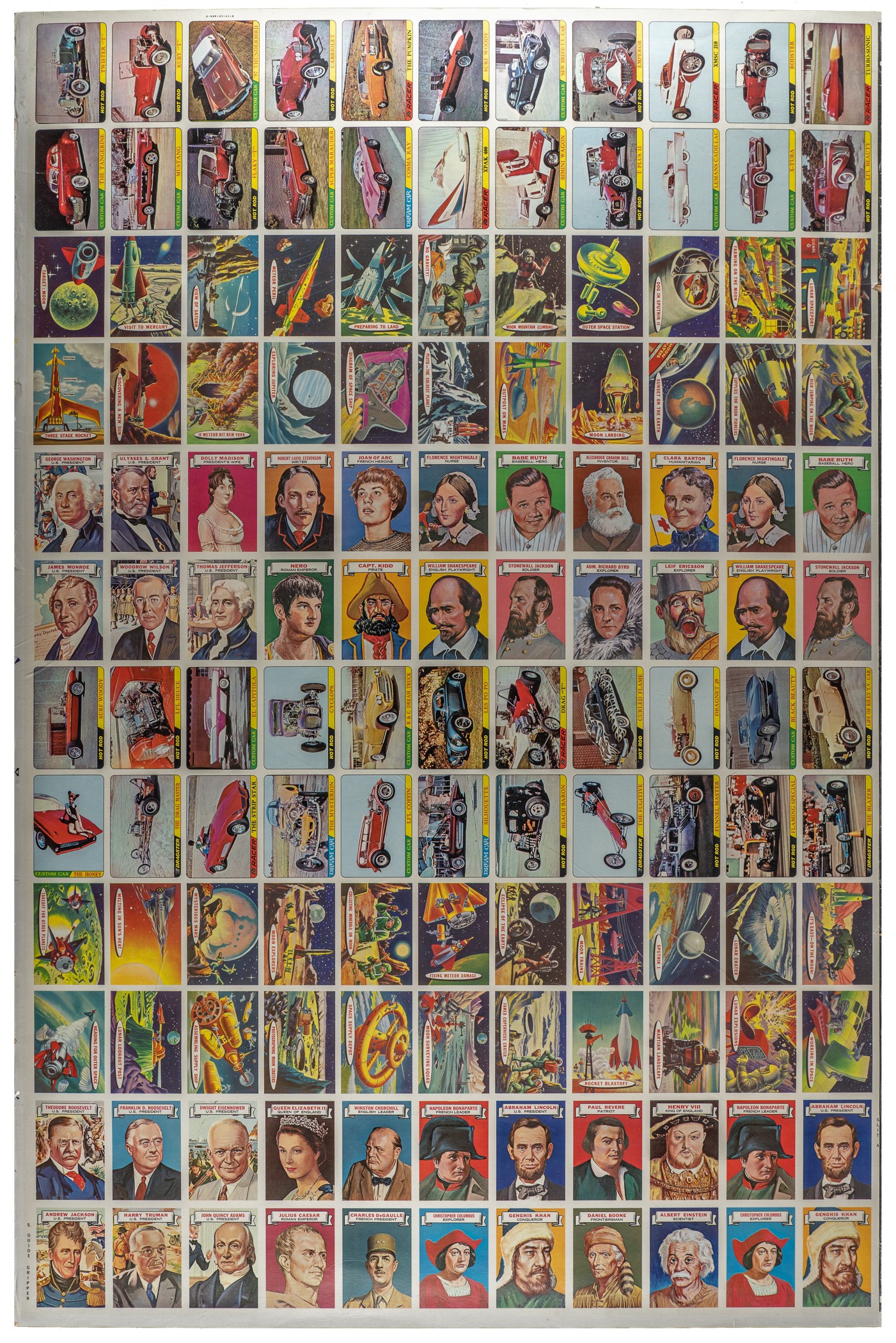
Topps used a scratch off feature for the set, which was nothing new as they had used such technology as far back as 1949. What was new however, was using it on the front of the card and not the reverse.  Another gimmick involved a question and answer format, time tested again and again in Topps-land, with some additional hints offered as well if the initial question proved to be too vexing.  It's a great set and one of my favorites from the 60's:


I forgot to mention it but there's four baseball players in the 44 subject set, every one of them a bona fide top-tier Hall-of-Famer. It's made things pricey!   We'll get to the front artwork momentarily but here's the reverse, where the little floating heads looks almost amateurish as they swirl around.  Great design, partially lousy execution!

The scratch off material seems to have caused some issues in production as it would often streak the uncoated portion of the front of the card, or foul the reverse with little dots.  Once scratched, the result was revealed:


Messy, innit?  That's the general result with these.  The set is loaded with historical figures:

1 George Washington
2 Andrew Jackson
3 James Monroe
4 Joan of Arc
5 Nero
6 Franklin D. Roosevelt
7 Henry VIII
8 William Shakespeare
9 Clara Barton
10 Napoleon Bonaparte
11 Harry Truman
12 Babe Ruth
13 Thomas Jefferson
14 Dolly Madison
15 Julius Caesar
16 Robert L. Stevenson
17 Woodrow Wilson
18 Stonewall Jackson 
19 Charles DeGaulle
20 John Quincy Adams
21 Christopher Columbus

22 Mickey Mantle 
23 Albert Einstein
24 Benjamin Franklin 
25 Abraham Lincoln 
26 Leif Ericsson
27 Adm. Richard Byrd
28 Capt. Kidd
29 Thomas Edison 
30 Ulysses S. Grant
31 Queen Elizabeth II
32 Alexander Graham Bell
33 Willie Mays 
34 Teddy Roosevelt
35 Genghis Khan
36 Daniel Boone
37 Winston Churchill
38 Paul Revere
39 Florence Nightingale
40 Dwight Eisenhower
41 Sandy Koufax
42 Jackie Kennedy
43 Lady Bird Johnson
44 Lyndon Johnson

There is a twist though, as a later version had uncoated cards but excised 8 original subjects, which were not replaced.  That later, sorta-reissue-sorta-not, is what I really want to explore today.

Here is a reissued card:


Topps had to change the reverse as there was nothing to scratch off. Note how the dot under the crook is now blank:


Here's what I think happened, short version first...

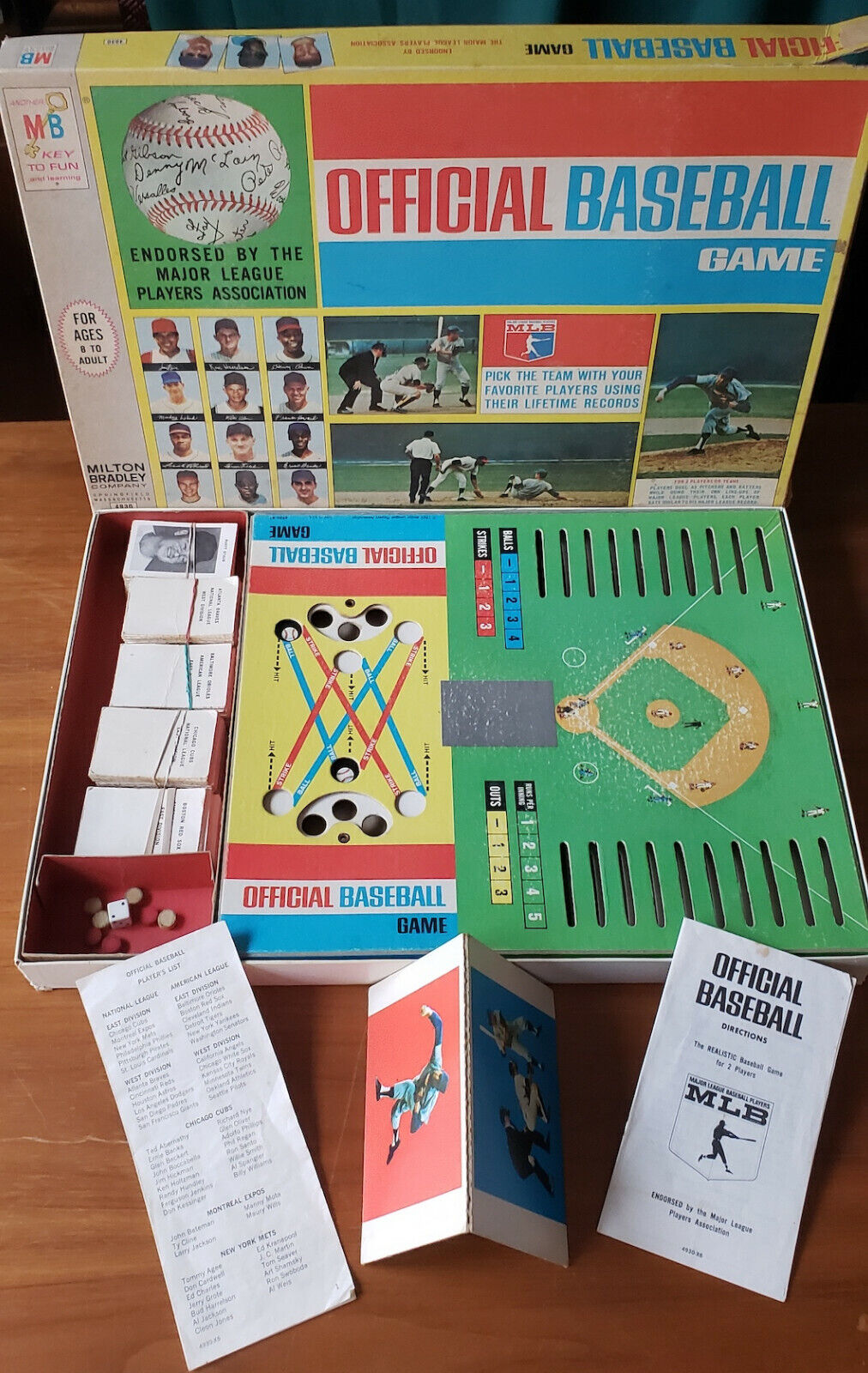
In 1968 Topps created a half sheet of cards that mixed bits and pieces of 1965 Hot Rods, 1967 Football, 1968 Baseball for a game produced by Milton Bradley called "Win A Card", as below:


I won't bore you with the details as Dr. Carlton Miller, the absolute expert on the game, has a piece on it over it over at SCD, just click here for a good read on it.  I do note the cards Topps made up on this special sheet have bright yellow backs, a dead giveaway once you've seen some mixed in with, say 1968 Baseball. The "Win A Card" game was a big failure but I think it's the reason the uncoated Who Am I? cards were produced.

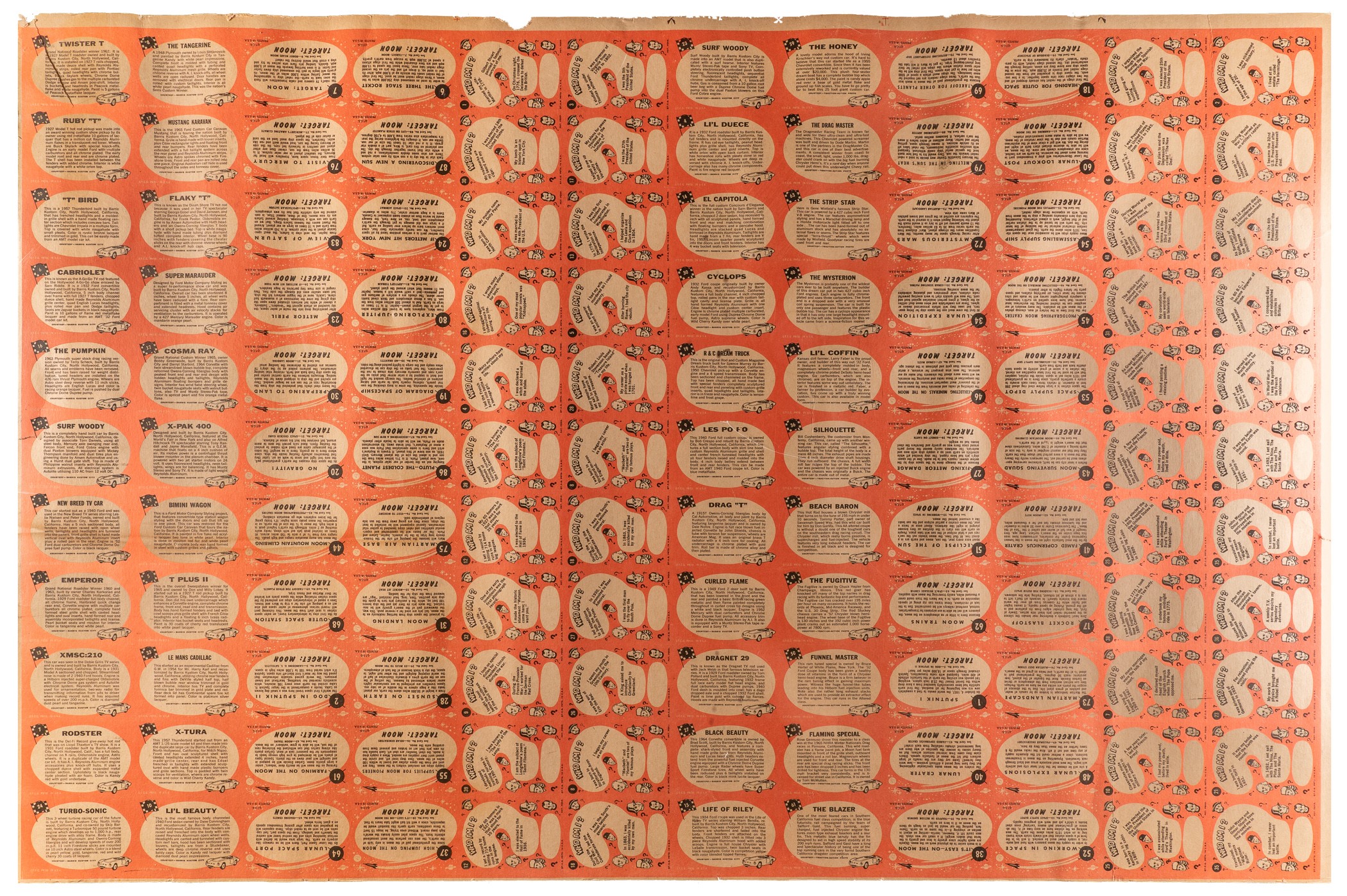
Topps produced another hybrid half sheet with salmon colored backs (some call the color coral, it's as above no matter what name is used) that included 38 Who Am I? cards, 44 Hot Rods (again with the Hot Rods!) and 44 Target: Moon cards, which originally hailed from 1958 (and which were, in turn,  a rebranding of 1957's Space cards.

If you have been reading this blog for a while or are a student of the Topps production sheets, you know that a half sheet should have 132 slots.  Well 44+44+38=126, so what happened?  Well, Topps pulled eight Who Am I? cards is what happened and replaced them with eight Double Prints. The sheet was arrayed like so.


I'm thinking this was made for an intended update of the Milton Bradley game, which never happened as the game company went on to issue a more traditional baseball board game in 1969 instead:


Now that is only a guess but the scuttlebutt on the salmon backed cards has been that they were found in 1969 Fun Packs. This is not something that's 100% proven but it's a persistent story. I have serious doubts that Topps composed and ran off a substantial number of press sheets just to fill up Fun Packs, which they had never done before and never did after from what I know of it. No, they used Fun Packs to get rid of excess inventory and that part of the story makes sense if my theory holds any water. In that scenario Topps salvaged things and used these cards for the 1969 Fun Packs.

Now about those missing eight Who Am I? subjects. Three baseball players weren't reused: Mantle, Willie Mays and Sandy Koufax. Mays and Mantle were active players in 1967 while Koufax had retired on 11/18/66 but his contract, and all MLB ballplayers contracts with Topps, essentially ran season-to-season, with one year extensions for most veteran players built in. Had he played in '67, Koufax's contract likely would have renewed on Opening Day 1967, which was on April 10th.  There is a box proof for Baseball Punch-Out, an ancillary 1967 baseball set Koufax was in after he retired, dated 3/1/67 so his appearance in the coated WAI? set seems like it was composed before the 1967 season commenced, since his retirement voided his one year contract extension.

Mantle retired as well on 3/1/69, five weeks before before the 1969 season kicked off, so he was another baseball subject pulled, maybe for the same reason as Koufax or just due to the changeover to 1969 for the Fun Pack sheet, being a "stale" player by then as the calendar flipped from 1968 to 1969.  Mays was likely on a 1967-69 extended contract that didn't end in until April 7, 1969, or one that ran 1968-70 but Topps never did anything to jeopardize the baseball card licenses and perhaps they just pulled another stale player. Ruth's image was licensed by Topps on and off, as needed, from 1952 until around 1970 I believe, so they kept him on the Fun Pack sheet as they had him in the bag in 1967 and 1969 (Babe is on some Bazooka Baseball All Time Great cards in 1969-70).

Three other 1967 subjects that were dropped can be explained easily enough.  Jackie Kennedy married Ari Onassis on 10/19/68 and was no longer a Kennedy, so she was out. Lady Bird and Lyndon Johnson would have been known to not be continuing on as First Lady and US President. The election was held on 11/5/68 but LBJ had announced he wasn't running well before that and he was out of office on 1/20/69 anyway.

That leaves two headscratchers: Benjamin Franklin and Thomas Edison. About the only thing I can think of is that Edison's card mentions electricity and Franklin, while his card is silent on that, was unmistakably associated with it and they were removed due to an overabundance of caution, lest some kid stick a fork in an outlet.

The Milton Bradley game was released no later than the Summer of 1968 based upon Dr. Miller's recollections, so the timing of an early 1969 update for the game makes sense. Miller notes the 1968 game was prepared to be marketed at the NY Toy Fair, which started on Feb. 16, 1968. Based on all this, I surmise the 1967 coated Who Am I? set was made up sometime in the first six weeks of 1967 and the 1969, uncoated Fun Pack cards were produced after March 1, 1969 and likely after the start of the 1969 baseball season in April. None of this explains why they rejiggered the WAI? cards. Target: Moon makes sense due to the impending moon launch in July 1969 and Hot Rods were always popular with young boys.

For the record, the eight 1969 Who Am I? uncoated Double Prints are:

 8 William Shakespeare
10 Napoleon Bonaparte
12 Babe Ruth
18 Stonewall Jackson
21 Christopher Columbus
15 Abraham Lincoln
35 Genghis Kahn
39 Florence Nightingale

Saturday, December 10, 2022

Taking Stock

Well, we're on our to the next 1,000 posts here kids!  Recently I acquired a batch of hobby publications that included some issues of the annual Card Collectors Company  Price List that I was lacking. Eighty or Ninety percent or so of each catalog would regurgitate the last version, some newer stuff would work its way in and a rotation of certain other things would be offered.  Occasionally though, some interesting overstock would be offered.  Take a look at the January 15, 1971 list:


I don't have the 1970 edition yet so I can't tell if 1969 Topps Super Baseball was offered but I suspect it was as there was an alleged massive overstock and barrage of returns on the item.  Later, a large chunk of whatever CCC held of this release was famously burned up or singed in their 1975 warehouse fire and realistically, the "rarity" of the set and 1970's larger version was being overstated here.  And dig these Berk-Ross prices (that's their 1951 set) compared to the 1969 Supers-there's been a massive reversal of fortune and interest there, eh?

The January 15, 1972 Price List saw a massive expansion of these "miscellaneous issues" and tellingly there are no 1971 Supers offered, while 1969 and 1970 remain in stock despite their "rarity": 


The Bazooka cards would pop up in these lists occasionally, likely as Woody Gelman or Topps uncovered more somewhere in their respectively vast inventories. Too, it's worth noting they ran regular ads in the Sporting News, Boys Life and some hobby publications like The Trader Speaks, where they would offer various, newly-uncovered goodies, especially in the latter, which once offered the three pulled-from-production 1951 Topps Major League All Stars at auction.  

Back to 1972, there are some scarcer offerings here, namely in the upper right corner.  There you get both 33 Sticker sets of the Red Sox and Pirates for under three bucks combined-certainly indicating the test of these failed.  Those 1967 Pin-Ups would be offered for years, it's kind of curious why there was so much overstock on those as you would think Topps would know hoe many were needed to insert in the packs. But take a gander at the 1969 Mini Baseball Stickers, which are a tough issue to find nowadays. I'll take all you have at $3 a throw please! Ringside at that price, even for random lots of 60, were also a good deal at four bucks.

The rest of the offerings are older inserts that mirror the 1967 Pin-Ups and beg the question of why there was so much overstock available.  One interesting offering though, are the 1968 Game cards (Batter-Up), which may be the boxed set version (and may be why so many have the retail price blotted out on the box).

The January 15, 1973 Price List (the latest one I currently have) was offering items that are still tough today. A full set of 1971 Topps Greatest Moments for $19.95 was a steal even then due to the 22 short prints within. And 1964 Topps Stand-Ups at six bucks for the set?  What a deal! The 1967 and 1969 Stickers were still available and Ringside was right-sized to a lot of 25 for the same price as a year earlier.


As for those 1956 Baseball Buttons (not sure what the coins are from that year, maybe they had the pins removed?), Sam Rosen (Woody Gelman's Step-Father, who ran the proto-CCC), had ya covered back in the day (1958 actually):


What's old was new again.....


Saturday, December 3, 2022

Batting A Thousand

Well the inevitable has happened-this is post number 1,000!  September 12, 2008 saw my first post - a short introduction as it were - and a whole lot has happened since then and hopefully a lot more will follow. This blog is essentially my experimental lab and I end up circling back and updating things as developments occur. Really, a major reason I started this project was just to keep track of all the myriad things Topps, in their "vintage" era, was involved with in one place. 

There would be far fewer discoveries over the past fourteen years if not for a good number of folks who have contributed leads, scans, links, cards and wrappers, publications and the occasional reprimand or correction to whatever my fevered mind relays to my fingers.  I sometimes wedge the posts in here among a gaggle of other activities occurring in my day-to-day life and time and again (and again) the eagle eyed among you have caught errors big and small.  So thank you all!

The whole Topps vintage era (which ended sometime in the 1970's I say) suffers from a lack of documentation and small details from readers often lead to big discoveries and aha! moments. Special shout outs and thanks do need to be extended then to various Friends o'the Blog: Jeff Shepherd, Lonnie Cummins, Keith Olbermann, Mark Newgarden, Len Brown, Richard Gelman, Bobby Burrell, Tom Boblitt, Bill Christensen, Al Crisafulli, Al Richter, Bob Fisk, Peter Fishman, John Moran, Anthony Nex, Roy Carlson, George Vrechek, Josh Alpert, Doug Goodman, Dan Calandriello, Rob Lifson, Dean Faragi, Brian Dwyer, Jason Rhodes, Jon Helfenstein, Larry Tipton, Spike Glidden, Terry Gomes, Marty Krim, Mark Hellman, Mike Thomas, Jason Liebig, Jake Ingebrigston and a gaggle of others.  If I missed you I'm sorry, names don't come to me like they used to 14 years ago but thank you one and all for your insights big and small over the years! Will I make it to 2,000 posts? Beats me! 

Meanwhile, to illustrate the point that all sorts of things come my way thanks to this blog, a recent eBay auction featured what I consider to be the "missing" Topps Candy Division wrapper from their Brooklyn-Chattanooga years.  Here then is a unicorn, their 1947 Cocoanut-Marshmallow Roll wrapper that turns out to have been swathed in foil. Jeff Shepherd alerted me to the auction but as it turns out, we both missed it and it went to a good home with someone in the thanks list above! 


Dig those graphics! That bad boy joins ranks with the Caramel Nut Roll, Mairzy and Marshmallow Opera Bars with known wrappers. How something like this survived from 75 years ago is beyond me but there it is, resplendent despite my wonder!

See ya in post #1,001!